Is Digital Marketing a Good Career in 2026? Salary, Skills, Jobs & Future Scope
Introduction:
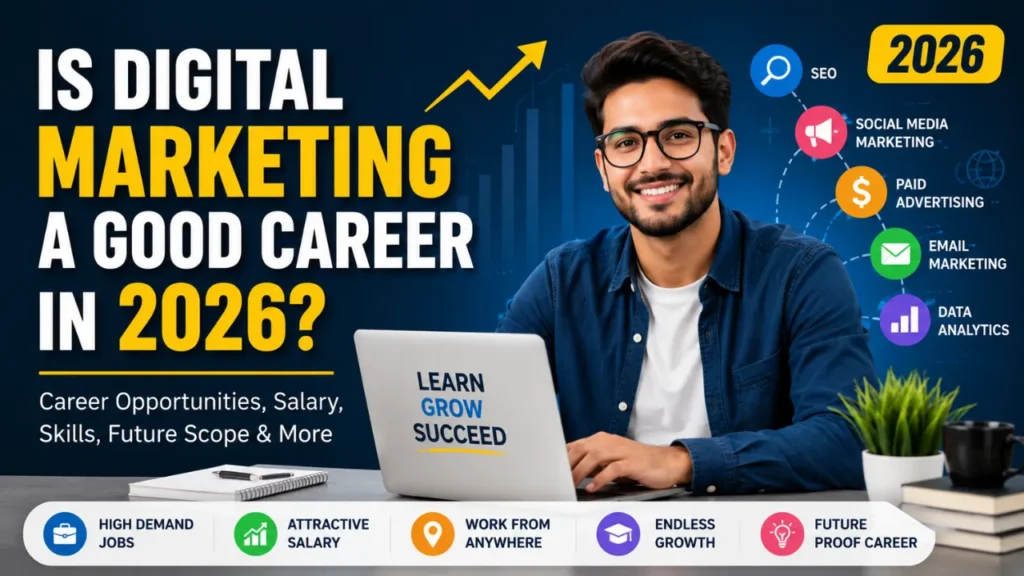
Is digital marketing a good career choice for 2026? Whether you are a student, a recent graduate, a working professional, a freelancer, or a business owner, this question has likely crossed your mind at least once. As businesses increasingly shift towards online platforms, the demand for skilled digital marketing professionals is growing faster than ever. From startups to global brands, companies of all sizes are seeking experts capable of boosting online visibility, generating leads (potential customers), increasing sales, and building long-term customer relationships.
Unlike many traditional professions, there are multiple paths to success in digital marketing. Using the same set of skills, you can work as a full-time employee, build a freelance career, launch your own agency, or even start your own online business. The industry is undergoing massive transformation driven by emerging technologies like Artificial Intelligence (AI), marketing automation, voice search, and data analytics; consequently, digital marketers who continuously upgrade their skills are expected to remain in high demand in the coming years.
However, choosing a career involves more than just looking at market demand. Before making a decision, it is essential to understand the required skills, potential salary, job opportunities, career progression, and future prospects. Whether you are seeking financial stability, flexible remote work options (working from home), or a future-proof career, it is crucial to understand the real opportunities digital marketing offers.
In this comprehensive guide, you will learn what digital marketing is, why it has become one of the fastest-growing professions for 2026, the essential skills required, average salaries in India and globally, top career opportunities, future industry trends, and practical tips for a successful start. After reading this article, you will have a clear idea of whether digital marketing is the right career path for you.
Is digital marketing a good career choice for 2026?
Yes, digital marketing is one of the best career options for 2026 due to high demand, attractive salaries, remote work opportunities, and professional diversity. Whether you choose to work for a company, freelance, or start your own business, digital marketing offers excellent growth, work flexibility, and long-term career potential.
What is Digital Marketing?

Digital marketing is the process of promoting products, services, or brands using digital channels such as search engines, websites, social media platforms, email, mobile apps, and online advertising. Compared to traditional marketing, digital marketing helps businesses reach their target audience more effectively, measure campaign results in real-time, and refine or optimize strategies based on data.
Today, digital marketing has become an essential component of business growth. Businesses of all types—from local shops and e-commerce stores to multinational corporations—use digital marketing to boost brand awareness, attract potential customers, generate leads, and increase sales. With the continuous rise in internet and smartphone usage, the demand for skilled digital marketers is also expected to grow.
Definition of Digital Marketing
Digital marketing is a broad field of marketing that connects businesses with their target audience through online platforms and digital technologies. Key strategies within this field include Search Engine Optimization (SEO), content marketing, Social Media Marketing (SMM), Pay-Per-Click (PPC) advertising, email marketing, affiliate marketing, video marketing, and marketing automation.
The primary goal of digital marketing goes beyond merely promoting products or services; it aims to build long-term customer relationships, enhance brand credibility, and increase business revenue through measurable and cost-effective marketing campaigns.
How Does Digital Marketing Works?
Digital marketing enables businesses to reach the right customers at the right time through various online channels. The process begins by identifying the target audience and understanding their interests, search behaviors, and online activities. Based on this information, marketers create valuable content, optimize websites for search engines, run paid advertising campaigns, engage with users on social media, and execute personalized email campaigns. Every marketing activity generates various data points—such as website traffic, click-through rates (CTR), conversions, and customer engagement. Digital marketers analyze this data using tools like Google Analytics and Search Console to identify the most effective strategies and continuously improve campaign results. This data-driven approach enables businesses to maximize their return on investment (ROI) while delivering a superior customer experience.
Why Digital Marketing is Essential for Every Business
In today’s digital-centric world, having an online presence is no longer optional—it is essential. Before making a purchase, consumers now search for products online, compare prices, read reviews, and interact with various brands. Consequently, businesses of all sizes—from local startups to multinational corporations—rely on digital marketing to reach their target audience and remain competitive.
One of the major advantages of digital marketing is its ability to connect businesses with the right people at the right time. Unlike traditional advertising, digital marketing allows companies to target specific customer segments based on factors such as age, location, interests, online behavior, and purchasing habits. This targeted approach helps businesses utilize their marketing budgets more effectively and achieve better results.
Digital marketing also provides measurable data regarding campaign performance. Using tools like Google Analytics and Google Search Console, businesses can track website traffic, click-through rates, conversions, customer engagement, and return on investment (ROI). These insights help identify successful strategies, improve underperforming campaigns, and facilitate informed business decisions.
Another significant benefit is cost-effectiveness. Even small businesses with limited budgets can compete with major brands; they can build brand awareness and generate quality leads through Search Engine Optimization (SEO), content marketing, email marketing, and social media marketing, without spending vast sums on traditional advertising.
As consumer behavior increasingly shifts toward online platforms, businesses that invest in digital marketing position themselves advantageously to enhance visibility, build trust, strengthen customer relationships, and achieve long-term growth. Whether the goal is generating leads, boosting sales, or expanding into new markets, digital marketing has become one of the most valuable tools for sustainable business success.
Why Is Digital Marketing an Excellent Career Choice in 2026?
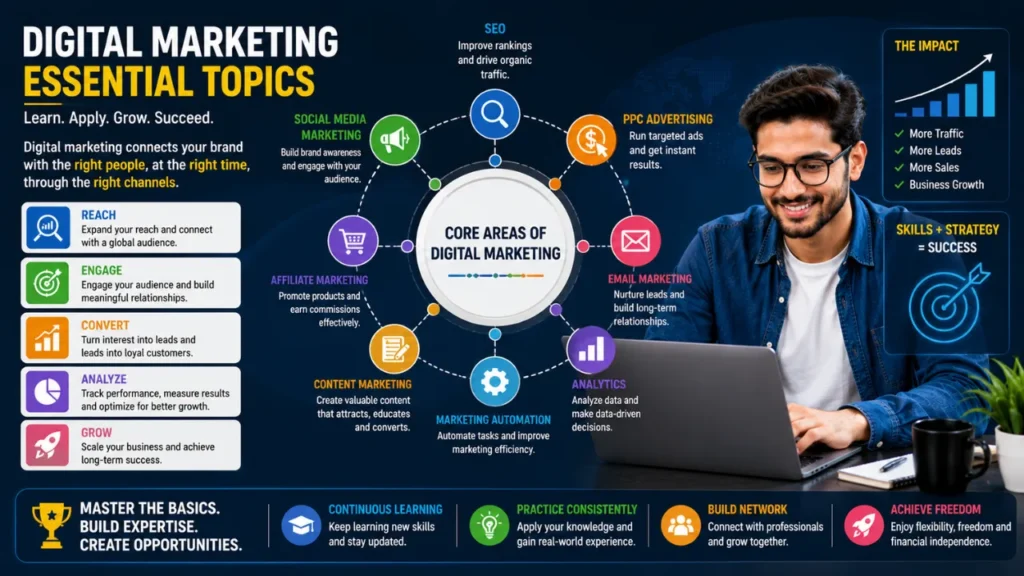
Digital marketing has evolved from a niche field into one of the world’s fastest-growing professions. As more businesses shift online and consumers increasingly rely on the internet to find products and services, the demand for skilled digital marketers continues to rise. Whether you are seeking a stable job, a high-paying career, or the opportunity to work independently, digital marketing offers prospects that few other industries can match.
To stay competitive in 2026, companies are investing heavily in Search Engine Optimization (SEO), social media marketing, content creation, paid advertising, email marketing, and AI-driven campaigns. This growing investment has created thousands of job opportunities across various sectors, making digital marketing an attractive career path for students, graduates, working professionals, and entrepreneurs alike.
Unlike many traditional professions, digital marketing does not always require a specific college degree. Employers often prioritize practical skills, certifications, real-world experience, and measurable results over formal academic qualifications. This makes it easier for motivated and enthusiastic individuals to enter the industry and build a successful career.
Growing Demand Across Industries
Today, almost every business requires an online presence to survive and grow. Whether in healthcare, education, finance, e-commerce, real estate, tourism, technology, manufacturing, or entertainment, companies rely on digital marketing to reach customers and boost revenue.
The rapid expansion of online shopping, mobile applications, social media platforms, and AI-driven search has significantly increased the demand for digital marketing professionals. Businesses are constantly seeking experts capable of enhancing website visibility, generating quality leads (potential customers), driving sales, and strengthening brand reputation. Small businesses are hiring freelancers to manage their marketing activities, while multinational companies are forming dedicated teams for digital marketing. Government agencies, educational institutions, startups, and non-profit organizations are also investing in digital marketing strategies. This widespread demand means professionals can find opportunities across various industries rather than being confined to a single sector.
**High-Paying Career Opportunities**
One of the primary reasons people choose a career in digital marketing is the immense earning potential. As professionals gain experience and develop specialized skills, their salaries often see significant increases.
There are numerous career paths within digital marketing, including roles such as SEO Specialist, Content Marketer, PPC Specialist, Social Media Manager, Email Marketing Specialist, Digital Marketing Analyst, Marketing Automation Specialist, and Digital Marketing Manager. Employers place a high premium on professionals skilled in data analytics, AI marketing, Conversion Rate Optimization (CRO), and performance marketing.
Freelancers and consultants can boost their earnings by working with multiple clients simultaneously. Those who establish their own digital marketing agencies or online businesses often create additional revenue streams through consulting, affiliate marketing, content creation, online courses, and the sale of digital products.
Since businesses can use data to directly measure marketing outcomes, professionals who consistently deliver strong results often secure promotions, bonuses, and higher salaries more quickly than those in many traditional professions.
**Flexible Remote and Freelance Work Opportunities**
One of the most attractive benefits of a career in digital marketing is work flexibility. Many digital marketing tasks—such as SEO, content writing, social media management, advertising, analytics, and email marketing—can be performed entirely online. As a result, professionals can work remotely from home while maintaining successful careers, collaborate with international clients, and even adopt the lifestyle of a ‘digital nomad’ (someone who works online while traveling). Companies worldwide are now hiring remote digital marketers, as cloud-based tools facilitate easy communication and project management.
Freelancing offers another significant advantage. Instead of working for a single employer, digital marketers can serve multiple businesses, set their own schedules, and select projects that align with their interests and expertise. This flexibility fosters a healthy work-life balance while paving the way for increased earnings through multiple clients.
Entrepreneurs also benefit from digital marketing skills, as they can promote their businesses without relying entirely on expensive advertising agencies.
Continuous Learning and Career Advancement
Digital marketing is a dynamic sector that constantly evolves alongside new technologies, algorithms, and shifting consumer behaviors. Search engines update their ranking methods, social media platforms introduce new features, and artificial intelligence (AI) continually reshapes how businesses communicate with customers.
While this demands continuous learning, it also creates excellent career opportunities. Professionals who regularly update their knowledge stay ahead of the competition and maintain their value in the job market.
By mastering new tools and methods—such as Google Analytics, Google Ads, AI-driven marketing platforms, CRM software, marketing automation systems, and advanced SEO strategies—marketers can enhance their skills and qualify for senior-level positions. Additionally, industry-recognized certifications and hands-on experience further brighten career prospects.
In many professions, career advancement relies heavily on years of experience; however, digital marketing prioritizes practical skills, creativity, problem-solving abilities, and measurable results. Those who commit to continuous learning, adapt to changing circumstances, and deliver effective results or value can build successful long-term careers, launch their own businesses, or establish themselves as respected consultants in the digital marketing landscape.
Overall, digital marketing offers a compelling blend of job and income security, work flexibility, and endless opportunities for professional growth. As businesses continue to invest in digital transformation, the demand for skilled digital marketers is expected to remain strong well beyond 2026. Consequently, it is currently regarded as a highly future-proof career path.
Types of Digital Marketing
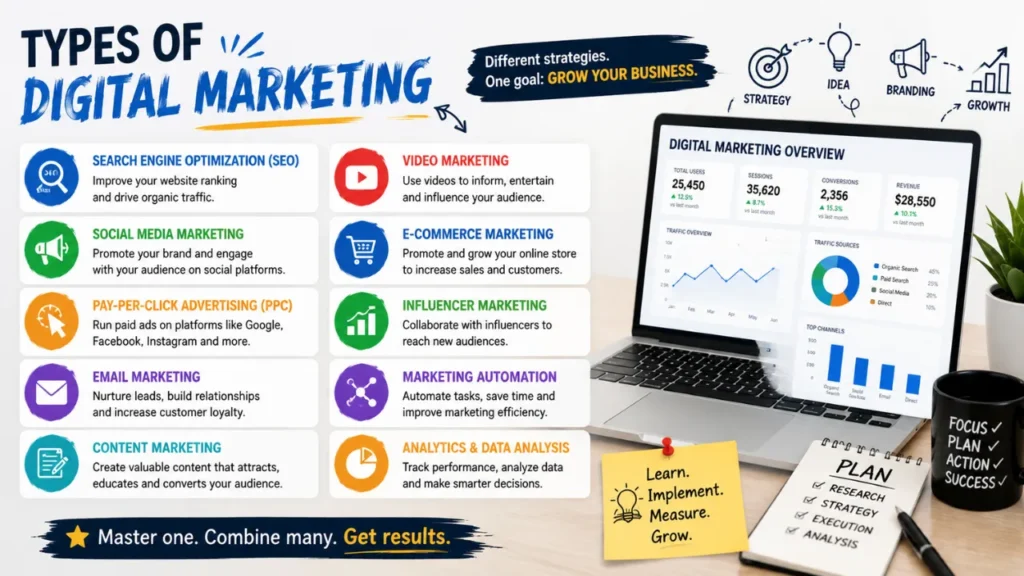
Digital marketing is not a single strategy but a combination of various online marketing methods that help businesses reach their target audience, engage with them, and convert them into customers. Each type of digital marketing serves a specific purpose, and together, they create a comprehensive marketing ecosystem. This system facilitates brand awareness, lead generation (acquiring potential customers), customer engagement, and long-term business growth.
For instance, Search Engine Optimization (SEO) helps businesses gain free ‘organic traffic’—or natural visitors—from search engines; conversely, ‘Pay-Per-Click’ (PPC) advertising ensures immediate visibility through paid campaigns. Social media marketing builds relationships with the audience, email marketing helps retain existing customers by maintaining communication, and content marketing establishes an organization’s credibility and authority by providing valuable information. To maximize marketing results, businesses often employ a combination of these strategies.
For those wishing to build a career in this field or promote an online business, understanding the various types of digital marketing is essential. The most important digital marketing channels—which every newcomer should know—are discussed below.
Search Engine Optimization (SEO)
Search Engine Optimization (SEO) is the process of enhancing a website so that it ranks higher in the results of search engines like Google and Bing. The primary goal of SEO is to increase organic traffic by making web pages more relevant, valuable, and user-friendly for people searching for information online.
The SEO process involves several activities, such as keyword research, content optimization, technical SEO, improving website speed, building quality backlinks, and enhancing the user experience. When implemented correctly, SEO helps a website gain visibility for relevant search queries without incurring direct costs, making it one of the most cost-effective digital marketing strategies.
For businesses, SEO enhances online visibility, attracts the right audience, and builds long-term credibility. It is a highly valuable skill for digital marketers, as nearly every website relies on search traffic to generate leads, boost sales, or build brand awareness. Since search engine algorithms are constantly evolving, SEO professionals must stay up-to-date with industry best practices and Google’s latest guidelines.
Content Marketing
Content marketing focuses on creating and distributing valuable, relevant, and informative content that educates and engages the target audience while building trust. Instead of directly promoting products or services, businesses use high-quality content to answer customer questions, solve problems, and establish themselves as experts in their respective industries.
Content marketing encompasses various formats, including blog posts, articles, videos, infographics, podcasts, case studies, e-books, newsletters, and downloadable guides. Quality content not only improves search engine rankings but also supports other digital marketing channels such as SEO, email marketing, and social media marketing.
An effective content marketing strategy begins with understanding audience needs and creating content that offers genuine utility or value. Businesses that consistently publish relevant and original content are more likely to attract loyal visitors, boost customer engagement, and improve conversion rates over time.
Social Media Marketing (SMM)
Social Media Marketing (SMM) is the process of promoting a business, product, or personal brand through social media platforms such as Facebook, Instagram, LinkedIn, X (formerly Twitter), Pinterest, and YouTube. It enables businesses to connect directly with their audience, increase brand awareness, and foster meaningful engagement.
A successful social media strategy involves publishing valuable content, interacting with followers, responding to comments, building a community, and running targeted advertising campaigns. Since each platform serves a different purpose, businesses should select the channels that best align with their audience and marketing objectives. Social media marketing requires digital marketers to possess creativity, communication skills, audience research capabilities, and performance analysis skills. Since millions of people actively use social media every day, businesses that maintain an active presence there can strengthen customer relationships, generate new leads, and ensure a steady flow of traffic to their websites.
Pay-Per-Click (PPC)
Pay-Per-Click (PPC) is a digital advertising model in which a business pays only when a user clicks on an advertisement. Some popular PPC platforms include Google Ads, Microsoft Advertising, Facebook Ads, Instagram Ads, and LinkedIn Ads.
Unlike SEO, which takes time to yield results, PPC makes it possible to generate targeted traffic very quickly. Advertisers can select specific keywords, locations, demographics, interests, and device types to reach the right audience. Such precise targeting helps minimize wasteful advertising expenditure and ensures a maximum Return on Investment (ROI).
Running a successful PPC campaign requires keyword research, compelling ad copy, effective landing pages, bid management, and continuous optimization. PPC specialists are highly valued because they help businesses increase leads and sales—and achieve measurable growth—through paid marketing campaigns.
Email Marketing
Email marketing is one of the digital marketing channels that offers the highest returns and serves as an essential medium for building long-term customer relationships. It involves sending personalized emails to customers to share relevant information, promotional offers, company updates, educational resources, and product recommendations.
Businesses use email marketing to welcome new customers, nurture prospects, recover abandoned carts, promote new products, and encourage repeat purchases. Modern email marketing platforms also feature automation tools that help businesses send the right message at the right time based on customer behavior.
The primary goal of a successful email marketing strategy is to deliver valuable information to the customer rather than focusing solely on constant sales. Through relevant content and personalized communication, businesses can boost customer loyalty, improve engagement, and generate recurring revenue.
Affiliate Marketing
Affiliate marketing is a performance-based marketing strategy in which individuals or publishers promote products and earn a commission for every successful sale or lead generated through their unique referral links.
This marketing model benefits both businesses and affiliates. Companies can expand their promotional reach without upfront advertising costs, while affiliates earn passive income by recommending products via blogs, YouTube channels, websites, or social media platforms.
Affiliate marketing has become one of the most popular online business models because it requires relatively low investment and offers opportunities for growing income. Its success depends on selecting the right niche, creating valuable content, building audience trust, and promoting products that genuinely solve customer problems.
Influencer Marketing
Influencer marketing involves collaborating with content creators who have established trust and credibility among a specific audience. Instead of relying solely on traditional advertising, businesses partner with influencers to promote products through authentic recommendations and engaging content.
Influencers can range from celebrities, industry experts, bloggers, and YouTubers to micro-influencers who have smaller but highly active communities. Since followers often trust their recommendations, influencer marketing can significantly boost brand awareness, customer trust, and purchasing decisions.
To achieve successful results, businesses should collaborate with influencers whose audiences align with their target market and whose content reflects the brand’s values and objectives.
Video Marketing
Video marketing utilizes visual content to promote products, services, or brand messages while simultaneously educating, entertaining, and engaging the audience. Popular platforms include YouTube, Instagram Reels, Facebook Videos, TikTok, and LinkedIn Videos.
Video is highly effective because it can convey complex information quickly and drive higher engagement than text alone. Businesses use product demonstrations, tutorials, customer testimonials, educational videos, interviews, and short-form content to connect with their audiences.
With the continuous rise in internet speeds and smartphone usage, video has become one of the most powerful mediums in digital marketing. Across various industries, there is a growing demand for digital marketers skilled in video creation, storytelling, and video editing.
Mobile Marketing
Mobile marketing focuses on reaching users via smartphones and tablets by utilizing mobile-friendly websites, applications, SMS campaigns, push notifications, QR codes, and location-based marketing.
Since the majority of internet users now browse websites and make purchasing decisions on mobile devices, businesses must provide fast-loading, responsive, and user-friendly experiences. A mobile-optimized website not only enhances customer satisfaction but also contributes to improved search engine rankings.
Effective mobile marketing enables businesses to connect with customers anytime and anywhere, making it an essential component of every modern digital marketing strategy.
Marketing Automation
Marketing automation uses software and artificial intelligence to automate repetitive marketing tasks, thereby improving both efficiency and the customer experience. Businesses can automatically send emails, nurture leads, schedule social media posts, segment audiences, and track customer activity without performing each task manually.
Automation platforms allow marketers to create personalized customer journeys based on user behavior, making marketing campaigns more relevant and effective. This saves time, boosts productivity, and helps businesses scale their marketing efforts more efficiently.
With advancements in AI technology, marketing automation has become one of the fastest-growing areas in digital marketing, creating attractive career opportunities for professionals who understand automation tools and workflows.
Analytics and Data-Driven Marketing
Analytics and data-driven marketing involve collecting, measuring, and analyzing data to improve marketing performance and make informed business decisions. Instead of relying on guesswork, marketers use data to understand customer behavior, campaign performance, website traffic, conversion rates, and return on investment (ROI).
Tools such as Google Analytics, Google Search Console, advertising dashboards, and Customer Relationship Management (CRM) systems provide valuable insights that help businesses identify successful strategies and optimize underperforming campaigns.
Data-driven decision-making has become a key skill for modern digital marketers. Professionals who can interpret marketing data, identify trends, and translate insights into actionable strategies are highly valuable, as they help businesses achieve sustainable growth and maximize marketing results.
Essential Skills for Becoming a Digital Marketer:

Building a successful career in digital marketing requires more than just theoretical knowledge. Today’s employers and clients seek professionals who can combine creativity, technical expertise, analytical thinking, and effective communication to achieve measurable business results. As digital marketing constantly evolves alongside artificial intelligence (AI), automation, and changing consumer behaviors, acquiring the right skills has become more important than ever.
The good news is that you do not need to master every skill right from the start. Most successful digital marketers begin with the fundamentals and gradually specialize in areas that align with their interests and career goals. Whether you wish to work for a company, become a freelancer, or launch your own digital marketing agency, the following skills will help you build a strong foundation and remain competitive in the industry.
SEO Skills
Search Engine Optimization (SEO) is one of the most valuable skills for any digital marketer. It focuses on improving a website’s visibility in search engine results, helping businesses attract organic traffic without relying solely on paid advertising.
A digital marketer should understand keyword research, on-page SEO, technical SEO, content optimization, internal linking, backlink building, and Core Web Vitals. Learning how search engines rank web pages and keeping up with algorithm updates is equally important. Strong SEO skills not only improve website performance but also drive long-term business growth by increasing online visibility and attracting qualified visitors.
Content Writing and Copywriting
Content lies at the heart of every successful digital marketing campaign. Digital marketers should be capable of creating informative, engaging, and persuasive content that aligns with user intent and encourages action.
The primary goal of content writing is to educate and inform readers through blog posts, articles, guides, and website pages. Conversely, the objective of copywriting is to persuade people to take specific actions—such as clicking an ad, subscribing to a newsletter, or purchasing a product. Mastering strong writing skills helps businesses establish authority, improve SEO performance, and boost conversions across multiple marketing channels.
Social Media Management
Social media has become one of the most effective ways to build brand awareness and engage directly with customers. Digital marketers need to know how to develop content strategies, manage business profiles, schedule posts, respond to customer feedback, and analyze campaign performance across platforms like Facebook, Instagram, LinkedIn, Pinterest, X (formerly Twitter), and YouTube.
Beyond merely publishing content, successful social media management requires an understanding of audience behavior, platform algorithms, and current trends. Businesses value professionals who can build active communities, increase engagement, and drive meaningful traffic through social media marketing.
PPC Advertising
Pay-Per-Click (PPC) advertising is an essential skill for marketers aiming to achieve rapid and measurable results. This involves creating and managing paid campaigns on platforms such as Google Ads, Microsoft Advertising, Facebook Ads, and LinkedIn Ads.
A skilled PPC specialist understands keyword targeting, audience segmentation, bidding strategies, ad copy creation, landing page optimization, and campaign performance analysis. Since businesses invest a significant portion of their advertising budgets in paid campaigns, there is a high demand for professionals who can ensure the highest Return on Investment (ROI).
Email Marketing
Email marketing remains one of the best-performing digital marketing channels for building customer relationships and driving repeat business. Digital marketers need to know how to create email campaigns, segment subscriber lists, personalize messages, and automate communications based on customer behavior.
A successful email strategy focuses on delivering valuable content rather than constant promotion. Understanding email design, subject lines, automation workflows, and performance metrics helps marketers improve open rates, click-through rates, and customer engagement over time.
Google Analytics and Search Console
Data analysis is a crucial skill for modern digital marketers. Google Analytics and Google Search Console provide valuable insights into website traffic, user behavior, keyword performance, technical issues, and overall marketing effectiveness.
By mastering these tools, marketers can measure campaign performance, identify growth opportunities, resolve website issues, and make decisions based on real data rather than guesswork.
AI Tools and Marketing Automation
Artificial Intelligence is transforming the digital marketing industry. Modern marketers utilize AI-powered tools to generate ideas, create content, analyze data, automate repetitive tasks, personalize customer experiences, and boost productivity.
Familiarity with AI content assistants, marketing automation platforms, Customer Relationship Management (CRM) systems, and workflow automation tools has become a valuable competitive advantage. Professionals who learn to combine AI with human creativity and strategic thinking are likely to remain in high demand as the industry continues to evolve.
Communication and Soft Skills
Technical knowledge alone is not enough to succeed in digital marketing. Strong communication and interpersonal skills enable marketers to collaborate more effectively with clients, team members, designers, developers, and business stakeholders.
Problem-solving, creativity, adaptability, time management, critical thinking, and continuous learning are equally important soft skills. Since digital marketing changes rapidly, professionals who can adapt to new technologies, accept feedback, and articulate ideas clearly are more likely to build successful long-term careers and advance into leadership roles.
Salary of a Digital Marketer:

One of the primary reasons for choosing digital marketing as a career is its excellent earning potential. As businesses continuously invest in online marketing, the demand for skilled professionals has risen significantly, creating opportunities for competitive salaries across various industries. Unlike many traditional professions, digital marketing offers multiple avenues for income—ranging from full-time employment, freelancing, and consulting to agency work and entrepreneurship.
Your salary as a digital marketer depends on several factors, such as experience, technical skills, certifications, the specific industry, the nature of the work, and the company’s size and location. Professionals specializing in high-demand areas—such as SEO, performance marketing, PPC, marketing automation, data analytics, and AI-driven marketing—often earn significantly more than general digital marketers.
Whether you plan to work in India or the United States, or work remotely for international clients, the digital marketing profession offers opportunities for rapid career growth and attractive salary prospects. Below is an overview of expected salaries for 2026.
Average Salary in India
India’s digital marketing industry is expanding rapidly, driven by continuous investment in online marketing across all types of businesses. This growing demand has created thousands of job opportunities for skilled professionals in startups, agencies, multinational corporations, and e-commerce companies. While salaries vary based on location, company size, and expertise, the typical annual salary ranges are as follows:
Entry-level (0–2 years): ₹2.5–5 lakhs per annum
Mid-level (2–5 years): ₹5–10 lakhs per annum
Senior-level (5+ years): ₹10–20 lakhs or more per annum
Professionals skilled in SEO, Google Ads, performance marketing, AI-driven marketing, data analytics, and marketing automation often earn above the industry average. Freelancers and consultants can further boost their earnings by working with multiple clients or providing services to international businesses.
Average Salary in the USA
The USA is one of the highest-paying markets for digital marketing professionals. Companies in sectors such as technology, healthcare, finance, retail, and e-commerce invest heavily in digital advertising, customer acquisition, and data-driven marketing strategies.
Typical annual salary ranges are:
Entry-level: $45,000–$60,000
Mid-level (2–5 years): $60,000–$80,000
Senior-level (5+ years): $80,000–$100,000+
Specialized areas such as performance marketing, marketing analytics, paid media, growth marketing, and marketing automation often command higher salaries. Professionals with strong leadership qualities and a track record of delivering successful business results may also receive bonuses, stock options, and other performance-based incentives.
Salary Based on Experience
Experience plays a crucial role in salary growth within digital marketing. Beginners typically start by learning marketing fundamentals and assisting senior team members. As they gain practical experience, execute successful campaigns, and enhance their expertise in specialized areas, they become qualified for high-paying positions and leadership roles.
Typical career progression stages include:
Entry-level or Beginner (0–2 years): Learning the fundamentals, assisting with campaigns, and gaining practical experience.
Mid-level or Intermediate (2–5 years): Managing projects independently, optimizing marketing strategies, and handling large-budget assignments.
Senior Professional (5+ years): Leading marketing teams, formulating growth strategies, managing large-scale (enterprise-level) campaigns, and mentoring junior marketers.
Continuous learning, obtaining certifications, achieving measurable success, and adapting to new technologies like AI significantly accelerate career advancement and earning potential.
Highest-Paying Digital Marketing Roles
Earning potential varies across different specialized areas of digital marketing. Professionals who possess analytical and strategic skills alongside technical expertise generally command the highest salaries.
Some of the highest-paying digital marketing roles include:
- Digital Marketing Manager
- Performance Marketing Manager
- SEO Manager
- Growth Marketing Manager
- PPC Specialist
- Marketing Automation Specialist
- Digital Marketing Consultant
- Marketing Analytics Specialist
- Conversion Rate Optimization (CRO) Specialist
- Head of Digital Marketing
These roles require advanced knowledge, hands-on experience, and the ability to deliver measurable business results. As businesses increasingly adopt AI, automation, and data-driven decision-making processes, professionals who continuously upgrade their skills can look forward to superior career opportunities and higher earning potential in the coming years.
Best opportunity for Digital Marketer in the future:
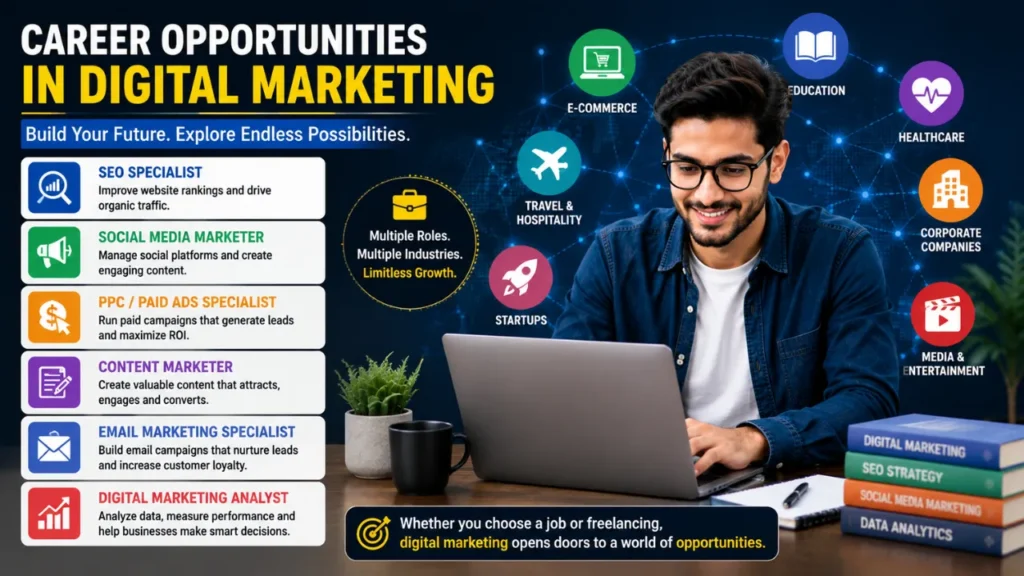
Digital marketing offers a wide range of career opportunities for individuals with diverse interests and skill sets. Whether you enjoy writing, data analysis, managing advertising campaigns, or creating social media content, there is a specialized role that matches your abilities. As businesses continue to expand their online presence, the demand for skilled digital marketing professionals is expected to remain strong across various industries such as e-commerce, healthcare, education, finance, technology, tourism, and media.
One of the major advantages of a career in digital marketing is its flexibility. You can work as a full-time employee, join a digital marketing agency, work as a freelancer, work remotely for international clients, or even build your own agency or online business. Through continuous learning and practical experience, professionals can advance from entry-level positions to leadership roles, enjoying significant salary growth and career stability.
Below are some of the most popular and lucrative career opportunities in digital marketing.
SEO Specialist
An SEO specialist focuses on improving a website’s visibility in search engine results to attract organic traffic. Their responsibilities include keyword research, on-page SEO, technical SEO, backlink building, content optimization, website audits, and performance monitoring.
SEO specialists work closely with content creators, developers, and marketing teams to improve search rankings and increase website traffic. Since search engines are one of the largest sources of online visitors, SEO is one of the most in-demand and future-proof professions in digital marketing.
Content Marketer
Content marketers create valuable and engaging content that attracts potential customers, educates them, and converts them into buyers. They create blog posts, website content, landing pages, e-books, case studies, newsletters, videos, and other educational materials that help achieve business goals.
This role requires strong research, writing, storytelling, and SEO skills. Businesses value content marketers because high-quality content helps improve search rankings, build brand authority, generate leads, and establish long-term customer trust.
PPC Specialist
A PPC (Pay-Per-Click) specialist manages paid advertising campaigns on platforms such as Google Ads, Microsoft Advertising, Meta Ads, and LinkedIn Ads. Their goal is to drive qualified traffic, leads, and sales while ensuring the highest possible return on investment (ROI).
Responsibilities include keyword research, audience targeting, campaign setup, bid management, A/B testing, landing page optimization, and performance analysis. PPC specialists are considered highly valuable because they contribute directly to business growth through measurable advertising results.
Social Media Manager
Social media managers are responsible for developing and implementing social media strategies that boost brand awareness and audience engagement. They create content calendars, publish posts, manage communities, respond to customer feedback, collaborate with designers, and analyze campaign performance.
A successful social media manager understands platform algorithms, audience behavior, current trends, and content strategies. Creativity, communication, and analytical thinking are essential skills for success in this role.
Email Marketing Specialist
Email marketing specialists design and manage email campaigns that build customer relationships, nurture leads, and drive repeat sales. They create newsletters, promotional campaigns, welcome sequences, abandoned cart emails, and automated customer journeys.
This role requires knowledge of email marketing platforms, audience segmentation, automation workflows, copywriting, and campaign analytics. Businesses rely on email marketing specialists because email is one of the highest-converting digital marketing channels.
Digital Marketing Manager
A digital marketing manager oversees a business’s overall online marketing strategy. They coordinate across multiple marketing channels, manage budgets, monitor campaign performance, and ensure that marketing activities align with business objectives.
This leadership role requires a deep understanding of SEO, paid advertising, social media, content marketing, analytics, email marketing, and team management. Experienced digital marketing managers often lead cross-functional teams and play a crucial role in business growth.
Performance Marketer
Performance marketers focus on achieving measurable business outcomes such as leads, sales, app installs, or customer acquisitions. They continuously optimize paid campaigns through performance metrics, conversion tracking, audience segmentation, and data analysis.
As businesses increasingly seek measurable marketing results, performance marketing has become one of the fastest-growing and highest-paying specialized fields in the industry.
Marketing Automation Specialist
Marketing automation specialists use advanced software and AI-driven tools to automate repetitive marketing processes. They design customer journeys, manage CRM systems, create lead-nurturing workflows, automate email campaigns, and enhance customer engagement through personalized communication.
Professionals in this field combine technical knowledge with marketing strategies to help businesses improve efficiency, boost conversions, and deliver superior customer experiences.
Freelance Digital Marketer
Freelance digital marketers provide marketing services independently rather than working for a single employer. They may specialize in areas such as SEO, content writing, PPC, social media management, email marketing, or website optimization while serving multiple clients across various industries.
Freelancing offers the freedom of work, location independence, and unlimited earning potential. By building a strong portfolio, gaining practical experience, and honing excellent client communication skills, freelance marketers can establish successful long-term careers and collaborate with businesses worldwide.
Digital Marketing Consultant
Digital marketing consultants advise businesses on how to improve their online marketing strategies and achieve sustainable growth. Instead of managing day-to-day campaigns, consultants analyze business goals, identify marketing opportunities, recommend strategies, and assist organizations in tackling complex marketing challenges.
Successful consultants typically possess extensive industry experience, strong analytical skills, and proficiency across multiple digital marketing channels. They often work with startups, established companies, and enterprise-level organizations to improve marketing performance, boost revenue, and strengthen brand positioning.
Future Prospects of Digital Marketing
The future of digital marketing is incredibly bright, as businesses continue to invest in digital transformation, artificial intelligence (AI), automation, and customer-centric marketing strategies. With the annual rise in internet usage, e-commerce, mobile technology, and online content consumption, organizations across various sectors require skilled professionals who can help them reach the right customers and drive business growth.
Unlike many traditional professions, digital marketing evolves rapidly in tandem with technology. The emergence of new platforms, changes in search engine algorithms, AI-driven tools, and shifts in consumer behavior create opportunities for marketers to acquire new skills and specialize in emerging areas. Professionals who maintain a mindset of continuous learning and stay updated on the latest industry trends will enjoy a significant advantage in the job market.
Below are some key trends shaping the future of digital marketing:
AI-Driven Marketing
Artificial Intelligence (AI) is transforming every aspect of digital marketing. Modern AI tools assist businesses in content creation, personalizing customer experiences, automating repetitive tasks, analyzing vast datasets, predicting consumer behavior, and optimizing advertising campaigns with greater efficiency than ever before.
Rather than replacing marketers, AI is becoming a productivity-enhancing tool that facilitates faster decision-making and delivers better campaign results. Professionals who can effectively combine AI with human creativity, strategic thinking, and ethical marketing practices will see their importance and demand soar in the coming years.
Voice Search Optimization
Voice search is becoming increasingly popular as people utilize virtual assistants like Google Assistant, Siri, and Alexa to search for information. Instead of typing short keywords, users are now asking questions in a conversational tone, which is transforming how businesses optimize their online content.
Digital marketers need to learn how to create content that answers natural language queries; simultaneously, they must master strategies for optimizing websites for ‘featured snippets,’ improving Local SEO, and utilizing structured data. With the rising use of voice-activated devices, voice search optimization will become a crucial skill for SEO professionals.
Data Analytics
Modern marketing decisions are based on data rather than guesswork. Businesses rely on analytics to understand customer behavior, measure campaign results, identify growth opportunities, and improve Return on Investment (ROI).
There will continue to be a demand for professionals skilled in using tools such as Google Analytics, Google Search Console, Looker Studio, CRM platforms, and business intelligence dashboards. Data analysis enables marketers to make accurate, data-driven decisions, optimize campaigns, and achieve measurable business results.
Marketing Automation
Marketing automation is becoming a key component of modern digital marketing. Businesses are now automating repetitive tasks—such as email campaigns, lead nurturing, customer segmentation, social media scheduling, and workflow management—to boost efficiency and personalize the customer experience.
AI-powered automation platforms help marketers save time and deliver highly relevant communications at every stage of the customer journey. As organizations continue to invest in automation technology, professionals specializing in marketing automation will enjoy excellent career opportunities.
AR and VR Marketing
Augmented Reality (AR) and Virtual Reality (VR) are transforming how businesses connect with customers by creating engaging digital experiences. Retailers now allow customers to virtually try out products before purchasing, while real estate companies, educational institutions, and entertainment brands use AR and VR to offer immersive experiences.
Although this is still an emerging field, AR and VR marketing are expected to grow significantly as the technology becomes more affordable and widely adopted. Digital marketers who understand compelling content strategies will find great opportunities in the future.
Influencer Marketing
Influencer marketing continues to expand as consumers increasingly trust recommendations from content creators over traditional advertising. Brands collaborate with influencers, industry experts, and niche creators to reach highly engaged audiences and build credibility.
The future of influencer marketing is expected to focus more on long-term partnerships, authentic storytelling, micro-influencers, and measurable campaign performance. Marketers who understand influencer selection, campaign management, audience analysis, and ROI measurement will be highly valued across various industries.
Future Job Trends
The digital marketing job market is expected to expand rapidly in the coming years. Companies are increasingly hiring professionals with specialized skills rather than just general marketing knowledge. Strong demand is anticipated for roles related to AI-driven marketing, SEO, performance marketing, data analytics, conversion rate optimization (CRO), marketing automation, customer experience (CX), and growth marketing.
Remote work and freelancing will continue to create global career opportunities, allowing marketers to collaborate with businesses across different countries and industries. At the same time, employers will place greater emphasis on practical experience, certifications, problem-solving abilities, and measurable business outcomes rather than relying solely on formal academic qualifications.
Overall, the future of digital marketing is highly promising. Professionals who continuously enhance their skills, embrace new technologies, and focus on delivering added value to businesses and customers will be well-positioned to build successful, future-proof careers in this rapidly evolving industry.
Advantages and Challenges of a Career in Digital Marketing
Digital marketing has emerged as one of the fastest-growing professions globally, offering excellent opportunities for professionals with diverse skills and interests. However, like any profession, it comes with both advantages and challenges. Understanding these aspects will help you decide whether a career in digital marketing aligns with your goals, personality, and long-term aspirations.
While the industry offers attractive salaries, remote work opportunities, and prospects for continuous career growth, it also demands a mindset geared towards constant learning, adaptability, and the ability to operate within a rapidly changing digital landscape. Therefore, before embarking on this path, it is essential to have a realistic understanding of both the rewards and the challenges involved.
Advantages
A career in digital marketing offers numerous benefits that make it appealing to students, graduates, working professionals, freelancers, and entrepreneurs alike.
Key advantages include:
- High demand across various industries: Almost every business requires digital marketing professionals to boost their online presence and attract customers.
- Excellent career growth: By gaining experience and developing specialized skills, you can advance to high-paying leadership roles.
- Remote work opportunities: With a laptop and an internet connection, many digital marketing tasks can be performed from anywhere in the world.
- Opportunities for freelancing and entrepreneurship: You can work independently, start your own agency, become a consultant, or build an online business.
- Competitive salaries: Skilled professionals often enjoy attractive compensation packages and multiple streams of income.
- Creative and analytical work: Digital marketing combines creativity with data analysis, making the work dynamic and engaging.
- Opportunities for continuous learning: The industry is constantly evolving with new tools, technologies, and marketing strategies, creating endless opportunities for professional development.
- Global employment opportunities: Digital marketing skills are applicable across various countries and industries, making it easier to work with international clients and companies.
These advantages have established digital marketing as one of the most flexible and future-proof professions of our time.
Challenges
Despite its many benefits, the digital marketing profession also presents challenges that professionals must be prepared to tackle.
Some common challenges include:
- Constant industry changes: Search engine algorithms, advertising platforms, and social media trends shift frequently, necessitating continuous learning.
- Intense competition: As more people enter the field, standing out requires strong skills, practical experience, and the ability to demonstrate measurable results.
- Pressure for performance: Many organizations evaluate marketers based on metrics such as traffic, leads, conversions, and Return on Investment (ROI).
- Keeping pace with technology: Utilizing AI tools, automation platforms, analytics software, and emerging technologies requires constant skill development.
- Managing multiple projects: Digital marketers often have to handle multiple campaigns, clients, or marketing channels simultaneously.
- Balancing creativity and data: Successful campaigns require a blend of innovative thinking and analytical decision-making.
- Meeting deadlines: Marketing campaigns often involve strict deadlines, particularly during product launches or seasonal promotions.
While these challenges may seem daunting, they also create new opportunities for those willing to learn, adapt, and continuously improve their skills.
Is digital marketing a high-stress job?
Like most professions, digital marketing can involve stress at times; however, the level of stress largely depends on the nature of your work, the work environment, and your ability to prioritize tasks effectively. For instance, professionals responsible for paid advertising, campaign outcomes, or client management may face pressure when launching key products or services or striving to meet business targets. Similarly, freelancers may encounter challenges such as finding clients, adhering to deadlines, and managing multiple projects simultaneously.
However, many digital marketers manage to maintain a healthy work-life balance, thanks to the profession’s flexible schedules, remote work opportunities, and diverse career paths. Effective time management, realistic planning, a mindset geared towards continuous learning, and clear communication can significantly alleviate workplace stress.
Overall, digital marketing is viewed more as a rewarding and satisfying career than one defined by excessive stress. For those who enjoy problem-solving, creativity, technology, and constant learning, the advantages outweigh the challenges, making it an excellent choice for a long-term career.
Why will choose Digital Marketing as your career?
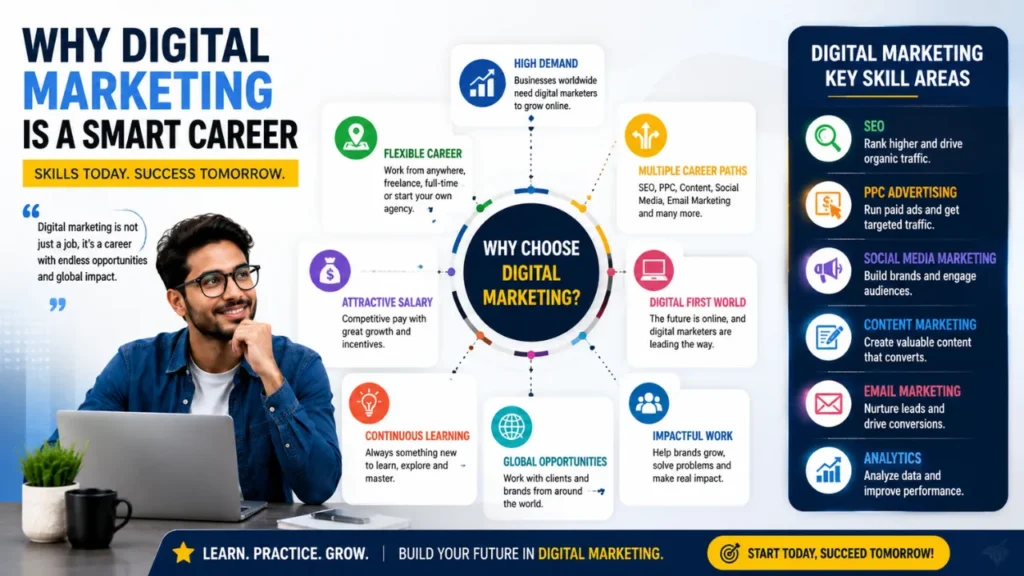
There are several reasons why someone might choose digital marketing as a career:
High demand:
Digital marketing skills are in high demand as businesses increasingly rely on online channels to reach their target audience. This demand creates numerous job opportunities and career growth prospects.
Creativity:
Digital marketing allows for creativity in developing campaigns, content, and strategies to engage with audiences across various digital platforms. It’s an ideal career choice for those who enjoy thinking outside the box and coming up with innovative ideas.
Analytics-driven:
Digital marketing is highly data-driven, with tools and platforms available to analyze campaign performance in real time. This analytical aspect appeals to individuals who enjoy working with data to optimize campaigns and achieve better results.
Diverse skill set:
Digital marketing encompasses a wide range of skills, including content creation, social media management, SEO, email marketing, PPC advertising, analytics, and more. This diversity allows individuals to develop a versatile skill set and explore different areas of interest within the field.
Remote work opportunities:
Many digital marketing roles offer flexibility in terms of remote work, making it an attractive career choice for those seeking a better work-life balance or the ability to work from anywhere.
Continuous learning:
The digital marketing landscape is constantly evolving with new technologies, platforms, and trends emerging regularly. This offers opportunities for continuous learning and skill development, keeping the work dynamic and challenging.
Impactful results:
Effective digital marketing campaigns can have a significant impact on business growth, brand awareness, and customer engagement. Seeing tangible results from your efforts can be highly rewarding and fulfilling.
How to Start a Career in Digital Marketing
Starting a career in digital marketing is much easier now than it used to be. Unlike many traditional professions, entry into this field does not require a specific college degree. Employers and clients often prioritize practical skills, real-world experience, certifications, and measurable results over formal qualifications.
Whether you are a student, a recent graduate, a working professional, or someone looking to switch careers, you can start learning digital marketing through various online resources—both free and paid. The key is to build a strong foundation, practice regularly, and stay updated on the latest industry trends.
Follow the steps below to build a successful career in digital marketing.
Learn the Fundamentals
The first step is to understand the core concepts of digital marketing. Learn how different marketing channels work, including Search Engine Optimization (SEO), Content Marketing, Social Media Marketing (SMM), Pay-Per-Click (PPC) advertising, Email Marketing, Affiliate Marketing, and Marketing Analytics.
Before moving on to advanced strategies, focus on understanding consumer behavior, search intent, keyword research, conversion funnels, and basic marketing principles. Reading industry blogs, watching educational videos, and practicing on your own projects can help strengthen your foundation.
Obtain Certifications
While certifications are not mandatory, they demonstrate your knowledge and your commitment to continuous learning. Additionally, they enhance your credibility when applying for jobs or working with clients.
Some of the most highly regarded certifications in digital marketing include:
- Google Skillshop (Google Ads)
- Google Analytics Certification
- HubSpot Academy
- Meta Blueprint
- Semrush Academy
- LinkedIn Learning
- Coursera Digital Marketing Courses
These certifications help you understand industry best practices and make your resume more attractive to employers.
Gain practical experience
Practical experience is crucial to becoming a successful digital marketer. Instead of focusing solely on theory, apply the knowledge you have gained by working on real-world projects.
Ways to gain experience include:
- Creating your own blog or website
- Managing social media pages
- Running small-scale advertising campaigns
- Practicing SEO optimization
- Writing blog articles
- Undertaking internships
- Assisting local businesses
- Completing freelance projects
Hands-on experience helps you understand real-world marketing challenges and builds your confidence before applying for professional roles.
Build your portfolio
A strong portfolio showcases your skills and achievements more effectively than a resume alone. Include elements such as SEO improvements, content writing samples, details of advertising campaigns, website analytics, keyword research, social media growth metrics, or email marketing projects.
Whenever possible, highlight measurable results—such as increased website traffic, improved search rankings, higher conversion rates, or audience growth. Employers and clients tend to place more trust in marketers who can demonstrate tangible results or success rather than just listing their skills.
Apply for jobs or start freelancing
Once you have acquired practical skills and built a portfolio, you can start applying for entry-level digital marketing positions or offering freelance services. Job opportunities exist in digital marketing agencies, startups, e-commerce firms, software companies, educational institutions, healthcare organizations, and multinational corporations. Alternatively, you can work as a freelance digital marketer, providing services such as SEO, content writing, PPC management, social media marketing, website optimization, or email marketing to clients worldwide.
Remember, digital marketing is a field that offers constant opportunities for learning. By gaining experience, obtaining certifications, and adapting to new technologies like Artificial Intelligence (AI) and marketing automation, your career prospects, earning potential, and professional growth will continue to expand.
Is Digital Marketing the Right Career for You?
Digital marketing is a profession that welcomes individuals from diverse educational and professional backgrounds. Whether you are a student planning for the future, a professional looking to switch careers, a freelancer seeking flexible income opportunities, or a business owner aiming to expand your brand, digital marketing can open up a world of possibilities for you.
However, no single career is equally suitable for everyone. Your success will depend on your eagerness to learn, ability to adapt to new technologies, problem-solving skills, and a mindset geared towards continuous skill development. If you enjoy creativity, data analysis, communication, technology, and working in a fast-paced environment, digital marketing could be an excellent and rewarding career choice.
The following sections will help you understand how well digital marketing aligns with your personal goals and professional aspirations.
Best for Students
Digital marketing can be an excellent career path for students because it can be learned alongside their academic studies. While many professions require extensive formal education before one can start earning, students can begin learning digital marketing through online courses, practical projects, and internships.
Acquiring skills in areas such as SEO, content marketing, social media management, Google Ads, and analytics boosts employment prospects. It also paves the way for internships, part-time jobs, freelancing, and even entrepreneurship. By gaining practical experience early on, students can complete their education equipped with valuable skills that are in high demand across various industries.
Best for Career Changers
If you are considering a career change, digital marketing offers one of the easiest entry points into the technology and business sectors. Professionals from fields such as sales, customer service, teaching, journalism, graphic design, finance, or traditional marketing can often successfully transition into this profession, as many of their existing skills are directly transferable. Strong communication skills, problem-solving abilities, project management expertise, and proficiency in customer relations can provide a solid foundation for learning digital marketing. Through continuous learning, practical experience, and industry-recognized certifications, many career changers can build successful careers in digital marketing without needing a new university degree.
**Ideal for Freelancers**
Digital marketing offers excellent opportunities for those who value flexibility and independence in their work. Instead of working for a single employer, freelance digital marketers can provide services—such as SEO, content writing, PPC campaign management, social media marketing, email marketing, website optimization, and marketing consultancy—to clients worldwide. Freelancing allows professionals to choose projects that interest them, set their own schedules, and create multiple income streams. As they gain experience, freelancers can increase their rates, specialize in high-demand services, and even reach the stage of establishing their own agencies or consultancy firms.
**A Top Choice for Business Owners**
Digital marketing is not just a profession; it is also an essential skill for business. Entrepreneurs and business owners who understand digital marketing can promote their products and services more effectively, reduce their reliance on external agencies, and make accurate, data-driven marketing decisions.
By possessing knowledge of SEO, content marketing, paid advertising, email marketing, analytics, and social media, business owners can attract more customers, strengthen their online presence, boost customer engagement, and increase sales. Even if marketing tasks are eventually outsourced to external firms, understanding the fundamentals enables business owners to evaluate results, manage budgets efficiently, and ensure long-term business growth.
Final Advice
If you are seeking a career that combines creativity, technology, analytical thinking, work flexibility, and the opportunity for continuous learning, digital marketing could be an excellent choice. This industry offers high job demand, attractive salaries, remote work options, freelancing prospects, and opportunities for entrepreneurship.
Whether your goal is to secure a high-paying job, build a successful freelance career, or expand your own business, investing in digital marketing skills today can pave the way for valuable future opportunities. The key to long-term success lies in staying curious, constantly expanding your knowledge, and applying the skills you have acquired to real-world projects.
Frequently Asked Questions (FAQ):
1. Is digital marketing a good career choice in 2026?
Yes, digital marketing is considered one of the best career paths in 2026 due to growing demand, attractive salaries, remote work opportunities, and diverse career prospects. As businesses continue to invest in online marketing and AI-driven technologies, there is expected to be a high demand for skilled digital marketers across various industries.
2. Is coding knowledge required for digital marketing?
No, knowing how to code is not mandatory for most digital marketing roles. Many professionals have built successful careers without any programming knowledge. However, having a basic understanding of HTML, CSS, and JavaScript can be beneficial for areas like SEO, website optimization, and coordinating with web developers.
3. Is it possible to learn digital marketing without a degree?
Absolutely. Digital marketing is a skill-based profession where practical experience, certifications, and tangible results matter far more than formal academic qualifications. Many successful marketers are self-taught or have acquired skills through online courses, hands-on projects, and industry-recognized certifications.
4. How long does it take to learn digital marketing?
The time required depends on your goals and dedication. With consistent learning and practice, most beginners can master the fundamentals within 3 to 6 months. Becoming an experienced digital marketer usually requires one to three years of practical work experience.
5. What is the average salary of a digital marketer?
Salaries for digital marketers vary based on experience, specialization, industry, and location. In India, entry-level professionals typically earn between ₹2.5 lakh and ₹5 lakh annually, whereas experienced marketers can earn anywhere from ₹10 lakh to ₹20 lakh or more per year. Salary rates in the United States and other developed markets are generally quite high.
6. Which digital marketing skills command the highest salaries?
Some of the highest-paying digital marketing skills include Search Engine Optimization (SEO), Performance Marketing, Pay-Per-Click (PPC) advertising, Marketing Automation, Data Analytics, Growth Marketing, and Conversion Rate Optimization (CRO). Additionally, there is a growing demand for professionals skilled in using AI-powered marketing tools.
7. Is digital marketing a good career choice for beginners (freshers)?
Yes. Digital marketing is an excellent career choice for beginners because companies place significant value on practical skills and real-world work experience. Beginners can start their journey through internships, entry-level jobs, freelance projects, or by working on personal websites to gain experience and advance their careers.
8. Can I work remotely as a digital marketer?
Yes. Many digital marketing tasks can be performed remotely since most of the work is done online. Companies worldwide hire remote professionals for roles such as SEO, content marketing, social media management, PPC advertising, email marketing, and digital strategy.
9. Is AI replacing digital marketers?
No. While AI is transforming the way digital marketers work, it is not completely replacing them. AI automates repetitive tasks and boosts efficiency, whereas human creativity, strategic thinking, understanding of customer relationships, and decision-making capabilities remain crucial. Professionals who learn to use AI effectively will have a competitive edge over others.
10. Which certifications are best for beginners?
Some highly acclaimed certifications suitable for beginners include Google Analytics Certification, Google Ads Certification, HubSpot Academy, Meta Blueprint, Semrush Academy, and digital marketing courses on Coursera. These certifications help in acquiring foundational knowledge and enhancing employment opportunities.
11. Can I become a freelance digital marketer?
Yes. Freelancing is a popular career path in the field of digital marketing. Once you have acquired practical skills and built a portfolio, you can offer services such as SEO, content writing, PPC management, social media marketing, email marketing, and website optimization to clients worldwide.
12. Is digital marketing a secure and promising career for the future?
Yes. Businesses are continuously investing in digital transformation, artificial intelligence (AI), automation, and increasing online customer engagement. Therefore, digital marketing is expected to remain a rapidly growing and highly promising career field in the years to come.
Read Also:
If you are interested in learning more about digital marketing and building a successful online career, these beginner-friendly guides can help expand your knowledge:
- What is Digital Marketing? A Comprehensive Guide for Beginners
Learn the fundamentals of digital marketing and its key channels, and understand how businesses leverage it for online growth. - How to Start Digital Marketing Without Prior Experience
Follow a step-by-step roadmap to launch your digital marketing journey—even if you are completely new to the field. - SEO vs. GEO vs. AEO: What’s the Difference?
Discover the differences and comparisons between traditional SEO, Answer Engine Optimization (AEO), and Generative Engine Optimization (GEO) in the era of AI-powered search. - Best Free AI Tools for Digital Marketers in 2026
Explore powerful AI tools that can help you create content, boost productivity, automate marketing tasks, and optimize campaigns
Conclusion:
So, is digital marketing a good career choice for 2026? The answer is yes. For most people, it represents one of the most promising and future-proof professions of our time. As businesses expand their online presence and invest in AI-driven technologies, the demand for skilled digital marketing professionals is expected to rise across industries worldwide.
One of the greatest strengths of digital marketing is its flexibility. Whether you seek a full-time job, remote work, freelance opportunities, or the freedom to build your own business, the same core skills can open doors to various career paths. Unlike many traditional professions, success in digital marketing depends less on a specific academic degree and more on your practical skills, creativity, adaptability, and ability to deliver results.
However, building a successful career requires continuous learning and regular practice. Search engine algorithms, advertising platforms, consumer behavior, and marketing technologies are constantly evolving; therefore, staying up-to-date with the latest industry trends and tools is essential. Those who maintain a lifelong learning mindset and master areas such as SEO, AI-driven marketing, data analytics, performance marketing, and marketing automation will gain a significant competitive edge.
If you are just starting out, do not feel overwhelmed by the extensive list of required skills. Begin with the fundamentals, gain hands-on experience through personal projects or internships, obtain credible industry certifications, and gradually build a portfolio that showcases your capabilities. Every successful digital marketer started as a beginner at some point; it is the habit of continuous learning that sets long-term professionals apart from the rest. In conclusion, digital marketing is not merely a profession—it is a valuable skill that can help you secure good job opportunities, build a successful freelance business, grow your own company, or create multiple streams of income. If you are willing to learn, experiment with new ideas, and adapt to changing circumstances, digital marketing can offer you a rewarding, flexible, and future-proof career for years to come.

Sona Bera Kar
Founder of Toppez Digital