
Can AI Content Get AdSense Approval? Everything You Need to Know in 2026
Introduction :
Artificial intelligence has transformed the way bloggers create content. With tools like ChatGPT, Gemini, and Claude, it’s now possible to draft high-quality articles in a fraction of the time. But as AI writing becomes more common, one question continues to worry website owners and content creators: Can AI content get AdSense approval?
Table of Contents
ToggleMany beginners hesitate to use AI because they’ve heard conflicting advice online. Some believe Google automatically rejects AI-generated articles, while others claim that publishing hundreds of AI-written posts is the fastest path to earning from AdSense. The truth lies somewhere in between. Google doesn’t approve or reject a website simply because AI was involved in the writing process. Instead, it focuses on the overall quality, originality, usefulness, and trustworthiness of the content.
If you’re planning to monetize your blog with Google AdSense, understanding this distinction is essential. Using AI without proper editing, fact-checking, or adding unique value can hurt your chances of approval. On the other hand, AI can be a powerful assistant when used responsibly to create helpful, user-focused content.
In this guide, you’ll learn what Google’s policies actually say, how AI-generated content is evaluated, the mistakes that often lead to rejection, and the best practices for creating high-quality articles that have a strong chance of earning AdSense approval.
Can AI Content Get AdSense Approval?
Yes, AI content can get Google AdSense approval if it is original, accurate, helpful, and created for users rather than search engines. Google evaluates content quality—not whether AI assisted in writing it. Human editing, fact-checking, and unique insights significantly improve your chances of AdSense approval.
What Is AdSense Approval?
AdSense approval is the process by which Google reviews a website to determine whether it meets the requirements of the Google AdSense Program. Once approved, website owners can display Google ads on their pages and earn revenue when visitors view or interact with those ads.
Google doesn’t approve a website based solely on the number of articles or traffic it receives. Instead, it evaluates factors such as content quality, originality, user experience, site navigation, policy compliance, and overall trustworthiness. Websites that provide helpful, valuable, and user-focused content are more likely to be approved.
If you’re using AI to create articles, it’s worth reading Google’s guidance on generative AI content, which explains how to use AI responsibly while complying with Search Essentials and spam policies.
Before applying for AdSense, it’s important to ensure your website has high-quality content, essential pages (such as About, Contact, Privacy Policy, and Terms), a mobile-friendly design, HTTPS security, and easy navigation. Meeting these standards improves your chances of approval and creates a better experience for your visitors.
If you’re new to online business, understanding Digital Marketing for Beginners will help you create content that attracts the right audience and supports long-term website growth.
Can AI Content Get AdSense Approval?
The short answer is yes. AI-generated content can qualify for Google AdSense approval, but only if it meets the same quality standards expected of any other content. Google does not approve or reject a website simply because artificial intelligence was used during the writing process. Instead, it evaluates whether your content is useful, original, trustworthy, and created to help readers.
Many bloggers assume that AI-written articles are automatically penalized or rejected. This misconception often leads people to avoid AI tools altogether or, on the other hand, publish large volumes of unedited AI-generated content. Neither approach is ideal.
Think of AI as a writing assistant rather than a replacement for human expertise. AI can help you generate ideas, create outlines, improve grammar, and speed up the writing process. However, the final article should always be reviewed, edited, fact-checked, and enhanced with your own knowledge, examples, and insights.
For example, imagine two bloggers writing an article about starting a blog. The first copies an AI-generated draft and publishes it without making any changes. The article contains generic advice, outdated information, and no personal insights. The second blogger uses AI to create a first draft but rewrites key sections, adds screenshots, includes practical tips from personal experience, verifies every fact, and answers common reader questions. Although both writers used AI, the second article provides significantly more value to readers and is far more likely to meet Google’s quality expectations.
The key takeaway is simple: Google rewards helpful content, not the method used to create it.
Getting AdSense approval is just one monetization method. You can also learn other proven ways to earn money from your website to build multiple income streams.
The Short Answer
If your content is original, accurate, and genuinely helpful, AI-assisted articles can absolutely qualify for AdSense approval. Google focuses on the final quality of your website rather than whether a human or an AI tool helped produce the content.
This means you should spend less time worrying about whether AI is “allowed” and more time improving the overall quality of every article you publish.
What Google Actually Cares About
Rather than focusing on AI itself, Google evaluates several quality signals that determine whether your website deserves to display ads.
Originality
Original content is one of the strongest indicators of quality. Google wants visitors to find fresh information instead of reading the same advice repeated across dozens of websites.
Originality doesn’t always mean discovering something entirely new. It often means presenting information in a unique and useful way.
For example, instead of writing another generic article titled “10 SEO Tips,” you could include:
- Real examples from your own website
- Original screenshots
- Step-by-step tutorials
- Case studies
- Personal lessons learned from experience
Adding your own perspective makes your content more valuable and demonstrates genuine expertise.
Actionable tip: Never publish AI-generated text without reviewing and expanding it. Add examples, practical recommendations, and unique insights that readers cannot find elsewhere.
Helpfulness
Google’s goal is to provide users with the most useful answers to their questions. Articles written only to target keywords rarely perform well over time.
Before publishing, ask yourself:
- Does this article solve a real problem?
- Will readers leave with practical knowledge?
- Are all important questions answered clearly?
For instance, an article explaining AdSense approval should do more than say AI content is allowed. It should explain Google’s policies, common mistakes, practical improvements, and real-world examples readers can apply immediately.
Actionable tip: Every section should answer a specific question or solve a problem. Avoid adding paragraphs that exist only to increase word count.
Accuracy
Incorrect or outdated information can reduce trust and harm your website’s reputation.
AI tools occasionally generate incorrect facts, outdated recommendations, or unsupported claims. Publishing those mistakes without verification can negatively affect both user experience and credibility.
For example, if you mention Google’s AdSense policies, always confirm that your explanation matches Google’s current documentation rather than relying solely on AI-generated text.
Actionable tip: Verify statistics, dates, product features, pricing, and policy information using reliable and authoritative sources before publishing.
User Experience
Even excellent content may struggle if visitors find your website difficult to use.
Google considers factors that improve the overall browsing experience, including:
- Fast page loading speed
- Mobile-friendly design
- Clear headings
- Easy navigation
- Readable fonts
- Well-organized content
- Minimal intrusive ads
Imagine reading a valuable article filled with large blocks of text and no headings. Most visitors would leave before finishing. Breaking content into logical sections with descriptive headings, bullet points, tables, and images makes information easier to understand.
Actionable tip: Format every article for readability. Use short paragraphs, meaningful subheadings, and visual elements where appropriate.
Trustworthiness
Trust is essential for both readers and Google.
A trustworthy website clearly demonstrates who created the content and why readers should believe it. It also provides transparent information about the business or author behind the site.
Ways to improve trust include:
- Creating a detailed About page
- Publishing accurate contact information
- Including Privacy Policy and Terms pages
- Updating outdated content regularly
- Correcting factual errors promptly
- Citing reputable sources when appropriate
For example, if you’re explaining AdSense approval, referencing Google’s official guidance and combining it with your own practical experience creates a stronger, more reliable article than repeating unsupported opinions found on forums.
Actionable tip: Build trust through consistency. Publish well-researched content, maintain your website regularly, and focus on helping readers rather than chasing search rankings.
Ultimately, Google doesn’t ask, “Was this article written by AI?” It asks, “Will this page genuinely help someone searching for this information?” If the answer is yes, and your content demonstrates originality, usefulness, accuracy, a great user experience, and trustworthiness, your website is far more likely to meet the standards expected for AdSense approval.
If you’re not ready to launch a blog yet, you can still begin affiliate marketing without a website using social media and other online platforms.
Google's Official Position on AI-Generated Content
Google has made its position on AI-generated content much clearer in recent years. Contrary to many online myths, Google does not ban or automatically reject content simply because it was created with AI assistance. Instead, Google evaluates whether the content is helpful, reliable, original, and created to benefit users.
This approach applies to both Google Search and Google AdSense. If your articles provide genuine value, answer users’ questions accurately, and follow Google’s policies, using AI as part of your writing process is not a problem. However, relying on AI to mass-produce low-quality or unhelpful articles can negatively affect both your search rankings and your chances of AdSense approval.
Let’s look at what Google’s official guidance means for bloggers and website owners.
Google Search’s View on AI Content
Google has stated that it focuses on the quality of content rather than how it is produced. Whether an article is written entirely by a person, created with AI assistance, or combines both approaches, the same quality standards apply.
Google’s ranking systems are designed to reward content that demonstrates:
- Experience
- Expertise
- Authoritativeness
- Trustworthiness (EEAT)
In other words, Google asks questions like:
- Does this article answer the user’s question?
- Is the information accurate?
- Is the content original?
- Does it provide value beyond what already exists online?
For example, suppose two websites publish an article about Google AdSense approval. One copies an AI-generated draft without making any improvements. The other uses AI to create an outline but expands it with real examples, updated information, screenshots, and practical advice. The second article is much more likely to perform well because it offers a better experience for readers.
The important point is that AI is a tool, not a ranking factor. Google rewards useful content regardless of whether AI assisted in creating it.
Actionable advice: Use AI to speed up research, brainstorming, or drafting, but always improve the final article with human editing, expert insights, and fact-checking.
Google AdSense Program Policies
Google AdSense also focuses on content quality and policy compliance, not on whether AI was used during the writing process.
When reviewing a website for AdSense approval, Google looks at factors such as:
- Original and valuable content
- Clear website navigation
- Good user experience
- Compliance with AdSense policies
- Unique information
- Trustworthy website design
- Policy-compliant content
A website filled with copied, repetitive, automatically generated, or low-value articles is unlikely to be approved. On the other hand, a website that uses AI responsibly while publishing well-researched and helpful content can meet AdSense requirements.
For example, imagine a travel blog that uses AI to draft destination guides. If the author adds personal travel experiences, original photos, local recommendations, updated pricing, and practical tips, the final article becomes far more valuable than a generic AI-generated version.
The same principle applies to technology, blogging, finance, education, and almost every other niche.
Actionable advice: Before applying for AdSense, review every article to ensure it provides unique value instead of simply repeating information available on hundreds of other websites.
Helpful Content System and AI
Google’s Helpful Content System was introduced to reward content that is genuinely useful to readers while reducing the visibility of pages created mainly to attract search engine traffic.
This system doesn’t target AI-generated content specifically. Instead, it identifies whether content appears to be written for people or primarily for search engines.
AI writing tools are only one part of the process. Explore these best free tools to make money online to improve your productivity and grow your online business.
Helpful content usually has these characteristics:
- Solves a specific problem
- Answers questions clearly
- Demonstrates expertise
- Includes practical examples
- Uses accurate information
- Meets the reader’s search intent
- Provides a satisfying user experience
Unhelpful content often shows signs such as:
- Generic explanations with no unique value
- Excessive keyword repetition
- Misleading titles
- Poor organization
- Thin or incomplete information
- Publishing large numbers of nearly identical articles
For instance, an AI-generated article titled “What Is SEO?” that only contains basic definitions is unlikely to stand out. However, an article explaining SEO with real examples, screenshots, beginner-friendly tutorials, common mistakes, and actionable tips offers much greater value to readers.
Google’s systems are designed to reward the second type of content because it better satisfies user intent.
To better understand what Google considers high-quality content, review Google’s Helpful Content guidance, which explains how to create people-first, reliable, and valuable content for search users.
Actionable advice: Instead of asking, “Can AI write this article?” ask, “Will this article genuinely help my readers?” That mindset leads to better content and stronger long-term results.
Why Quality Matters More Than AI
The biggest misconception about AI-generated content is that the technology itself determines whether an article will rank or receive AdSense approval. In reality, quality is what matters most.
Google evaluates the final content—not the writing tool.
High-quality content generally includes:
- Original insights
- Accurate information
- Clear explanations
- Logical structure
- Easy readability
- Strong user experience
- Helpful examples
- Updated facts
- Genuine expertise
Poor-quality content often includes:
- Repetitive paragraphs
- Generic AI wording
- Unsupported claims
- Outdated information
- Clickbait headlines
- Little or no editing
- No unique perspective
Consider two articles about affiliate marketing. One is generated entirely by AI with generic advice copied from common online sources. The other starts with an AI draft but is expanded with real earnings examples, screenshots, lessons learned, recommended tools, and practical strategies tested by the author. Even though both articles involved AI, the second provides significantly more value and aligns much better with Google’s quality expectations.
For bloggers, the lesson is clear: AI should improve your productivity, not replace your responsibility as a content creator.
The most successful websites use AI to save time on brainstorming, outlining, and drafting while relying on human expertise to refine the content, verify facts, improve readability, and add unique value. This balanced approach not only supports better search performance but also increases the likelihood of earning and maintaining Google AdSense approval.
How Google Evaluates Content for AdSense Approval
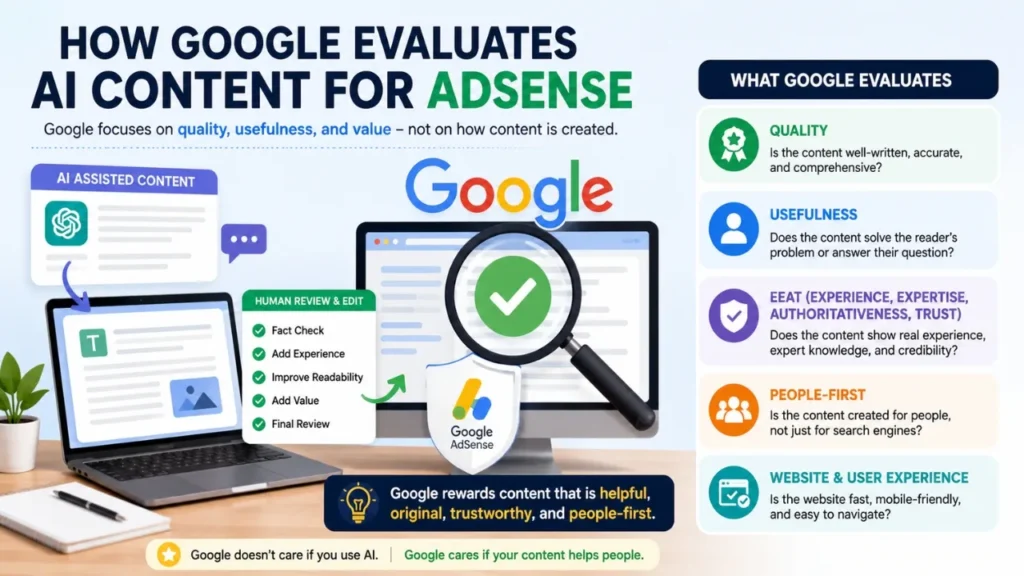
Getting Google AdSense approval involves much more than publishing a certain number of blog posts. Google reviews your website as a whole to determine whether it offers a safe, trustworthy, and valuable experience for users. This includes the quality of your content, the credibility of your website, its design, and even its technical performance.
Whether your articles are written by you, created with AI assistance, or produced using a combination of both, the evaluation criteria remain the same. Google wants to display ads on websites that provide real value to visitors and maintain high editorial standards.
Below are the key factors Google considers when reviewing a website for AdSense approval.
Original and Valuable Information
One of the most important requirements for AdSense approval is publishing original and valuable content. Google prefers websites that contribute something useful rather than simply repeating information already available across the internet.
Originality does not necessarily mean inventing a completely new topic. Instead, it means presenting information in a way that is unique, informative, and helpful to your audience.
For example, hundreds of websites explain how to start a blog. A generic article that lists the same basic steps adds little value. However, an article that includes personal experience, screenshots, common mistakes, budget recommendations, and practical tips offers readers a much better experience.
Google also looks for content that answers questions completely. A well-written guide should provide enough detail for readers to solve their problem without needing to search for another article immediately afterward.
Here are a few ways to create more valuable content:
- Share real experiences and lessons learned.
- Include original examples and case studies.
- Add screenshots, charts, or custom graphics.
- Explain complex topics using simple language.
- Update articles regularly to keep information accurate.
Creating helpful AI-assisted content becomes even more effective when you understand the benefits of digital marketing and how content supports business growth.
Actionable tip: Before publishing, ask yourself, “Does this article provide information that readers won’t easily find elsewhere?” If the answer is yes, you’re moving in the right direction.
User-First Content
Google consistently emphasizes creating people-first content rather than content designed only to rank in search engines.
User-first content focuses on solving problems instead of chasing keywords. It answers the reader’s question clearly, avoids unnecessary filler, and provides practical solutions.
For example, someone searching “Can AI content get AdSense approval?” wants a clear explanation, Google’s current stance, examples, and actionable advice. They don’t want an article filled with repeated keywords or vague statements that never answer the question directly.
Characteristics of user-first content include:
- Addresses the reader’s search intent.
- Uses clear and simple language.
- Provides practical advice.
- Organizes information logically.
- Includes relevant examples.
- Answers follow-up questions readers may have.
In contrast, search-engine-first content often contains:
- Excessive keyword repetition.
- Clickbait headlines.
- Thin or generic information.
- Long paragraphs with little value.
- Content created solely to increase page count.
Actionable tip: Write each article as if you’re helping one real person solve a problem. If your content genuinely helps readers, it is far more likely to satisfy Google’s quality expectations.
Experience, Expertise, Authoritativeness, and Trustworthiness (EEAT)
Google uses the EEAT framework to evaluate the overall credibility of content and the websites that publish it.
Experience
Readers trust advice that comes from someone who has actually done what they’re writing about.
For example, if you’re explaining how to get AdSense approval, including lessons from your own blogging journey, screenshots of your website, or mistakes you’ve learned from makes the content more authentic.
Expertise
Expertise means demonstrating a solid understanding of the topic you’re discussing.
Instead of making unsupported claims, explain concepts clearly, provide accurate information, and stay up to date with Google’s latest recommendations.
Authoritativeness
Authority grows over time through consistently publishing high-quality content within your niche.
For example, a website that regularly publishes detailed articles about SEO, blogging, AI tools, and digital marketing is more likely to be viewed as an authority than a website covering unrelated topics with inconsistent quality.
Trustworthiness
Trust is the foundation of every successful website.
Google and your visitors both expect transparency and reliability.
You can strengthen trust by:
- Providing accurate information.
- Correcting outdated content.
- Citing reputable sources when appropriate.
- Displaying clear contact information.
- Publishing About and Privacy Policy pages.
- Using HTTPS security.
Actionable tip: Don’t focus only on writing more articles. Build credibility by consistently publishing accurate, well-researched, and trustworthy content that reflects real knowledge and experience.
Website Design and User Experience
Excellent content alone may not be enough if your website is difficult to use. Google considers the overall user experience when reviewing websites for AdSense approval.
A clean, professional website helps visitors find information quickly and encourages them to stay longer.
Important elements include:
- Easy-to-read typography.
- Clear navigation menus.
- Logical content categories.
- Mobile responsiveness.
- Fast-loading pages.
- Consistent page layout.
- Minimal intrusive pop-ups.
- Well-placed internal links.
For example, if a visitor lands on your article and immediately encounters multiple pop-ups, confusing navigation, or unreadable text, they are more likely to leave. High bounce rates and poor user experience can negatively affect your website over time.
A well-designed website makes it easy for users to explore additional articles, understand your content, and trust your brand.
Actionable tip: Test your website on both desktop and mobile devices. Ensure that readers can navigate your content easily without distractions or unnecessary obstacles.
Technical SEO and Site Performance
Technical SEO plays an important role in creating a positive user experience and supporting AdSense approval. While technical optimization alone won’t guarantee approval, ignoring it can reduce your website’s overall quality.
Key technical factors include:
- HTTPS security certificate.
- Fast page loading speed.
- Mobile-friendly design.
- Proper heading structure.
- Clean URL structure.
- XML sitemap.
- Working internal links.
- No broken pages or 404 errors.
- Optimized images.
- Good Core Web Vitals.
For example, a website that loads in two seconds provides a much better experience than one that takes ten seconds. Likewise, articles with descriptive headings, optimized images, and clean URLs are easier for both users and search engines to understand.
If your website uses WordPress, plugins such as Rank Math, WP Rocket, and image optimization tools can help improve technical performance when configured correctly.
Actionable tip: Regularly audit your website using tools like Google Search Console and PageSpeed Insights. Fix crawl errors, improve loading speed, optimize Core Web Vitals, and ensure every important page is accessible to both users and search engines.
Ultimately, Google evaluates your website as a complete package. High-quality, original content combined with excellent user experience, strong EEAT signals, and solid technical SEO creates the kind of website Google is more likely to approve for AdSense. Instead of looking for shortcuts, focus on consistently building a site that readers genuinely find useful and trustworthy.
Can ChatGPT, Gemini, or Claude Content Get AdSense Approval?
One of the most common questions among bloggers is whether content created with AI tools like ChatGPT, Google Gemini, or Claude AI can qualify for Google AdSense approval. The simple answer is yes—but only if the final content meets Google’s quality standards.
Google does not approve or reject a website based on the specific AI tool you use. Whether you write with ChatGPT, Gemini, Claude, or another AI assistant, the same principles apply. Your content must be original, accurate, helpful, trustworthy, and created primarily for users—not just to rank in search engines.
Think of these AI tools as productivity assistants. They can save time by generating ideas, organizing information, drafting outlines, or improving readability. However, they should not replace human judgment, expertise, or editorial review.
Let’s look at how each tool can be used responsibly.
Using ChatGPT for Blog Writing

ChatGPT is one of the most popular AI writing assistants for bloggers. It can help generate article ideas, create outlines, write first drafts, suggest headlines, improve grammar, and simplify complex topics.
For example, if you’re writing an article about AdSense approval, ChatGPT can quickly generate a structured outline or explain Google’s policies in simple language. This can significantly reduce the time spent on research and drafting.
However, publishing ChatGPT’s output exactly as generated is not a good practice. AI-generated text may include:
- Generic explanations
- Repetitive wording
- Outdated information
- Missing context
- Occasional factual errors
That’s why every article should be carefully reviewed before publishing.
A better workflow looks like this:
- Generate an outline with ChatGPT.
- Expand each section using your own knowledge.
- Verify facts using official or authoritative sources.
- Add practical examples, screenshots, or case studies.
- Improve readability and remove repetitive wording.
- Proofread the final article before publishing.
For instance, instead of letting ChatGPT write a complete article about SEO, use it to create the structure and then add examples from your own website, analytics, or real projects. These unique additions make the article far more valuable and difficult to replicate.
Actionable advice: Use ChatGPT to speed up the writing process, but make sure the published version reflects your expertise, experience, and editorial judgment.
Using Google Gemini
Google Gemini is another powerful AI assistant that many bloggers use for brainstorming, research, and content creation. Because Gemini is developed by Google, some people mistakenly believe that content generated with it receives special treatment in Google Search or AdSense.
That is not true.
Google does not give ranking or AdSense advantages simply because an article was created with one of its AI tools. The same quality standards apply regardless of which writing assistant you choose.
Gemini is particularly useful for:
- Generating topic ideas
- Creating content outlines
- Summarizing information
- Explaining technical concepts
- Improving writing clarity
- Brainstorming FAQs
Like any AI tool, Gemini can occasionally produce inaccurate or incomplete information. It may also present opinions as facts if prompts are unclear.
Suppose you’re writing about Google’s Helpful Content System. Gemini can explain the concept, but you should still verify policy details using Google’s official documentation and include your own interpretation or practical examples.
Actionable advice: Treat Gemini as a research assistant rather than the final author. Always fact-check important claims and enhance the article with original insights.
Using Claude AI
Claude AI is known for producing natural, well-structured, and easy-to-read content. Many writers prefer it for creating long-form articles because its responses often flow more smoothly than standard AI-generated text.
Claude works well for tasks such as:
- Writing detailed first drafts
- Improving readability
- Organizing lengthy articles
- Rewriting complex paragraphs
- Maintaining a consistent writing style
Even though Claude produces polished content, it still requires human review.
For example, Claude might generate an excellent explanation of EEAT, but it may not include the latest changes to Google’s documentation or specific examples relevant to your audience. Adding those details increases both accuracy and originality.
Readers also appreciate articles that include personal experiences, screenshots, real-life examples, or lessons learned—elements AI cannot genuinely provide.
Actionable advice: Use Claude to improve writing quality, but make every article uniquely yours by adding firsthand experience, updated information, and practical recommendations.
AI-Assisted Writing vs Fully Automated Content
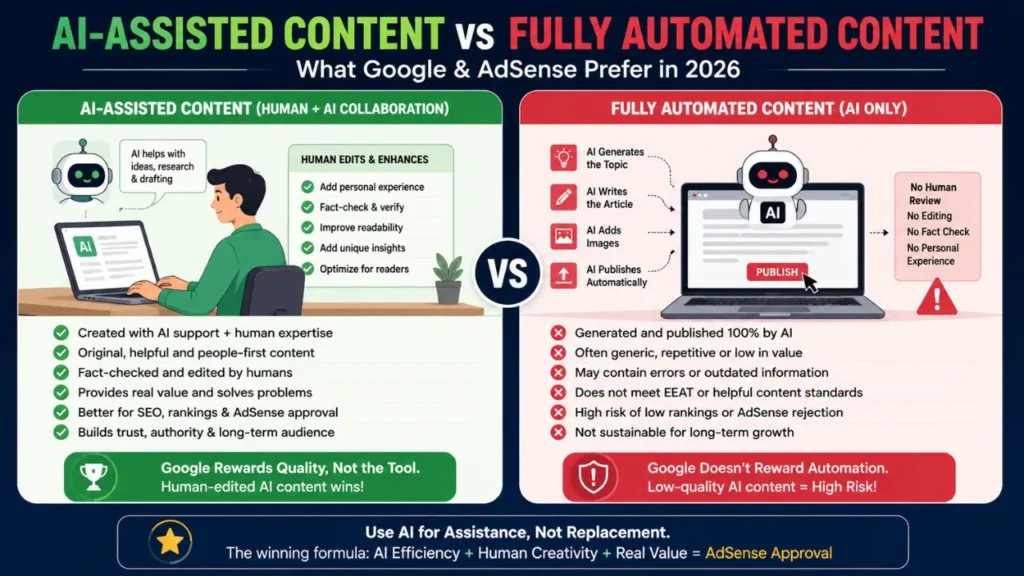
Understanding the difference between AI-assisted writing and fully automated content is one of the most important factors for AdSense approval.
AI-assisted writing means AI helps during the content creation process, but a human remains responsible for planning, editing, verifying facts, improving readability, and adding original value.
This approach typically includes:
- Human research
- Original insights
- Fact-checking
- Custom examples
- Manual editing
- Clear editorial oversight
By contrast, fully automated content is created and published with little or no human involvement. It often consists of generic information, repetitive wording, weak structure, and little unique value. Publishing large numbers of articles this way can reduce the overall quality of your website and may negatively affect both search performance and AdSense approval.
Consider two technology blogs.
The first uses AI to generate fifty articles in a single day and publishes them without editing. Many articles repeat the same information, contain outdated facts, and provide no unique perspective.
The second publishes one carefully edited article each week. The writer uses AI to create the first draft but adds original screenshots, practical tutorials, expert recommendations, and answers to common reader questions.
Although both websites use AI, the second is far more likely to earn readers’ trust and satisfy Google’s quality expectations.
Best Practices for AI-Assisted Blog Writing
To maximize your chances of AdSense approval:
- Use AI for brainstorming, outlining, and drafting.
- Research topics thoroughly before publishing.
- Verify every important fact and statistic.
- Add your own experience, examples, and insights.
- Remove repetitive or generic AI wording.
- Optimize articles for readability and search intent.
- Update older content regularly.
- Focus on solving readers’ problems rather than publishing large volumes of content.
Ultimately, ChatGPT, Google Gemini, and Claude are all capable writing assistants—not shortcuts to AdSense approval. Google evaluates the final quality of your content, not the name of the AI tool you used. Bloggers who combine AI efficiency with human expertise, careful editing, and genuine value are in the strongest position to build a successful, AdSense-friendly website.
Common Reasons AI Content Gets Rejected by AdSense
Using AI to create blog content does not automatically prevent your website from getting Google AdSense approval. In fact, many successful websites use AI as part of their content creation workflow. The real issue arises when AI is used to produce low-quality, repetitive, or unhelpful content without proper human oversight.
Google’s AdSense review process focuses on the overall quality of your website. If your content fails to provide value, appears untrustworthy, or is created solely to generate ad revenue, your application may be rejected regardless of whether AI was involved.
Below are the most common mistakes that reduce your chances of AdSense approval—and how to avoid them.
Thin Content
Thin content refers to articles that provide very little useful information or fail to answer the reader’s question in a meaningful way. This is one of the most common reasons websites struggle to receive AdSense approval.
A thin article often contains:
- Very short explanations
- Generic definitions
- Repetitive sentences
- Little practical advice
- No examples or supporting details
For example, imagine writing a 300-word article titled “What Is SEO?” that only defines SEO and lists a few basic points. Readers would likely leave the page searching for a more detailed explanation elsewhere.
By contrast, a high-quality article would explain how SEO works, discuss different types of SEO, include practical examples, common mistakes, recommended tools, and actionable tips.
How to avoid it:
- Answer the topic thoroughly.
- Include examples and step-by-step guidance.
- Cover related questions readers may have.
- Add original insights instead of repeating common information.
- Write with the goal of solving a problem, not simply filling a page.
Duplicate or Rewritten Articles
Google expects websites to publish original content. Simply copying existing articles or lightly rewriting content from other websites offers little value to users.
Some bloggers use AI to rewrite articles found online without adding any new information. Although the wording may change, the underlying ideas remain the same, making the content less valuable.
For example, rewriting an existing article about “AdSense Approval Tips” by changing a few words does not create a unique resource. However, writing the same topic based on your own experience, adding updated policy information, screenshots, and practical recommendations creates a much stronger article.
Duplicate content can also occur within your own website if multiple articles cover the same topic without offering different perspectives.
How to avoid it:
- Write from your own knowledge and experience.
- Add original examples and case studies.
- Create unique images, tables, or screenshots.
- Avoid publishing multiple articles that repeat the same information.
- Use AI for inspiration—not for rewriting someone else’s work.
Poor Fact-Checking
AI tools are impressive, but they are not perfect. They sometimes generate incorrect facts, outdated statistics, or misleading information presented as accurate.
Publishing these errors without verification can damage your credibility and reduce trust in your website.
For instance, an AI tool might describe an outdated Google AdSense policy or mention features that no longer exist. Readers who discover these mistakes may lose confidence in your content, and Google also values accuracy when assessing overall quality.
This is especially important for topics related to finance, health, legal advice, education, or technology, where incorrect information can have serious consequences.
How to avoid it:
- Verify important facts using reliable sources.
- Check official Google documentation for policy-related topics.
- Confirm statistics, dates, and product information before publishing.
- Update older articles regularly to keep them accurate.
- Never assume AI-generated information is automatically correct.
Keyword Stuffing
Keywords help search engines understand your content, but using them excessively creates a poor reading experience.
Keyword stuffing occurs when the same phrase is repeated unnaturally throughout an article in an attempt to improve rankings.
For example, repeatedly writing “Can AI content get AdSense approval” in nearly every paragraph makes the content feel forced and difficult to read.
Instead, use natural language and include related phrases such as:
- AI-generated content
- Google AdSense
- AI writing tools
- Helpful content
- AdSense policies
- AI-assisted blogging
This improves readability while also helping search engines understand the topic.
How to avoid it:
- Write naturally for readers first.
- Use synonyms and related terms.
- Include the primary keyword where it fits naturally.
- Focus on answering questions rather than repeating keywords.
- Read your article aloud to identify awkward repetition.
Low User Value
Google wants to display ads on websites that genuinely help people. If your content offers little value beyond what is already available online, it becomes much harder to earn AdSense approval.
Low-value content often includes:
- Generic AI-generated paragraphs
- No original opinions
- No practical examples
- Surface-level explanations
- Content created only to target keywords
Imagine two articles discussing AI blogging tools.
The first lists five tools with one sentence describing each.
The second compares pricing, strengths, limitations, ideal users, screenshots, real testing results, and recommendations.
Both cover the same topic, but the second provides far greater value because it helps readers make informed decisions.
How to avoid it:
- Answer readers’ questions completely.
- Include actionable recommendations.
- Add comparisons, examples, or tutorials.
- Explain concepts clearly for beginners.
- Ask yourself whether readers would bookmark or share the article because it was genuinely useful.
Spammy Publishing Practices
Publishing large amounts of low-quality content in a short period can make a website appear spammy.
Examples include:
- Hundreds of AI-generated articles published within days.
- Automatically creating pages for every possible keyword variation.
- Using misleading titles to attract clicks.
- Publishing nearly identical articles targeting similar keywords.
- Creating content only to increase page count.
Quality always matters more than quantity.
For example, publishing four thoroughly researched articles each month is generally more beneficial than publishing one hundred generic AI-generated articles with minimal editing.
A smaller collection of excellent content often performs better than a large library of low-quality pages.
How to avoid it:
- Prioritize quality over publishing speed.
- Create a consistent editorial schedule.
- Review every article before publishing.
- Remove outdated or low-quality content.
- Focus on building topical authority instead of maximizing article count.
Excessive Automation Without Human Review
Automation can improve productivity, but relying on it entirely creates significant risks.
Some bloggers use AI to generate articles, automatically publish them, and never review the content. This approach often produces pages containing factual errors, repetitive wording, poor formatting, broken internal links, or irrelevant information.
Google expects websites to demonstrate editorial oversight and responsibility.
Human review remains essential for:
- Improving clarity.
- Verifying facts.
- Correcting grammar.
- Adding unique perspectives.
- Updating outdated information.
- Ensuring content aligns with user intent.
Think of AI as a first draft rather than the final product.
A professional editor would never publish an article without reviewing it, and the same principle applies when using AI.
How to avoid it:
- Always edit AI-generated drafts manually.
- Add your own experience and expertise.
- Check formatting and readability.
- Verify every important claim.
- Read the article from a reader’s perspective before publishing.
Final Thoughts
AI itself is not the reason websites fail to receive AdSense approval. The real problem is poor-quality content created without sufficient human involvement.
If you avoid thin articles, duplicate content, factual inaccuracies, keyword stuffing, low-value information, spammy publishing habits, and fully automated workflows, you’ll be in a much stronger position to build a trustworthy website that meets Google’s quality expectations.
The most successful bloggers use AI to work smarter—not to avoid the responsibility of creating helpful, accurate, and original content. That balanced approach is far more likely to earn both Google Search visibility and AdSense approval.
Best Practices for Creating AdSense-Friendly AI Content
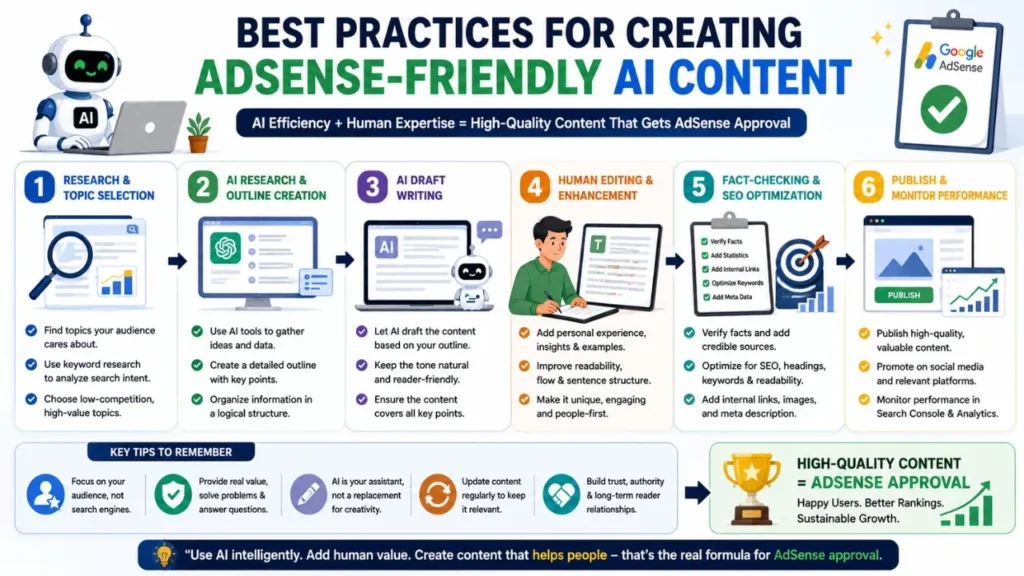
AI can dramatically speed up content creation, but it should never replace the effort required to produce high-quality, trustworthy articles. The most successful bloggers use AI as a productivity tool while remaining actively involved in researching, editing, and improving every piece of content they publish.
If your goal is to earn Google AdSense approval, focus on creating articles that genuinely help readers solve problems. Below are the best practices that can help you produce AI-assisted content that aligns with Google’s quality standards.
Start with Original Research
The foundation of every high-quality article is good research. While AI tools can summarize information and generate ideas, they should not be your only source of knowledge.
Before writing, spend time understanding the topic by reviewing official documentation, reputable websites, industry reports, and recent updates. This helps you identify accurate information and discover opportunities to add something unique.
For example, if you’re writing about Google AdSense approval, don’t rely solely on AI-generated responses. Review Google’s official AdSense policies, search documentation, and recent announcements to ensure your article reflects the latest guidance.
Original research can also include:
- Testing tools yourself.
- Comparing products.
- Collecting screenshots.
- Recording your own results.
- Answering questions based on personal experience.
Doing this allows you to publish content that stands out instead of repeating information already available on hundreds of websites.
Actionable tip: Create your own outline after researching the topic, then use AI to expand or organize ideas rather than letting it determine the entire direction of the article.
Add Personal Insights and Practical Examples
One of the easiest ways to make AI-assisted content more valuable is by including your own experience.
Readers appreciate advice that comes from someone who has actually used a tool, solved a problem, or learned from real-world situations.
Suppose you’re explaining how to improve a website before applying for AdSense. Instead of simply listing recommendations, describe changes you made on your own website, explain the results, or discuss mistakes you learned to avoid.
Practical examples also improve understanding.
Instead of writing:
“Optimize your content for readability.”
You could explain:
Break long paragraphs into shorter ones, use descriptive headings, add bullet points, and include screenshots where appropriate. These improvements make articles easier to read and encourage visitors to stay longer.
Real examples build credibility and demonstrate experience, which strengthens your content from both the reader’s perspective and Google’s EEAT framework.
Actionable tip: Ask yourself, “What have I personally learned that AI cannot know?” Include those insights throughout your article.
Human Edit Every Article
Even the best AI tools produce drafts—not finished articles.
AI may repeat ideas, use unnatural wording, overlook context, or include inaccurate information. Human editing transforms a generic draft into a polished, trustworthy resource.
A proper editing process should include:
- Removing repetitive sentences.
- Improving transitions between sections.
- Simplifying complex explanations.
- Correcting grammar and spelling.
- Rewriting awkward paragraphs.
- Adding examples and supporting details.
- Ensuring the article flows naturally.
Reading the article aloud is an effective way to identify sentences that sound robotic or difficult to understand.
Remember that AI should save you time, not eliminate the need for editorial review.
Actionable tip: Never publish the first AI-generated draft. Review it carefully at least once, and ideally return later for a second edit with fresh eyes.
Verify Facts and Statistics
Accuracy is one of the most important signals of quality.
Although AI tools can provide useful information, they occasionally generate incorrect facts, outdated recommendations, or unsupported statistics. Publishing inaccurate information can reduce trust and damage your website’s credibility.
Before publishing, verify:
- Statistics.
- Dates.
- Product pricing.
- Software features.
- Policy information.
- Technical recommendations.
- Quotes.
- Industry trends.
For example, if you mention changes to Google’s AdSense policies or Search guidelines, confirm the information using Google’s official documentation rather than relying solely on AI.
If you include numerical data, mention the source whenever appropriate. Accurate information helps readers trust your content and supports stronger EEAT signals.
Actionable tip: Create a final fact-checking checklist before publishing every article, especially for technology, finance, health, or legal topics where information changes frequently.
Improve Readability
Helpful content is also easy to read.
Many AI-generated articles contain long paragraphs, repetitive phrases, or complicated sentences that reduce the overall reading experience.
Improving readability makes your content more engaging and encourages visitors to stay on your website longer.
Simple improvements include:
- Using descriptive headings.
- Keeping paragraphs short.
- Breaking information into bullet points.
- Explaining technical terms in plain language.
- Highlighting important points where appropriate.
- Maintaining a logical flow from one section to the next.
For example, instead of presenting ten ideas in one long paragraph, organize them into smaller sections with clear subheadings. Readers can then scan the article quickly and find the information they need.
A well-structured article benefits both users and search engines.
Actionable tip: Imagine you’re explaining the topic to someone with no prior knowledge. If your writing feels clear and conversational, you’re likely on the right track.
Create Helpful Visuals and Tables
Visual elements improve both user experience and content quality.
While Google doesn’t require images for AdSense approval, visuals can make complex topics easier to understand and keep readers engaged.
Useful visual content includes:
- Screenshots.
- Comparison tables.
- Infographics.
- Checklists.
- Flowcharts.
- Process diagrams.
- Step-by-step illustrations.
For example, an article comparing AI writing tools becomes much more useful when it includes a table showing each tool’s strengths, limitations, pricing, and best use cases.
Similarly, a checklist summarizing AdSense requirements allows readers to review important points quickly without rereading the entire article.
Whenever possible, create original visuals instead of copying graphics from other websites.
Actionable tip: Add visuals only when they genuinely improve understanding. Every image or table should support the content rather than simply filling space.
Write for Users Before Search Engines
Perhaps the most important best practice is to focus on readers instead of algorithms.
Google’s ranking systems are designed to reward content that satisfies user intent. If your article genuinely answers questions, solves problems, and provides a positive experience, you’re already following the direction Google encourages.
Avoid writing solely to target keywords or increase word count.
Instead, ask questions like:
- What problem is the reader trying to solve?
- What information would be most useful?
- Which follow-up questions might they have?
- How can I make this topic easier to understand?
For example, someone searching “Can AI content get AdSense approval?” doesn’t just want a yes-or-no answer. They also want to understand Google’s policies, common mistakes, best practices, and practical steps they can take to improve their chances of approval.
By addressing those needs completely, your content becomes far more valuable than an article created only to rank for a keyword.
Actionable tip: Before publishing, read your article from the perspective of a first-time visitor. If it answers the main question clearly and provides practical guidance without unnecessary filler, you’ve created content that serves users first.
Final Thoughts
Creating AdSense-friendly AI content is not about avoiding AI—it’s about using it responsibly. AI can help you brainstorm ideas, organize information, and draft articles faster, but the final responsibility always belongs to you.
The strongest AI-assisted articles combine thorough research, original insights, careful editing, accurate information, clear writing, helpful visuals, and a genuine commitment to helping readers. When you consistently follow these best practices, you’re not only improving your chances of Google AdSense approval but also building a website that earns long-term trust from both users and search engines.
AI Content vs Human-Written Content
As AI writing tools become more advanced, many bloggers wonder whether AI-generated content is better than human-written content—or if one is more likely to receive Google AdSense approval. The reality is that this isn’t a competition between AI and humans. Each has unique strengths and limitations, and the most successful websites combine both.
Google doesn’t rank or approve content based on who—or what—wrote it. Instead, it evaluates whether the final content is accurate, original, helpful, and trustworthy. A poorly written human article won’t perform well simply because a person wrote it, just as a well-edited AI-assisted article isn’t disadvantaged because AI helped create it.
Understanding the strengths of both approaches can help you build a smarter and more effective content strategy.
Strengths of AI Content
AI writing tools such as ChatGPT, Google Gemini, and Claude can significantly improve productivity. They are especially useful for repetitive or time-consuming tasks, allowing bloggers to focus more on strategy and content quality.
Some of the biggest advantages of AI content include:
- Generates first drafts quickly.
- Produces detailed outlines in seconds.
- Brainstorms new content ideas.
- Improves grammar and sentence structure.
- Summarizes complex topics.
- Helps overcome writer’s block.
- Speeds up research and organization.
- Assists with SEO optimization.
For example, imagine you’re planning a 3,000-word guide about Google AdSense approval. Instead of starting with a blank page, you can ask AI to generate a detailed outline, suggest relevant headings, and prepare a rough draft. This may reduce hours of work to just a few minutes.
AI is also excellent for maintaining consistency across multiple articles. If you manage a large blog, it can help standardize formatting, writing style, and article structure.
However, AI also has limitations.
It may:
- Produce generic explanations.
- Repeat information.
- Miss important context.
- Generate inaccurate facts.
- Lack personal experience.
- Struggle with originality.
- Sound repetitive if left unedited.
These weaknesses explain why AI should support your writing process rather than replace it.
Actionable advice: Use AI for brainstorming, outlining, and drafting, but never treat its first response as the finished article.
Strengths of Human Content
While AI is excellent at generating text quickly, humans contribute qualities that machines cannot genuinely replicate.
Human-written content brings:
- Personal experience.
- Critical thinking.
- Emotional understanding.
- Creativity.
- Real-world problem solving.
- Original opinions.
- Context and judgment.
- Authentic storytelling.
For example, if you’ve successfully received Google AdSense approval after improving your website, you can explain exactly what changes you made, what mistakes you encountered, and what worked best. Those firsthand experiences make your article far more valuable than a generic explanation generated by AI.
Human writers also recognize subtle details that AI may overlook.
Suppose Google’s policies change. An experienced blogger can explain how those changes affect real websites, while AI may simply summarize the updated documentation without offering meaningful interpretation.
Another advantage is the ability to connect with readers emotionally.
Stories, personal challenges, successes, and lessons learned create trust and make articles more memorable.
This aligns closely with Google’s EEAT principles because real experience is difficult to imitate artificially.
Actionable advice: Include personal observations, lessons learned, testing results, or practical examples wherever possible. These additions strengthen both reader trust and content quality.
The Best Hybrid Approach
Rather than choosing between AI and human writing, the most effective strategy is to combine the strengths of both.
A hybrid workflow uses AI to improve efficiency while relying on human expertise to ensure quality.
A practical workflow might look like this:
- Research the topic using authoritative sources.
- Use AI to generate an outline.
- Draft the article with AI assistance.
- Add your own experience and unique insights.
- Verify every important fact.
- Rewrite sections that sound generic.
- Improve readability and formatting.
- Add screenshots, tables, and examples.
- Optimize for SEO and user intent.
- Proofread before publishing.
This approach allows you to produce high-quality content more efficiently without sacrificing originality or credibility.
Consider two bloggers writing the same article about AI content and AdSense.
Blogger A copies an AI-generated article and publishes it immediately without making any changes.
The article contains repetitive wording, generic advice, and no unique insights.
Blogger B uses AI only to generate the outline and first draft. They then rewrite sections, verify Google’s latest guidance, include screenshots, add personal experience, create a comparison table, and answer common reader questions.
Although both bloggers used AI, Blogger B publishes a much stronger resource because the article demonstrates expertise, originality, and genuine value.
This is exactly the type of content Google aims to reward.
AI vs Human Content Comparison
| Feature | AI Content | Human-Written Content |
|---|---|---|
| Speed | Excellent | Moderate |
| Original Insights | Limited | Excellent |
| Personal Experience | No | Yes |
| Creativity | Moderate | High |
| Fact Accuracy | Requires verification | Higher with proper research |
| Emotional Connection | Limited | Strong |
| Productivity | Excellent | Moderate |
| Editorial Judgment | No | Yes |
| EEAT Signals | Weak without editing | Strong |
| AdSense Potential | High when properly edited | High when high quality |
The comparison makes one thing clear: neither AI nor human writing is perfect on its own. AI offers speed and efficiency, while humans provide expertise, judgment, and authenticity.
Final Thoughts
The question isn’t whether AI content is better than human-written content. The real question is how effectively you combine the strengths of both.
Google AdSense doesn’t reward AI or human writing—it rewards high-quality content that helps users.
Use AI to save time on brainstorming, outlining, drafting, and editing. Then apply your own expertise to improve accuracy, add original insights, share real experiences, and ensure every article genuinely serves your audience.
This hybrid approach not only improves your chances of AdSense approval but also helps you build a trusted website that performs well in Google Search and delivers lasting value to readers.
EEAT Best Practices for AI-Assisted Articles
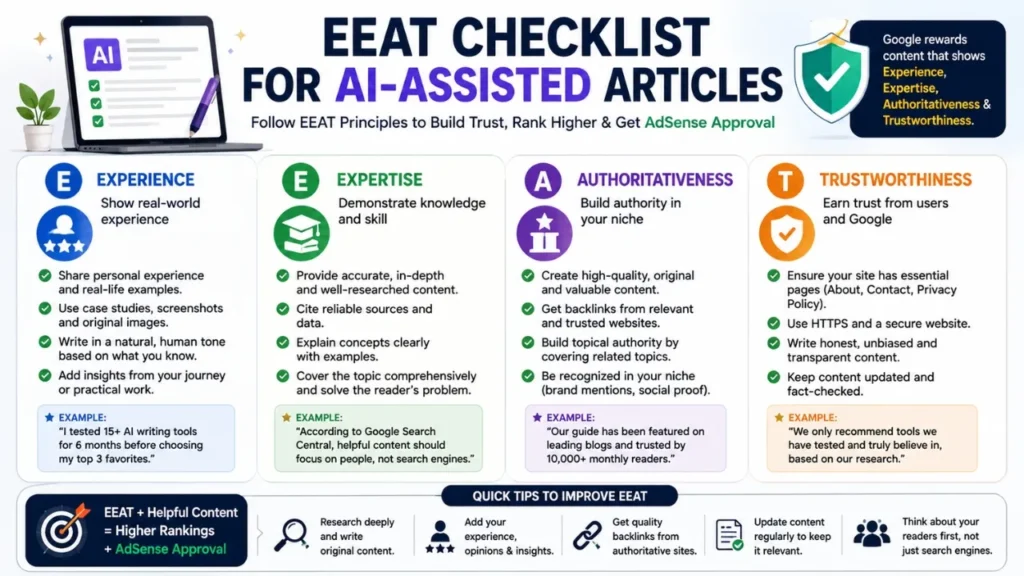
Whether you write articles yourself or use AI tools like ChatGPT, Google Gemini, or Claude, Google expects your content to demonstrate EEAT—Experience, Expertise, Authoritativeness, and Trustworthiness. These quality signals help Google determine whether your content deserves to rank in search results and whether your website provides enough value for users.
For bloggers seeking Google AdSense approval, EEAT is especially important. While Google has never stated that EEAT is a direct ranking factor, its quality systems consistently reward content that demonstrates genuine expertise, practical experience, and trustworthiness.
AI can help you write faster, but it cannot replace your real-world knowledge, judgment, or credibility. That’s why every AI-assisted article should be reviewed and enhanced with human expertise before publishing.
Here’s how to strengthen the EEAT of your AI-assisted content.
Demonstrate Real Experience
Experience is one of the strongest ways to make your content more valuable and trustworthy.
Readers appreciate advice from someone who has actually used a product, tested a strategy, or solved the problem being discussed. AI can explain concepts, but it cannot genuinely share personal experiences or lessons learned.
For example, if you’re writing about Google AdSense approval, don’t simply repeat general advice. Explain:
- How you prepared your website before applying.
- What changes improved your site’s quality.
- Mistakes you made during the process.
- What worked and what didn’t.
- Lessons you learned from your own experience.
Similarly, if you’re reviewing an AI writing tool, describe how you used it, what tasks it handled well, and where it fell short.
Real experiences help readers make informed decisions while also distinguishing your content from generic AI-generated articles.
Actionable advice: Include screenshots, examples, case studies, or results from your own projects whenever possible. Authentic experience is difficult to copy and significantly strengthens your content.
Build Author Credibility
People trust information more when they know who created it.
Google also looks for signals that demonstrate a website is managed by knowledgeable and trustworthy individuals.
You can build author credibility by:
- Creating a detailed author bio.
- Explaining your background and expertise.
- Publishing consistently within your niche.
- Maintaining a professional website.
- Providing clear contact information.
- Displaying an About Us page.
For example, if you regularly publish articles about blogging, SEO, AI tools, and digital marketing, readers begin to recognize your expertise over time. Consistently producing accurate and helpful content strengthens your authority in that niche.
Author credibility doesn’t require decades of professional experience. Honest, well-researched content combined with practical knowledge can also build trust.
Actionable advice: Add an author profile to every article and keep it updated. Mention relevant experience, certifications, or projects that demonstrate your knowledge of the topic.
Cite Reliable Sources
One of the easiest ways to improve trustworthiness is by supporting important claims with reliable sources.
AI-generated content sometimes presents information confidently without identifying where it came from. Adding credible references helps readers verify the information and increases confidence in your content.
Reliable sources may include:
- Official Google documentation.
- Government websites.
- Educational institutions.
- Industry research reports.
- Established publications.
- Product documentation.
- Peer-reviewed studies when appropriate.
For example, if you’re discussing Google’s AdSense policies or Search guidelines, refer to Google’s official documentation instead of relying solely on forum discussions or unverified opinions.
However, avoid excessive citations that interrupt readability. Use references when they genuinely strengthen the content or support important claims.
Actionable advice: Whenever you mention policies, statistics, or technical recommendations, confirm them using authoritative sources before publishing.
Keep Content Updated
High-quality content should remain accurate over time.
Technology, SEO, AI tools, and Google’s policies change frequently. An article that was completely accurate a year ago may now contain outdated recommendations.
Regular updates demonstrate that your website is actively maintained and committed to providing current information.
Review articles periodically to:
- Update screenshots.
- Replace outdated statistics.
- Revise product features.
- Remove broken links.
- Add new best practices.
- Reflect changes in Google’s recommendations.
For example, if Google introduces new AdSense policies or updates its guidance on AI-generated content, revise your article to include the latest information instead of leaving outdated advice online.
Fresh, accurate content provides a better experience for readers and helps maintain your website’s credibility.
Actionable advice: Schedule a content audit every six to twelve months, especially for articles covering rapidly changing topics like AI, SEO, and digital marketing.
Show Transparency About AI Assistance (When Appropriate)
Many bloggers wonder whether they should tell readers that AI helped create an article.
In most cases, Google does not require you to disclose AI assistance simply because you used AI during the writing process. What matters most is that the final content is accurate, original, and genuinely helpful.
However, transparency can be valuable in certain situations.
For example, if an article discusses your workflow for using AI tools, it may be appropriate to explain that AI assisted with brainstorming, outlining, or drafting while the final content was reviewed, edited, and fact-checked by you.
Transparency is also important when AI-generated outputs, images, or demonstrations are central to the article itself.
Regardless of whether you choose to mention AI assistance, you remain responsible for everything you publish.
Readers expect:
- Accurate information.
- Honest recommendations.
- Clear explanations.
- Responsible editing.
- Original value.
AI should support your expertise—not replace it.
Actionable advice: If you decide to disclose AI assistance, keep the statement simple and truthful. Explain that AI was used as a writing or research assistant while emphasizing that the final content was reviewed, edited, and verified by a human.
Final Thoughts
EEAT isn’t about proving that your content was written without AI. It’s about proving that your content deserves readers’ trust.
By sharing real experience, building author credibility, referencing reliable sources, keeping articles updated, and using AI responsibly, you create content that is more useful, more trustworthy, and better aligned with Google’s quality expectations.
The strongest AI-assisted articles combine the efficiency of modern writing tools with human expertise, careful editing, and a genuine commitment to helping readers. That’s the approach most likely to support long-term search visibility, reader trust, and Google AdSense approval.
Website Requirements Beyond Content for AdSense Approval
Publishing high-quality content is one of the most important steps toward Google AdSense approval, but content alone isn’t enough. Google also evaluates the overall quality, usability, and trustworthiness of your website.
Before applying for AdSense, visit the Google AdSense Help Center to review the latest publisher policies, account requirements, and best practices for maintaining policy compliance.
A well-designed website gives visitors confidence that your business is legitimate, makes it easier to find information, and creates a positive browsing experience. Even excellent articles can struggle if your site has poor navigation, missing legal pages, slow loading times, or technical issues.
Before submitting your AdSense application, review your website carefully to ensure it meets the following requirements.
Essential Pages
Every professional website should include a set of essential pages that help users understand who you are, how to contact you, and how you handle their information.
Although Google doesn’t publish a checklist stating these pages are mandatory for every website, including them demonstrates transparency and professionalism—qualities that support trust and improve your chances of AdSense approval.
About Us
The About Us page introduces your website and explains its purpose.
Readers should quickly understand:
- What your website is about.
- Who created it.
- Why the content can be trusted.
- What value visitors can expect.
For example, if you run a technology blog, explain your focus areas, such as AI tools, blogging, SEO, and digital marketing, along with your mission to provide accurate and practical information.
A well-written About Us page helps establish credibility and supports Google’s EEAT principles.
Contact
A Contact page shows that real people are behind your website.
Include one or more ways for visitors to reach you, such as:
- Contact form
- Business email address
- Social media profiles
- Business location (if applicable)
Visitors are more likely to trust websites that offer clear communication channels rather than hiding behind anonymous content.
Privacy Policy
A Privacy Policy explains how your website collects, stores, and uses visitor information.
It should describe topics such as:
- Cookies
- Analytics
- Advertising
- Personal data collection
- Third-party services
If you plan to display Google AdSense ads, a Privacy Policy becomes even more important because advertising platforms use cookies and similar technologies.
Disclaimer
A Disclaimer informs readers about the limitations of your content and clarifies your responsibilities.
Depending on your website, your disclaimer may explain:
- Educational purposes only
- No professional or legal advice
- Affiliate relationships
- Sponsored content
- Accuracy limitations
For example, a technology blog reviewing software should explain that recommendations are based on research, testing, or personal experience and may change over time.
Terms and Conditions
The Terms and Conditions page outlines the rules governing the use of your website.
It may include:
- Acceptable use policies
- Copyright information
- Intellectual property rights
- User responsibilities
- Limitation of liability
While many visitors never read this page, having it demonstrates that your website operates professionally.
Actionable advice: Review all legal pages regularly to ensure they reflect your current website practices, especially if you introduce new services, advertising, or affiliate partnerships.
Clear Website Navigation
Visitors should be able to find information quickly without becoming confused.
A clean navigation structure improves user experience and helps search engines understand the organization of your website.
Good navigation typically includes:
- A simple main menu.
- Clearly named categories.
- Logical article organization.
- Breadcrumb navigation (when appropriate).
- Search functionality.
- Easy access to important pages.
For example, instead of placing every article in one category, organize them into meaningful sections such as:
- AI Tools
- Blogging
- SEO
- Affiliate Marketing
- Digital Marketing
- WordPress
This structure helps users discover related content while improving crawlability for search engines.
Poor navigation often leads to frustrated visitors who leave the website before finding what they need.
Actionable advice: Ask someone unfamiliar with your website to locate a specific article. If they struggle to find it, your navigation likely needs improvement.
Mobile-Friendly Design
Today, most website visitors access content using smartphones or tablets.
Google also uses mobile-first indexing, meaning it primarily evaluates the mobile version of your website.
A mobile-friendly website should:
- Display correctly on all screen sizes.
- Use readable font sizes.
- Have buttons that are easy to tap.
- Avoid horizontal scrolling.
- Load quickly on mobile networks.
- Maintain consistent formatting.
For example, if text overlaps images or menus become difficult to use on smaller screens, visitors may leave immediately, reducing engagement and harming the overall user experience.
Responsive design ensures your website automatically adapts to different devices without requiring a separate mobile version.
Actionable advice: Test your website on multiple smartphones and tablets to confirm that every page is easy to read and navigate.
Fast Loading Speed
Website speed plays an important role in both user satisfaction and overall website quality.
Visitors expect pages to load quickly. Even a delay of a few seconds can increase bounce rates and reduce engagement.
Common causes of slow websites include:
- Large image files.
- Excessive plugins.
- Poor-quality hosting.
- Unoptimized code.
- Too many third-party scripts.
- Unnecessary animations.
Improving page speed benefits both users and search engines.
Some effective optimization techniques include:
- Compressing images.
- Enabling browser caching.
- Using a content delivery network (CDN).
- Minimizing CSS and JavaScript files.
- Removing unused plugins.
- Choosing reliable hosting.
Tools such as Google PageSpeed Insights and Google Search Console can help identify performance issues and recommend improvements.
Actionable advice: Aim for fast-loading pages on both desktop and mobile devices. Regular performance testing helps identify issues before they affect users.
HTTPS Security
Website security is essential for building trust.
An HTTPS-enabled website encrypts data transferred between visitors and your server, protecting sensitive information from unauthorized access.
Modern browsers also warn users when they visit websites that do not use HTTPS, which can reduce trust immediately.
Fortunately, most hosting providers now offer free SSL certificates that enable HTTPS with minimal setup.
Before applying for AdSense, ensure that:
- Every page loads securely using HTTPS.
- Mixed-content warnings are resolved.
- Internal links use HTTPS versions.
- Redirects from HTTP to HTTPS work correctly.
A secure website demonstrates professionalism and provides a safer browsing experience for visitors.
Actionable advice: Check that your SSL certificate renews automatically and monitor your website periodically for security issues.
Clean Internal Linking Structure
Internal links connect related pages across your website, helping both users and search engines discover additional content.
A strong internal linking strategy:
- Improves website navigation.
- Distributes authority across pages.
- Encourages longer visitor sessions.
- Helps search engines crawl your content.
- Builds topical authority.
For example, an article about Google AdSense approval can naturally link to related articles covering:
- SEO best practices
- Blogging tips
- AI writing tools
- Website speed optimization
- Google Search Console
- Content marketing
These connections create a logical content network that improves the overall user experience.
Avoid excessive internal links or links that have little relevance. Every link should help readers continue learning about related topics.
Actionable advice: Whenever you publish a new article, link it to several relevant existing articles, and update older posts to include links back to the new content. This creates a well-connected website that benefits both readers and search engines.
Final Thoughts
A successful AdSense application depends on more than just writing great articles. Google also evaluates whether your website is trustworthy, easy to use, secure, and professionally maintained.
By creating essential legal pages, organizing clear navigation, optimizing for mobile devices, improving loading speed, securing your website with HTTPS, and building a strong internal linking structure, you create a better experience for visitors while demonstrating the quality standards Google expects.
Combined with original, helpful content, these website improvements can significantly strengthen your chances of earning and maintaining Google AdSense approval.
AI Content Myths About Google AdSense
As AI writing tools become more popular, misinformation about Google AdSense and AI-generated content has spread across blogs, YouTube videos, and online forums. Some creators claim that Google rejects every AI-written article, while others believe publishing hundreds of AI-generated posts is the fastest way to earn from AdSense.
The truth is far more balanced.
Google has consistently emphasized that it evaluates content quality rather than the method used to create it. AI is simply a tool. Whether your website succeeds depends on how you use that tool and the value your content provides to readers.
Many myths about AI writing are based on outdated information. Google’s official AI content guidance confirms that its ranking systems reward high-quality content regardless of how it is produced.
Let’s examine some of the most common myths and separate fact from fiction.
Myth: Google Automatically Detects and Rejects AI Content
This is probably the biggest misconception about AI-assisted blogging.
Many people believe Google can instantly identify AI-generated articles and automatically reject them during the AdSense review process.
The reality is different.
Google has stated that its systems focus on helpful, reliable, and people-first content, not whether AI assisted in creating it. There is no official policy stating that websites are rejected simply because AI was used.
Instead, Google evaluates questions such as:
- Is the content original?
- Does it answer the user’s question?
- Is the information accurate?
- Does the article demonstrate expertise?
- Does it provide genuine value?
For example, imagine two bloggers using ChatGPT.
The first publishes AI-generated articles exactly as produced without editing or fact-checking.
The second uses ChatGPT to create outlines but rewrites the content, verifies information, adds screenshots, shares personal experience, and improves readability.
Although both bloggers used AI, the second website is far more likely to meet Google’s quality expectations because the final content is useful and trustworthy.
The issue isn’t AI itself—it’s low-quality content.
Actionable advice: Don’t focus on hiding AI usage. Focus on creating original, accurate, and genuinely helpful articles that readers will appreciate.
Myth: AI Articles Cannot Rank on Google
Another common belief is that AI-generated articles never rank in Google Search.
This is also inaccurate.
Many websites successfully rank AI-assisted content because Google evaluates the final page rather than the writing process behind it.
However, ranking depends on several important factors, including:
- Content quality
- Search intent
- Originality
- EEAT signals
- Technical SEO
- User experience
- Website authority
Simply asking an AI tool to generate a 2,000-word article does not guarantee rankings.
For example, an AI-generated guide about blogging that contains outdated information, weak explanations, and repetitive wording is unlikely to perform well.
On the other hand, an AI-assisted article that includes original research, updated information, screenshots, practical examples, internal links, and expert insights has a much stronger chance of ranking because it offers greater value.
Google rewards pages that satisfy users—not pages written by a particular tool.
Actionable advice: Use AI to improve productivity, then invest your time in adding originality, experience, and depth before publishing.
Myth: Human Content Always Performs Better
Some bloggers believe that every human-written article automatically outperforms AI-assisted content.
This assumption isn’t always true.
A poorly researched human article filled with inaccurate information, grammar mistakes, and weak structure can perform much worse than a carefully edited AI-assisted article.
Likewise, an AI-generated draft that has been thoroughly researched, fact-checked, rewritten, and enhanced with real-world experience may outperform many articles written entirely by humans.
The deciding factor is quality, not authorship.
Consider these two examples:
Article A
- Written entirely by a human.
- Contains outdated advice.
- Poor organization.
- No practical examples.
- Difficult to read.
Article B
- Drafted with AI.
- Carefully edited by a human.
- Includes original screenshots.
- Explains concepts clearly.
- Provides actionable advice.
- Updated regularly.
Most readers—and Google’s quality systems—would likely prefer Article B because it better satisfies user intent.
Actionable advice: Don’t worry about whether an article is AI-assisted or human-written. Focus on making it accurate, comprehensive, and genuinely useful.
Myth: Publishing More AI Articles Guarantees Success
One of the biggest mistakes new bloggers make is assuming that publishing hundreds of AI-generated articles will automatically increase traffic and AdSense earnings.
Unfortunately, content quantity alone rarely leads to long-term success.
Large numbers of low-quality articles can actually reduce the overall quality of your website and make it more difficult to build authority.
Imagine two blogs.
Blog A publishes 300 AI-generated articles in one month with almost no editing. Most articles are generic, repetitive, and provide little unique value.
Blog B publishes eight carefully researched articles during the same period. Each article is thoroughly edited, includes original examples, answers readers’ questions completely, and links naturally to related content.
Although Blog A has far more pages, Blog B is more likely to earn reader trust, attract backlinks, improve engagement, and build long-term search visibility.
Google consistently rewards quality over quantity.
Publishing fewer high-quality articles is generally a better strategy than producing large amounts of mediocre content.
Actionable advice: Create a realistic publishing schedule that prioritizes consistency and quality. One outstanding article each week often delivers better long-term results than dozens of low-value posts.
Final Thoughts
Many fears surrounding AI and Google AdSense are based on myths rather than official guidance.
Google does not automatically reject AI-assisted content, AI-generated articles can rank in search results, human-written content is not automatically superior, and publishing large volumes of AI content does not guarantee success.
What truly matters is the quality of your website.
If your articles are original, accurate, helpful, well-organized, and created with readers in mind, AI can become a valuable writing assistant rather than a barrier to AdSense approval.
Instead of chasing shortcuts or believing common myths, focus on building a trustworthy website that consistently delivers real value. That’s the strategy most likely to succeed with both Google Search and Google AdSense.
AI Content Checklist Before Applying for AdSense
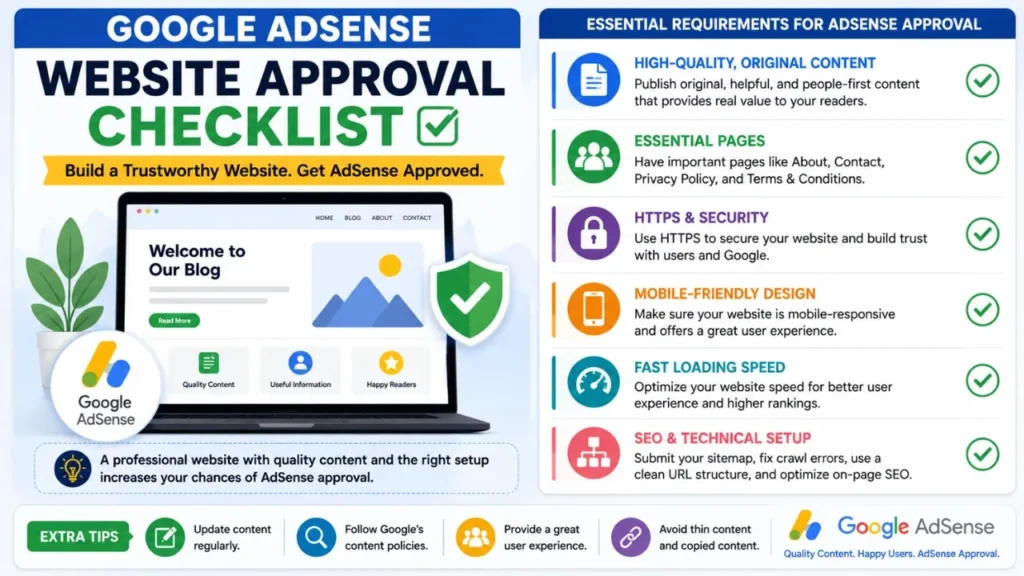
Before submitting your website for Google AdSense approval, take time to review every aspect of your content and website. Many applications are rejected not because AI was used, but because the overall quality of the site doesn’t meet Google’s expectations.
Think of this checklist as a final quality audit. It helps ensure your website provides a positive user experience, demonstrates trustworthiness, and follows Google’s best practices.
Go through each section carefully before clicking the Apply for AdSense button.
Content Quality Checklist
Content is the foundation of every successful AdSense website. Google wants to display ads on pages that provide real value to users.
Use this checklist to evaluate your articles:
- ✔ Every article is original and not copied from another website.
- ✔ AI-generated drafts have been thoroughly edited by a human.
- ✔ Content answers the reader’s question completely.
- ✔ Articles include practical examples or actionable advice.
- ✔ Facts, statistics, and recommendations have been verified.
- ✔ No duplicate or near-duplicate articles exist.
- ✔ Grammar and spelling have been checked.
- ✔ Articles are easy to read and well organized.
- ✔ Images, screenshots, or tables support the content where appropriate.
- ✔ Each article provides unique value instead of repeating common information.
Quick tip: Read your article from the perspective of a first-time visitor. If it genuinely solves a problem, you’re moving in the right direction.
SEO Checklist
Even excellent content should be optimized so search engines can understand and index it effectively.
Review the following SEO elements:
- ✔ Primary keyword appears naturally in the title.
- ✔ SEO-friendly URL is used.
- ✔ Meta title and meta description are optimized.
- ✔ Proper H1, H2, and H3 heading structure is followed.
- ✔ Internal links connect related articles.
- ✔ External links point to authoritative sources when necessary.
- ✔ Images include descriptive alt text.
- ✔ Pages are indexed correctly in Google Search Console.
- ✔ XML sitemap has been submitted.
- ✔ No broken links or crawl errors exist.
Use Google Search Console to monitor indexing status, identify crawl errors, submit your sitemap, and fix technical issues before submitting your website for AdSense approval.
Remember that SEO isn’t about stuffing keywords into every paragraph. Your primary goal should always be helping readers while making the content easy for search engines to understand.
Quick tip: Optimize for search intent rather than keyword density. Answer the user’s question better than competing pages.
EEAT Checklist
Google values content that demonstrates Experience, Expertise, Authoritativeness, and Trustworthiness (EEAT).
Ask yourself:
- ✔ Does the article reflect real experience?
- ✔ Have you added original insights or practical examples?
- ✔ Is the information accurate and up to date?
- ✔ Are important claims supported by reliable sources?
- ✔ Does your website include an author bio?
- ✔ Is there a detailed About Us page?
- ✔ Can visitors easily contact you?
- ✔ Is your content honest and transparent?
- ✔ Have outdated recommendations been removed?
- ✔ Does the article build trust with readers?
Strong EEAT signals improve credibility and encourage visitors to return to your website.
Quick tip: Don’t just explain a topic—show readers how you’ve applied it in real situations whenever possible.
Website Checklist
Google evaluates your entire website, not just individual articles.
Before applying for AdSense, confirm that your website meets these quality standards:
- ✔ Responsive mobile-friendly design.
- ✔ Fast loading speed.
- ✔ HTTPS enabled across the entire website.
- ✔ Easy-to-use navigation menu.
- ✔ Clear content categories.
- ✔ Working search functionality (if available).
- ✔ About Us page.
- ✔ Contact page.
- ✔ Privacy Policy.
- ✔ Disclaimer.
- ✔ Terms and Conditions.
- ✔ No broken pages or unnecessary redirects.
- ✔ Professional website design.
- ✔ Clean URL structure.
- ✔ Optimized images and media files.
Visitors should be able to browse your website comfortably on both desktop and mobile devices.
Quick tip: Test your website yourself. If you struggle to find important information, your visitors probably will too.
AdSense Readiness Checklist
Finally, review the overall readiness of your website before submitting your AdSense application.
Use this final checklist:
- ✔ Website contains sufficient high-quality content.
- ✔ Every article has been manually reviewed.
- ✔ AI-generated content has been edited and fact-checked.
- ✔ No policy-violating content is published.
- ✔ Navigation is simple and user-friendly.
- ✔ Website loads quickly.
- ✔ Mobile experience is excellent.
- ✔ All essential pages are available.
- ✔ Internal linking is implemented.
- ✔ No excessive advertisements or pop-ups are displayed.
- ✔ Google Search Console shows no major issues.
- ✔ Visitors receive genuine value from every important page.
If you can confidently check every item above, your website is in a much stronger position for Google AdSense review.
Final Thoughts
There is no secret formula for getting AdSense approval with AI-assisted content. Success comes from consistently publishing original, accurate, and helpful articles while maintaining a professional, trustworthy website.
Before applying, take time to complete this checklist honestly. Fix any weak areas, improve your content where necessary, and continue focusing on the needs of your readers.
Remember, Google doesn’t approve websites because they use AI—or reject them because they do. It approves websites that provide a high-quality experience for users. If your content demonstrates expertise, originality, and genuine value, you’ll significantly improve your chances of earning Google AdSense approval.
Real-World Examples of Good and Bad AI Content
Understanding the difference between high-quality and low-quality AI content is easier when you look at practical examples. The AI tool itself isn’t the deciding factor—how the content is created, reviewed, and improved is what matters.
Two bloggers can use the same AI writing tool and achieve completely different results. One may build a successful website that earns Google AdSense approval, while the other struggles with poor search performance and a rejected application.
The following examples illustrate why quality always matters more than the technology behind the content.
Example of High-Quality AI-Assisted Content
Imagine a blogger wants to publish an article titled “Can AI Content Get AdSense Approval?”
Instead of asking an AI tool to write the entire article and publishing it immediately, they follow a structured workflow.
First, they research Google’s official documentation, recent announcements, and trusted industry resources. They then use ChatGPT or another AI tool to create an outline and a first draft.
Before publishing, the blogger:
- Rewrites sections that sound generic.
- Adds personal experience from running their own website.
- Includes screenshots from Google Search Console and AdSense.
- Explains common mistakes they encountered.
- Verifies every important fact and statistic.
- Adds comparison tables and practical checklists.
- Links to related articles on their website.
- Proofreads the article for grammar, readability, and clarity.
The final article answers readers’ questions completely, includes original insights, and provides practical guidance that readers can immediately apply.
Why this content performs well:
- Original and well researched.
- Demonstrates real experience.
- Includes accurate and updated information.
- Uses AI only as a writing assistant.
- Offers practical value beyond basic definitions.
- Easy to read and well structured.
- Supports Google’s Helpful Content principles.
- Builds trust with readers.
This is an example of AI being used responsibly to improve productivity without sacrificing quality.
Example of Low-Quality AI-Generated Content
Now consider another blogger writing the same topic.
They ask an AI tool to generate a 2,500-word article and publish it exactly as it was produced.
The article contains:
- Generic introductions.
- Repetitive explanations.
- Outdated Google policies.
- No personal insights.
- No fact-checking.
- No examples or screenshots.
- Awkward transitions.
- Keyword repetition.
- Weak formatting.
- No unique value.
Although the article appears long, it doesn’t genuinely help readers solve their problem.
Visitors quickly leave because they find the information shallow and repetitive.
Over time, the website fills with hundreds of similar AI-generated articles published without human review.
This approach creates several issues:
- Poor user experience.
- Low trust.
- Weak EEAT signals.
- Reduced reader engagement.
- Thin or repetitive content.
- Higher risk of AdSense rejection.
- Poor long-term search performance.
The problem isn’t that AI was used.
The problem is that the publisher failed to improve the AI-generated draft before making it public.
Key Lessons from Both Examples
These two examples highlight an important lesson for every blogger.
AI is neither good nor bad. The quality of the final content depends on how you use it.
The first blogger treats AI as a productivity tool. They remain responsible for researching, editing, verifying facts, and adding original value.
The second blogger treats AI as a complete replacement for human effort, publishing unedited content with little concern for accuracy or user experience.
Google’s quality systems are designed to reward websites that prioritize readers—not shortcuts.
If you want to maximize your chances of Google AdSense approval, remember these key lessons:
- Use AI to brainstorm ideas and create first drafts—not final articles.
- Research every topic thoroughly before writing.
- Verify facts, statistics, and policy information.
- Add personal experience, original insights, and practical examples.
- Edit every article carefully to improve clarity and readability.
- Include helpful visuals, tables, and checklists where appropriate.
- Focus on solving readers’ problems instead of simply increasing article count.
- Keep older content updated as information changes.
- Build trust through transparency, accuracy, and consistency.
Ultimately, Google doesn’t evaluate whether an article was written by AI or by a human. It evaluates whether the article deserves to be shown to users.
When AI is combined with careful research, thoughtful editing, and genuine expertise, it becomes a powerful assistant that helps you create better content faster. However, when it’s used to mass-produce generic articles without human oversight, it often leads to poor user experiences and weaker long-term results.
The best strategy is simple: let AI improve your efficiency, but let your expertise define the final content.
Key Takeaways
If you remember only a few points from this guide, make them these. Google AdSense doesn’t judge your website based on whether you used AI—it evaluates whether your content is helpful, original, trustworthy, and valuable to readers.
- AI content is not prohibited by Google AdSense. Google does not automatically reject websites because AI was used to create or assist with content. What matters is whether the final content meets Google’s quality standards.
- Quality matters more than how content is created. Whether an article is written by a human, AI, or a combination of both, it should provide accurate, comprehensive, and useful information that satisfies user intent.
- Human editing is essential. Never publish AI-generated content without reviewing it. Edit for clarity, fact-check every important claim, remove repetitive wording, and add unique insights that only you can provide.
- Focus on EEAT and Helpful Content principles. Demonstrate real experience, showcase your expertise, build trust with readers, and create people-first content that genuinely solves problems rather than targeting search engines alone.
- Prioritize originality, accuracy, and user value. Publish content that offers fresh perspectives, practical examples, and reliable information. Articles that educate, inform, or solve real problems are far more likely to succeed in both Google Search and AdSense.
- Maintain a trustworthy, technically sound website. High-quality content should be supported by a fast, mobile-friendly, secure website with clear navigation, essential legal pages, and a strong internal linking structure.
Ultimately, the best strategy is to use AI as a productivity tool—not as a replacement for human expertise. When you combine AI with careful research, thoughtful editing, and a genuine commitment to helping your audience, you create the kind of website that Google is more likely to trust, rank, and approve for AdSense.
Conclusion
So, can AI content get AdSense approval? The answer is yes—provided it meets Google’s quality standards.
Throughout this guide, we’ve seen that Google doesn’t judge content based on whether it was written by a human or created with AI assistance. Instead, it evaluates the final result. If your content is original, accurate, helpful, well-researched, and created with the reader in mind, it can perform well in Google Search and qualify for Google AdSense.
AI is a powerful productivity tool that can help you brainstorm ideas, create outlines, speed up drafting, and improve your writing workflow. However, it should never replace human expertise, critical thinking, or editorial review. Publishing AI-generated articles without fact-checking, editing, or adding unique value may reduce your website’s credibility and limit its long-term success.
If you’re serious about earning AdSense approval, focus on creating content that genuinely helps your audience. Research every topic carefully, verify important facts, share practical examples, improve readability, and keep your articles updated as information changes. Combine these practices with a fast, secure, and user-friendly website to build trust with both readers and Google.
Remember, successful blogging isn’t about publishing the most content—it’s about publishing the most useful content. Use AI to work more efficiently, but let your knowledge, experience, and commitment to quality shape the final article. By consistently creating people-first content that provides real value, you’ll not only improve your chances of Google AdSense approval but also build a trusted website that continues to grow for years to come.
Expert Tips for Getting AdSense Approval with AI Content
After analyzing Google’s guidance and the practices of successful AdSense-approved websites, here are some expert recommendations that can significantly improve your chances of approval and long-term success.
1. Use AI for Speed, Not for Final Publishing
Let AI handle brainstorming, outlining, and first drafts, but never publish AI-generated content without human review. Edit every article to improve clarity, accuracy, and originality.
2. Add Something AI Can’t Create
Include personal experiences, case studies, screenshots, original images, testing results, or practical examples. These unique additions strengthen your EEAT signals and make your content stand out.
3. Verify Every Important Fact
Never assume AI-generated information is completely accurate. Double-check policies, statistics, dates, product details, and technical recommendations using official or authoritative sources before publishing.
4. Write for Search Intent, Not Just Keywords
Understand what readers actually want to know. Answer their questions thoroughly instead of focusing only on keyword placement. Content that satisfies user intent is more likely to perform well in both Google Search and AdSense reviews.
5. Build Topical Authority
Rather than publishing articles on unrelated subjects, focus on one niche and create comprehensive content around it. For example, a digital marketing blog should consistently cover SEO, blogging, AI tools, affiliate marketing, and content marketing.
6. Keep Your Website Professional
A clean layout, clear navigation, mobile-friendly design, HTTPS security, and essential pages like About Us, Contact, Privacy Policy, Disclaimer, and Terms & Conditions help build trust with both users and Google.
7. Update Existing Articles Regularly
Google values fresh and accurate information. Review your articles every few months to update screenshots, replace outdated statistics, improve examples, and reflect changes in Google’s policies or industry trends.
8. Prioritize Quality Over Quantity
Publishing ten outstanding articles is often more valuable than publishing one hundred low-quality AI-generated posts. Consistency and quality build authority over time.
9. Monitor Your Website with Google Search Console
Use Google Search Console to identify indexing issues, crawl errors, Core Web Vitals problems, and search performance opportunities. Regular monitoring helps keep your website healthy and ready for AdSense.
10. Think Like a Reader Before You Think Like a Publisher
Before publishing any article, ask yourself:
“If I found this article on Google, would it completely answer my question and be worth bookmarking or sharing?”
If the answer is yes, you’ve created the kind of helpful, people-first content that Google encourages and rewards.
Final Expert Advice
AI should be viewed as a productivity partner, not an automatic content creator. The websites that achieve long-term success with Google AdSense are those that combine AI efficiency with human expertise, careful editing, original insights, and a genuine commitment to helping readers. Build your content around trust, accuracy, and usefulness, and AdSense approval becomes a natural outcome rather than the only goal.
Frequently Asked Questions (FAQs) :
Yes. ChatGPT-generated articles can qualify for Google AdSense approval if they are original, accurate, helpful, and thoroughly reviewed by a human editor. Google evaluates the quality of the final content rather than the tool used to create it.
Google’s primary focus is not detecting whether content was created with AI. Instead, it evaluates whether the content is useful, trustworthy, original, and written for people. Low-quality or spammy content may perform poorly regardless of how it was created.
No. Google AdSense does not prohibit AI-generated content. However, websites must comply with AdSense Program Policies by publishing high-quality, original, and valuable content. AI-generated articles that are misleading, copied, or provide little value may be rejected.
In most cases, Google does not require you to disclose that AI assisted in creating your content. However, if AI played a significant role in research, analysis, or generated materials that readers should know about, being transparent can help build trust. Regardless of disclosure, you are responsible for the accuracy and quality of everything you publish.
Every AI-generated article should be thoroughly reviewed before publication. Edit for accuracy, readability, originality, grammar, tone, and completeness. Add your own insights, practical examples, and fact-check important claims to ensure the article provides genuine value.
Yes. AI-assisted content can rank well in Google Search if it satisfies search intent, demonstrates EEAT, provides accurate information, and offers unique value to readers. High-quality AI-assisted content often performs better than poorly written human content.
Google does not specify a minimum number of articles for AdSense approval. Instead of focusing on quantity, aim to publish a collection of high-quality, original, and comprehensive articles. Many successful blogs apply after building a well-structured website with 20–30 valuable posts, though approval depends on overall site quality rather than a fixed article count.
Content is more likely to be rejected if it is thin, duplicated, automatically generated without human review, factually inaccurate, keyword stuffed, misleading, or created solely to attract search engine traffic instead of helping users.
Yes. Many bloggers use multiple AI tools during the writing process. For example, you might use one tool for brainstorming, another for drafting, and another for proofreading. As long as the final article is carefully edited, fact-checked, and provides original value, using multiple AI tools is perfectly acceptable.
The best approach is to treat AI as a writing assistant rather than a replacement for human expertise. Use AI to generate ideas, create outlines, draft sections, or improve grammar, then enhance the content with original research, personal insights, practical examples, fact-checking, and careful editing. This hybrid workflow creates people-first content that aligns with Google’s quality expectations and improves your chances of AdSense approval.

Sona Bera Kar
Founder of Toppez Digital.
I’m Sona Bera Kar, the founder of Toppez Digital and a digital marketing professional with over five years of experience in SEO, blogging, WordPress, AI tools, and affiliate marketing. Through Tech Terapias, I share practical, research-backed, and experience-based insights, guides, and advice on digital marketing and technology. My goal is to help bloggers, content creators, entrepreneurs, and business owners build better websites, improve their search visibility, and grow their online presence and businesses with confidence.
Related Articles
- What Is Google AdSense? A Beginner’s Guide to Earning from Your Website
- How to Write Helpful Content That Ranks on Google
- Best AI Writing Tools for Blogging in 2026
- AI Content vs Human-Written Content: Which Is Better for SEO?