What Is Digital Marketing? 17 Benefits, Types & Tools
In today’s interconnected world, businesses need more than just traditional advertising to reach potential customers. Before making a purchase decision, people typically search on Google, browse social media, watch videos, read blogs, and compare products online. This is precisely where digital marketing plays a crucial role.
Digital marketing is a process used to promote products, services, or brands through various digital channels—such as search engines, websites, social media, email, online advertisements, and other internet-based platforms. It helps businesses reach specific customer segments, measure the effectiveness of campaigns, and build stronger relationships with customers.
Whether you run a small local business, an online store, or a growing company, understanding digital marketing can help you attract the right customers and achieve sustainable online growth.
In this guide, you will learn what digital marketing is, how it works, its main types, its 17 key benefits, and the essential tools involved; you will also gain insight into why learning digital marketing is so important and potentially lucrative in 2026.
What is Digital Marketing?
Digital marketing is a digital method of marketing to promote and sell a service or product. It is one of the best methods of marketing nowadays. It is also known as social media marketing. This process is done through digital devices, hence it is digital marketing. Different digital devices are mobile, PC, laptop, tab, etc. This is also known as online marketing. This marketing requires a digital device and a good internet connection. It can be done from home and anywhere.
Digital marketing is also known as internet marketing. In this way, brands, products, and services are promoted to target customers through the Internet using digital devices.
If you are completely new to online marketing, start with our Digital Marketing for Beginners guide to understand the basic concepts before moving on to more advanced strategies.
What is Digital Marketing?
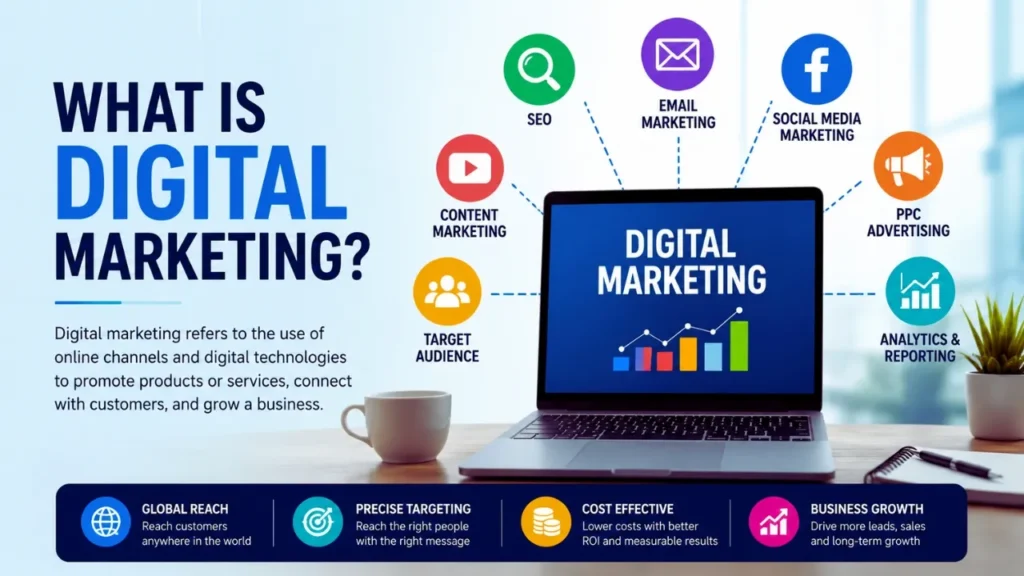
Digital marketing is the process of promoting products, services, or brands using digital channels such as search engines, websites, social media, email, online advertisements, and other internet-based platforms. Unlike traditional marketing, it enables businesses to reach specific customer segments, engage with potential customers, and measure campaign results using digital tools and data.
For instance, when a clothing business promotes its products via Google Search, Facebook, Instagram, YouTube, or email campaigns, these activities fall under the umbrella of digital marketing.
Digital marketing is not limited to social media alone; it encompasses various channels and strategies, such as SEO (Search Engine Optimization), content marketing, social media marketing, email marketing, PPC (Pay-Per-Click) advertising, affiliate marketing, and video marketing. Businesses can select the channels that best align with their customers, objectives, and budget.
If you are interested in earning online through performance-based promotion, our guide on how to start affiliate marketing without a website explains the process in detail.
How does digital marketing work?
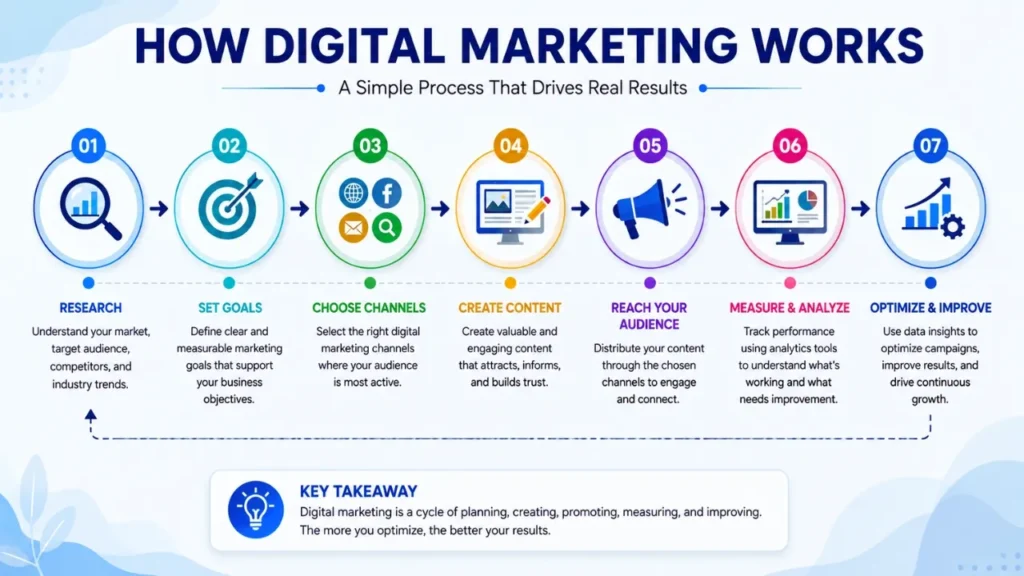
Digital marketing typically begins by identifying the target audience and understanding their needs, what they are searching for, and what they expect from a business. The business then selects appropriate digital channels and creates the necessary content, offers, or advertisements to reach those customers.
A typical digital marketing process might look like this:
Research → Goal Setting → Channel Selection → Content Creation → Reaching Customers → Measuring Results → Optimization (Improvement)
For example, a small business selling handmade products might use SEO to gain visibility on Google Search, Instagram to showcase products, email marketing to maintain customer engagement, and paid advertising to reach specific customer segments. One of the major advantages of digital marketing is that businesses can track and monitor key metrics such as website visits, engagement, leads (potential customers), conversions (sales or desired actions), and advertising effectiveness. These insights can subsequently be used to refine and improve future campaigns.
Digital Marketing vs. Traditional Marketing
The primary goal of both digital and traditional marketing is to attract customers and promote products or services; however, the mediums and methods employed differ.
| Digital Marketing | Traditional Marketing |
|---|---|
| Uses websites, search engines, social media, email, and online ads | Uses television, newspapers, magazines, radio, billboards, and print media |
| Can target specific audiences | Usually reaches a broader audience |
| Campaign performance can be tracked using digital analytics | Measurement can be more difficult for some channels |
| Campaigns can often be changed or optimized quickly | Changes may take more time and cost |
| Can reach local or global audiences | Often depends more heavily on location and media coverage |
| Businesses can interact directly with customers online | Customer interaction is generally less immediate |
Digital marketing and traditional marketing can work in tandem. A business can use traditional advertising to build awareness while simultaneously leveraging digital channels to provide detailed information, generate leads, and maintain customer relationships.
Why is Digital Marketing Important?
Digital marketing has become a crucial component of modern business because customers increasingly use digital channels to search for information, compare products, interact with brands, and make purchasing decisions. A strong online presence helps a business remain visible and connect with potential customers where they are already spending their time.
Why Businesses Need an Online Presence
An online presence enables a business to reach customers with its products, services, and information beyond physical or geographical boundaries. Websites, social media profiles, business listings, and other digital platforms help people learn about a business and access detailed information regarding its offerings.
For instance, a local restaurant can use a website and social media to showcase its menu, share updates, answer customer queries, and attract new patrons. Similarly, an online store can reach customers across various regions without relying on a physical storefront.
A strong online presence can help a business in the following ways:
- Reaching potential customers beyond the local area
- Making vital business information available to customers 24/7
- Building brand awareness and credibility
- Communicating directly with customers
- Showcasing products and services
- Increasing inquiries, leads, and sales
- Competing more effectively in the digital marketplace
If you are ready to build your online presence, you can also learn how to create a website for free and then apply the digital marketing strategies discussed in this guide.
How Digital Marketing Aids Business Growth
Digital marketing offers businesses various ways to attract, engage, and retain customers. Instead of relying on a single advertising medium, businesses can combine strategies—such as SEO, content marketing, social media, email marketing, and paid advertising—tailored to their specific goals.
For example, a business can use SEO to attract people searching for relevant information on Google; Social media content can be used to boost engagement; email marketing helps maintain customer relationships, while paid advertising allows businesses to reach specific audiences or customer segments.
Another significant advantage is the ability to measure results. Digital marketing tools provide data on website visitors, engagement, leads, conversions, and campaign effectiveness. Businesses can use this information to understand which strategies are working, how to improve them, and how to make better marketing decisions.
Ultimately, digital marketing fosters business growth by reaching the right customers, building strong customer relationships, enhancing brand visibility, and translating marketing activities into measurable results.
Why Learn Digital Marketing in 2026?
Digital marketing is becoming an essential skill for those looking to build a career, work independently, or expand an online business. As businesses increasingly utilize websites, social media, search engines, online advertisements, and other digital channels to reach customers, professionals with practical digital marketing skills are finding opportunities across various industries.
This field also offers flexibility in how you work. You can acquire digital marketing skills through online learning and practical projects, subsequently applying them to full-time employment, freelancing, remote work, or your own online business.
Growing Job Demand
Businesses of all sizes need professionals who can help attract customers and maintain an online presence. This creates job opportunities in areas such as SEO, content marketing, social media management, paid advertising, email marketing, analytics, and digital strategy.
Instead of limiting themselves to a single platform, beginners can broaden their skill sets and gradually specialize in a specific area that aligns with their interests and career goals.
Freelancing and Remote Work Opportunities
Digital marketing skills are highly valuable for freelancers and remote professionals. Since many marketing tasks can be performed online, professionals can work with clients without needing to be physically present in the same location.
For instance, a freelancer can offer services such as:
- SEO and keyword research
- Content creation
- Social media management
- Email marketing
- PPC campaign management
- Website and conversion optimization
- Marketing analytics
With experience and a strong portfolio, freelancers gain the opportunity to work with clients across various locations and industries.
Online Business and Career Growth
Digital marketing is not essential solely for those seeking jobs in the marketing sector. Entrepreneurs, bloggers, content creators, affiliate marketers, and small business owners can also leverage these skills to enhance their online presence.
A solid understanding of digital marketing enables you to make informed decisions regarding your target audience, content creation, choice of platforms, and performance measurement.
For those just starting out, the best approach is to first master the fundamentals, practice through real-world projects, and gradually acquire specialized skills. Success does not lie in learning every marketing tool or strategy at once; rather, it stems from understanding the basics and applying them consistently.
If you are considering digital marketing as a career, our guide Is Digital Marketing a Good Career? can help you understand the career opportunities and skills involved.
What are the main types of digital marketing?
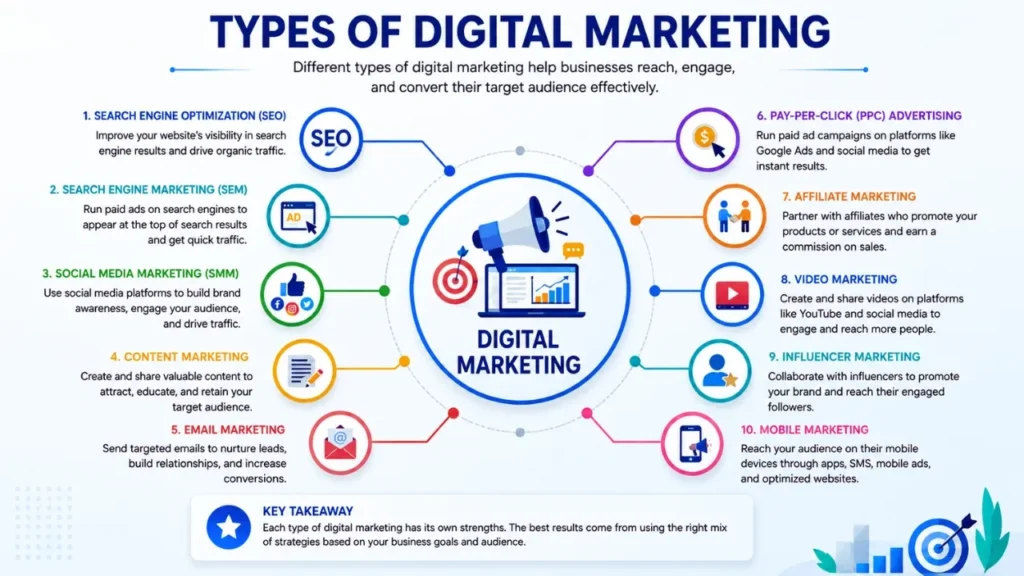
Digital marketing encompasses various channels and strategies. Each type serves a distinct purpose—ranging from ensuring a website appears in search results to building customer relationships through social media and email.
A business does not necessarily need to utilize every form of digital marketing. The right mix depends on factors such as the target audience, business goals, industry, budget, and available resources.
Search Engine Optimization (SEO)
Search Engine Optimization (SEO) is the process of enhancing a website and its content to improve its visibility in organic search engine results.
SEO activities may include keyword research, creating helpful content, on-page optimization, technical SEO, internal linking, and acquiring relevant backlinks. Unlike paid advertising, organic SEO does not require payment for each click generated by traffic.
For instance, a website selling laptops might create useful content based on search queries like “best laptops for students” to attract individuals who are already researching laptops.
Businesses can also use SEO to attract people who are actively searching for information, and our SEO for Beginners guide explains the fundamentals of search optimization.
Search Engine Marketing (SEM)
Search Engine Marketing (SEM) involves promoting a business and reaching individuals who are actively searching for relevant products, services, or information.
Search marketing can encompass paid search advertising as well as broader marketing initiatives focused on search engines. Businesses can utilize search campaigns to reach potential customers based on relevant keywords, location, audience demographics, and other targeting criteria.
Social Media Marketing (SMM)
Social Media Marketing leverages social platforms to build awareness, engage audiences, distribute content, and promote products or services. Businesses can utilize platforms such as Facebook, Instagram, LinkedIn, YouTube, and other social networks, depending on where their target audience is active.
Social media marketing encompasses elements such as:
- Organic posts and content
- Short-form videos and Reels
- Community engagement
- Collaborations with influencers
- Paid social advertising
- Customer support and communication
- Content marketing – Content marketing focuses on creating and distributing valuable and relevant content to attract and engage a specific audience.
Content may include:
- Blog posts
- Guides and tutorials
- Videos
- Infographics
- Case studies
- E-books
- Social media posts
For example, a software company might publish tutorials that help potential customers solve common problems. This can build trust while simultaneously introducing the audience to the company’s products or services.
Content creators can save time by exploring our guide to the best free AI tools for content creators and using suitable tools as part of their content workflow.
Email Marketing
Email marketing refers to communicating with customers or subscribers via email. Businesses can use email to share essential information, promote products, build relationships with potential customers (leads), announce new products, and maintain good relationships with existing customers.
Common email campaigns include newsletters, welcome emails, promotional campaigns, product updates, and follow-up messages.
Since email allows businesses to communicate directly with customers or subscribers, it can be an effective medium for customer retention and relationship building.
Affiliate Marketing
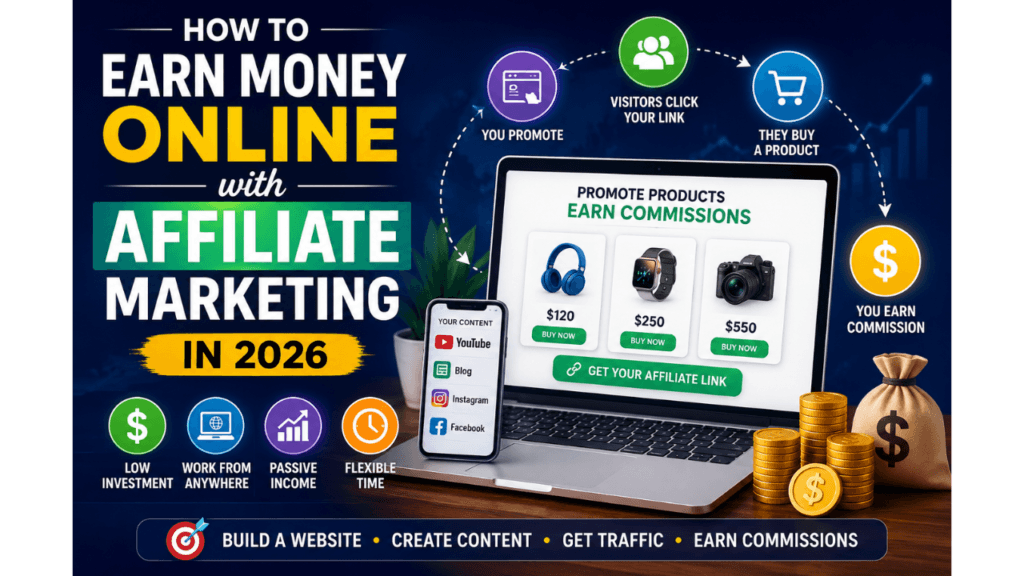
Affiliate marketing is a performance-based marketing method in which affiliates promote a company’s products or services and earn a commission when a specific action (such as a product purchase) is completed through their referral. For instance, a blogger might publish a detailed product review and include an affiliate link within it. If a reader purchases the product through that link and the program’s terms are met, the blogger can earn an affiliate commission.
When driven by relevant products, transparent recommendations, and useful content, affiliate marketing can be profitable for both businesses and content creators.
Influencer Marketing
Influencer marketing involves collaborating with individuals who possess a dedicated following or audience and exert influence within a specific field or community.
A brand might partner with a technology content creator to showcase a new gadget or collaborate with a fitness content creator to introduce a relevant product.
The effectiveness of influencer marketing does not rely solely on having a massive number of followers; rather, it depends more on relevance, credibility, authenticity, and active engagement with the audience.
Video Marketing
Video marketing involves using video content to inform, entertain, demonstrate product functionality, tell stories, or convey a brand’s message.
Businesses can publish videos on their websites, YouTube, social media platforms, and other digital channels.
Examples include:
- Product demonstrations
- Tutorials
- Customer testimonials
- Educational videos
- Behind-the-scenes content
- Short-form videos
- Brand storytelling
Videos make it easier to explain complex information and provide businesses with an additional opportunity to connect with their audience.
Pay-Per-Click (PPC) Advertising
Pay-Per-Click (PPC) is a type of paid digital advertising model where the advertiser typically pays a fee only when someone clicks on the ad.
PPC campaigns can appear on search engines, social media platforms, websites, and other advertising networks. Advertisers often have control over factors such as budget, target audience, location, keywords, and campaign objectives.
For example, an online store might run a paid search campaign targeting people looking for specific products and direct those users to the relevant product pages.
Businesses can use Google Adsto create paid advertising campaigns and reach potential customers through Google’s advertising network.
Mobile and SMS Marketing
Mobile marketing focuses on reaching customers primarily through mobile devices. This can include mobile-friendly websites, apps, push notifications, mobile ads, and other mobile-centric experiences.
SMS marketing involves using text messages to communicate with customers. This method is typically used for offers, reminders, updates, or notifications—provided that the customer has given their explicit consent. Since many people use smartphones throughout the day, providing a seamless and user-friendly mobile experience is a crucial aspect of modern digital marketing.
Referral Marketing
Referral marketing encourages existing customers or other individuals to recommend or promote a business, product, or service to others.
For instance, a company might reward an existing customer for referring a new one. Referral programs help acquire new customers through personal recommendations while maintaining the engagement of existing customers.
Referral marketing works particularly well when customers have had a positive experience with a brand and are willing to recommend it to people they know.
What are the benefits of digital marketing?
Digital marketing offers numerous advantages for businesses of all sizes. It helps companies reach new customers, communicate with them, manage marketing activities, and measure campaign results. However, the outcome depends on selecting the right channels and using them strategically.
1. Global Reach
Digital marketing allows businesses to reach potential customers beyond their local area. A website, social media profile, or online campaign can make a business visible to people across different cities, regions, and countries.
For example, an online store can promote its products to customers in various markets without needing to open physical shops in every location.
2. Local Targeting
Digital marketing is also highly effective for businesses that serve specific geographic areas. Local businesses can tailor their marketing activities based on specific cities, neighborhoods, or service areas.
For instance, a local restaurant can create content and advertisements specifically targeting people who are searching for restaurants in their area.
3. Precise Audience Targeting
Many digital platforms offer targeting features that allow businesses to reach customers based on factors such as location, interests, search behavior, demographics, and past interactions.
By targeting accurately, businesses can focus their marketing efforts on people who are most likely to be interested in their products or services.
4. Lower Marketing Costs
Digital marketing can be much more accessible for small businesses, as it is possible to launch campaigns on many digital platforms with a relatively small budget.
Businesses can decide for themselves how much they want to spend on paid campaigns (promotions run in exchange for payment). Additionally, businesses can attract customers through organic strategies—such as SEO, content marketing, and social media content—without incurring costs for every single visit.
5. Multiple Marketing Channels
Businesses can utilize various digital marketing channels rather than relying on just one method.
These include:
- Search engines
- Websites and blogs
- Social media
- Video platforms
- Online advertising
- Affiliate marketing
- Mobile marketing
By effectively combining these channels, a business can reach customers at various stages of their buying journey.
6. Better Customer Engagement
Digital platforms make it easier for businesses to communicate directly with customers.
Channels such as comments, messages, emails, reviews, and social media interactions create opportunities to answer customer queries, gather feedback, and build stronger relationships with customers.
7. Improved Brand Awareness
Consistent digital marketing can enhance a brand’s visibility and recognition. Publishing valuable content, maintaining active social media profiles, appearing in search results, and creating quality customer experiences allow more people to become familiar with a business.
Repeated visibility over time helps build strong brand recognition.
8. Customer Loyalty
Digital marketing helps businesses maintain contact with existing customers even after a purchase has been made.
Through email newsletters, relevant and informative content, personalized communication, loyalty programs, and customer support, businesses can encourage customers to return and maintain an ongoing relationship with the brand.
9. Measurable Results
One of the key advantages of digital marketing is the ability to measure various aspects of a campaign.
Depending on the channels used, businesses can track various metrics or indicators, such as:
- Website traffic
- Clicks
- Engagement
- Leads (potential customers)
- Conversions
- Sales
- Email performance
- Ad results
This data helps marketers understand how their campaigns are performing.
10. Analytics and Optimization
Digital marketing data can be used to improve future campaigns. Marketers can analyze which content, keywords, ads, or channels are yielding the best results and adjust or refine their strategies accordingly.
For example, if one landing page generates more leads than another, a business can analyze why it is more effective and apply similar improvements elsewhere.
11. Ease of Campaign Tracking
Digital campaigns can often be monitored while they are running. Marketers can assess performance and identify areas that need improvement.
This makes it easy to make necessary adjustments to targeting, content, budgets, or campaign settings without having to wait until the entire campaign has concluded.
12. Opportunities for Remarketing
Through remarketing, businesses can re-engage with individuals who have previously interacted with their website, content, or marketing campaigns (while adhering to relevant platform and privacy regulations).
For instance, a person might visit an online store without making a purchase; later, they might see a relevant advertisement for that store or receive an appropriate follow-up message.
13. Strong Potential for Conversion or Sales
Digital marketing can provide the right guidance to potential customers at various stages of the purchasing process.
An individual might first discover a brand via a search engine or social media, then visit the website to learn more, compare products, and ultimately make a purchase.
By incorporating relevant content and clear ‘calls-to-action’ (prompting the customer to take a specific step) at each stage, businesses can boost lead generation and conversion opportunities.
14. Flexible Marketing Strategies
Compared to traditional campaigns, digital campaigns can often be modified or refined much more easily. Businesses can adjust content, targeting, budgets, messaging, or promotional channels based on performance metrics and customer feedback.
This flexibility is particularly beneficial for small businesses that need to maximize the use of limited resources.
15. Personalized Marketing
Digital marketing enables the delivery of more personalized or tailored experiences for customers. Businesses can leverage relevant customer data and past interactions to deliver content, offers, or messages suited to specific customer segments.
For example, in compliance with privacy regulations, an online store might recommend products based on a customer’s previous browsing or purchasing habits.
16. Enhancing Brand Credibility
A professional-quality website, relevant content, positive reviews, active communication, and consistent branding all help build a business’s credibility.
When customers consistently receive useful and reliable information from a brand, they become more confident in choosing that brand’s products or services.
17. Supporting Long-Term Business Growth
Digital marketing can contribute to a business’s long-term growth by combining various activities such as SEO, content creation, customer engagement, analytics, and brand building.
Unlike a standard promotional campaign, a well-planned digital marketing strategy can sustain the processes of increasing brand visibility, fostering relationships, generating leads, and creating new opportunities over the long term.
Overall, the importance of digital marketing extends beyond merely reaching a large audience. Its core objective is to reach the right people, provide a meaningful experience, evaluate the effectiveness of various methods, and continuously improve the way the business connects with its customers.
Best Digital Marketing Tools:
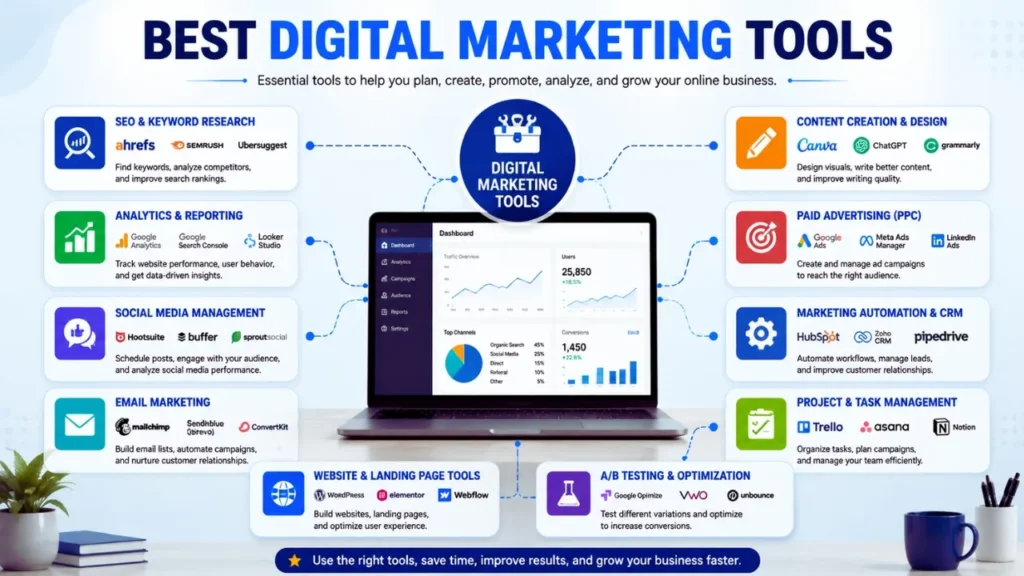
Using the right digital marketing tools makes tasks such as keyword research, content creation, campaign management, customer communication, and performance measurement much easier. There is no need to use every tool available on the market. Beginners should start with a few tools aligned with their specific goals and add more as their needs grow.
SEO and Keyword Research Tools
SEO tools help marketers understand search intent, conduct keyword research, analyze websites, monitor rankings, and identify opportunities to boost organic visibility.
Some essential tools include:
Google Search Console – Helps website owners monitor search performance, indexing, search queries, and technical issues.
Google Keyword Planner – Provides keyword ideas and search-related data for planning search campaigns.
Ahrefs – Offers a suite of tools for keyword research, backlink analysis, competitor analysis, and SEO auditing.
Semrush – Provides features for SEO, keyword research, competitor analysis, PPC, content marketing, and other digital marketing activities.
Rank Math – An SEO plugin that helps WordPress users optimize content and manage critical on-page SEO settings.
The original article also mentions Yoast SEO, Open Site Explorer, and an on-page optimization tool as digital marketing tools.
Social Media and Content Creation Tools
Content creation and social media tools assist marketers in creating visual content, writing and editing copy, scheduling posts, and managing their social media presence.
Some essential tools include:
Canva – Useful for creating social media graphics, presentations, thumbnails, and other visual content. Buffer – Helps schedule and manage social media posts.
Hootsuite – Offers features for social media management and post scheduling.
Grammarly – Helps improve grammar, spelling, writing clarity, and readability.
ChatGPT – When used with appropriate human oversight, it can assist with brainstorming ideas, content planning, research support, and drafting content.
YouTube – A major platform for publishing videos and engaging with a video-oriented audience.
These tools have been curated based on the various resources mentioned in the main article, including Canva, Buffer, Hootsuite, Grammarly, YouTube, and ChatGPT.
Analytics and Performance Measurement Tools

Analytics tools help marketers understand how visitors interact with a website and how campaigns are performing.
Some key tools include:
Google Analytics – Helps analyze website traffic, user behavior, acquisition (how users arrive), and conversions.
Google Search Console – Provides data on organic search performance and search visibility. Advertising platform analytics – Platforms like Google Ads and various social networks provide data on campaign effectiveness.
SEO analytics tools – Tools like Ahrefs and Semrush can provide insights into keywords, competitors, backlinks, and search visibility.
Analytics should not be used merely to collect numbers or data. The primary goal is to identify what is working, understand where improvements are needed, and make better marketing decisions.
Email Marketing and Automation Tools
Email marketing tools help businesses create campaigns, manage subscribers, automate communication processes, and measure email effectiveness. Some examples include:
Mailchimp – An email marketing and automation platform.
Brevo – Offers email marketing, automation, and customer communication features.
ActiveCampaign – Combines email marketing with automation and customer relationship management (CRM) capabilities.
Klaviyo – Focuses heavily on marketing automation and customer communication; particularly suitable for businesses requiring advanced customer segmentation.
HubSpot – Provides marketing, CRM, and customer management tools.
The list of tools in the original article already includes HubSpot, Mailchimp, Brevo, ActiveCampaign, and Klaviyo.
Advice for beginners: Do not try to master too many tools at once. Start by using a combination of Google Search Console, Google Analytics, an SEO tool, Canva, and a social media management tool; then, expand your toolkit as your digital marketing skills grow.
Best Digital Marketing Tools and Their Functions
| Tools | Functions |
| Unsplash | Beautiful, free images and photos |
| Canva | free-to-use online graphic design tool |
| Adobe Photoshop | graphics editor |
| PowerPoint | Make slideshow with music, graphics and charts |
| Buffer | schedule posts for sharing across multiple social networks |
| Hootsuite | social media management platform |
| Grammarly | reviews spelling, grammar, punctuation, clarity, engagement, etc. |
| Beautiful.ai | AI-powered presentation software |
| Zoom | videotelephony software |
| Live storm | online web conferencing software for webinars and virtual meetings |
| YouTube | online video sharing and social media platform |
| Wistia | video marketing platform |
| Wix | free website builder |
| Google Analytics | web analytics service |
| Shopify | No.1 eCommerce Platform for All Businesses |
| Square | financial services platform |
| Google Ads | online advertising platform |
| Unbounce | produces landing pages for websites |
| Ahrefs | professional-grade SEO keyword research tool |
| Trello | project management tool |
| Slack | team communication platform |
| Yoast SEO | search engine optimization tool |
| Rank math | search engine optimization tool |
| Google Translator | Text Translator |
| ChatGPT | free-to-use AI system |
| Google Bard | best AI chatbots |
| Manychat | managing interactions and chatbots |
| Survey Anyplace | web-based survey builder, to collect data, gauge client satisfaction and conduct research |
| Google Forms | create online forms and surveys with multiple question types. Analyze results in real-time and from any device |
| Typeform | specializes in online form building and online surveys |
| Jasper | Generate High Quality Copy For Emails, Ads, Websites |
| Open Site Explorer | check site’s backlinks |
| HubSpot Email Marketing and HubSpot CRM | Best Email marketing and etc. |
| Writesonic | artificial intelligence tools for content creation |
| WordPress | WordPress is a content management system (CMS) that allows you to host and build websites |
| Benchmark Email | international, internet-based service provider of email marketing |
| Mailchimp | marketing automation and email marketing platform |
| Crowdfire | powerful Social Media Management tool |
| Hemingway | makes your writing bold and clear |
| Onpage Optimization Tool | helpful for analyzing your internal links, your meta information and your page content in order to develop better on page SEO |
| Website Grader | free online tool that grades your site against key metrics like performance, mobile readiness, SEO, and security |
| ACTIVE Campaign | provides cloud-based marketing and sales automation software |
| Medium | a publishing platform where people can read important, insightful stories on the topics |
| Zoho CRM Plus | a unified CX platform that empowers your sales, marketing, and customer service teams to work as one, on a single interface |
| Brevo | a fantastic marketing automation tool |
| Klaviyo | help businesses acquire, retain and grow their customers for business |
| Semrush | Help in SEO, PPC, SMM, Keyword Research, Competitive Research, PR, Content Marketing, Marketing Insights, and Campaign Management |
| Google Keyword planner | Get new keyword suggestion |
| Background Remover | Remove image backgrounds automatically in 5 seconds |
| Image Compressor | Free online image compressor |
AI-powered tools can save time and improve productivity. Check out the best free AI tools for content creators.
Digital Marketing Strategies for Beginners
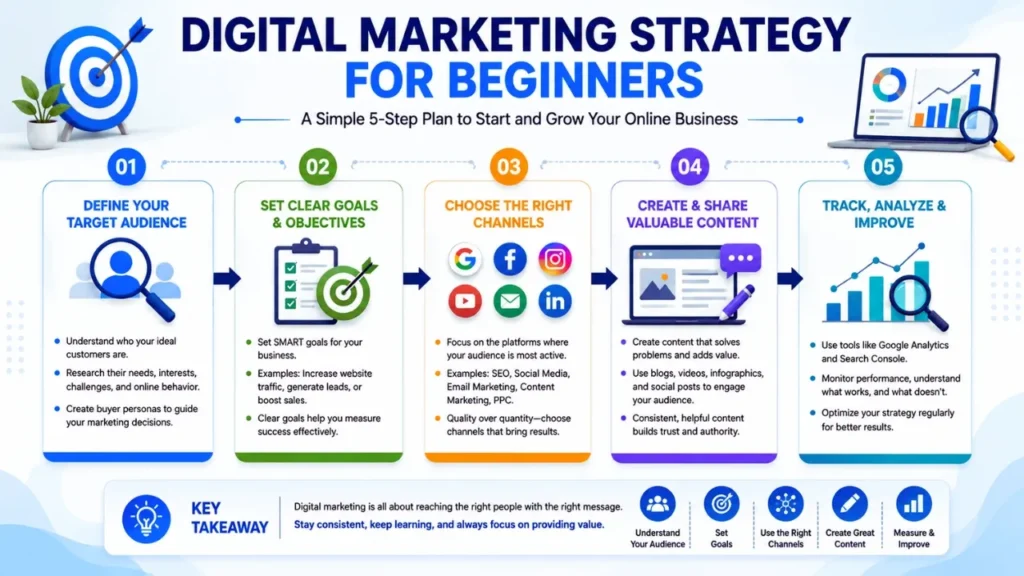
Getting started with digital marketing can often feel daunting or confusing due to the sheer number of platforms, tools, and strategies available. Beginners do not need to use everything at once. A better approach involves understanding your target audience, setting realistic goals, selecting the right channels, creating relevant and effective content, and regularly evaluating results.
Identify Your Target Audience
Before launching a marketing campaign, determine whom you want to reach. You can define your target audience based on factors such as location, age group, interests, needs, purchasing habits, or the specific problems they are trying to solve.
For instance, a business selling affordable laptops to college students should tailor its marketing activities around student needs rather than trying to reach everyone.
Having a clear understanding of your customers makes it easier to select appropriate topics, language, platforms, offers, and marketing messages.
Set Specific Marketing Goals
A digital marketing strategy requires a clear objective. Instead of a vague goal like simply “getting more customers,” specify exactly what you aim to achieve through your marketing activities.
Some common goals include:
- Increasing website traffic
- Generating leads (potential customers)
- Boosting sales
- Increasing brand awareness
- Building an email list
- Increasing social media engagement
- Improving customer retention rates
Whenever possible, make your goals specific and measurable. This makes it easier to determine whether your strategy is actually working.
Choose the Right Digital Channels
You do not need to be active on every digital platform. Select your channels based on where your target audience spends their time and what you aim to achieve.
For example:
- SEO can help attract people searching for information on Google.
- Social media can play a role in raising awareness and fostering engagement.
- Email marketing can be effective for converting leads into customers and maintaining customer relationships.
- Content marketing helps establish expertise and answer customer questions.
- PPC advertising can be used to quickly reach a targeted audience.
Rather than trying to maintain a presence everywhere, it is often more advantageous and manageable to start with two or three relevant channels.
Create useful and effective content
Relevant and effective content forms the foundation of many digital marketing strategies. Instead of creating content solely to promote products, focus on answering customer questions, solving problems, teaching the audience something new, or helping them make informed decisions. Depending on the nature of your business, useful content might include:
- Blog posts and guides
- Tutorials
- Videos
- Product demonstrations
- Frequently Asked Questions (FAQs)
- Case studies
- Social media posts
- Email newsletters
For instance, a website selling gardening products could publish a guide explaining how beginners can choose the right plants. This provides valuable information while naturally introducing relevant products.
Track and improve your results
Publishing content or launching a campaign is just the beginning. You should regularly review performance data to understand what is working and what needs improvement.
Depending on your strategy, you might track:
- Website traffic
- Search impressions and clicks
- Engagement
- Leads
- Conversion rates
- Sales
- Email performance
- Ad costs and results
If a particular piece of content generates good traffic and engagement, you can create related content. If a campaign underperforms, review its audience, message, offer, landing page, or targeting, and make appropriate adjustments.
The most effective strategy for beginners is to start small, measure regularly, learn from the data, and improve over time.
Businesses looking for a structured approach can learn more about proven digital marketing strategies and how different channels can work together.
Read Also
FAQs:
What is Digital Marketing?
The digital marketing is a marketing process for all business and services by using digital devices.
Is Digital Marketing best for jobs?
Nowadays, digital marketing is the best job for young generation to make a good finance.
What is the best qualification for digital marketers?
To acquire a good professional carrier on digital marketing you need complete a degree or diploma course on digital marketing.
Is Digital marketing important for small and local businesses?
Yes, digital marketing is very important for small and local business.
What is a digital marketing funnel?
The digital marketing funnel is the customer journey that leads them to become a customer.
What is a digital marketing strategy?
A digital marketing strategy is a plan by which you can take your business online, increase customer engagement, generate more sales, grow your business, etc.
What is a digital marketing agency?
A digital marketing agency is a company and organization that does all the work to give your business and services a digital presence and best profit.
Conclusion
Digital marketing has become an essential component for modern businesses to connect with customers, build their brands, and expand their online presence. From SEO and content marketing to social media, email marketing, PPC, and affiliate marketing, businesses can select various digital channels based on their target audience, objectives, and budget.
The greatest advantage of digital marketing is that it enables businesses to reach the right audience, build strong customer relationships, measure performance, and refine strategies based on actual data. However, success is not guaranteed simply by using multiple platforms. Effective digital marketing requires a clear understanding of the target audience, high-quality content, realistic goal setting, consistent execution, and continuous optimization of performance.
For beginners, the best approach is to start with the fundamentals rather than trying to master every tool or platform at once. Choose a specific area, practice your skills through real-world projects, evaluate the results, and gradually expand your knowledge.
Whether you aim to build a career, start freelancing, promote a small business, or grow an online brand, learning digital marketing equips you with practical skills applicable across various industries.
In conclusion, successful digital marketing is not about being present everywhere. Rather, the key lies in delivering the right message to the right people through the right channels and continuously improving your efforts based on the experience you gain.
🔔 Stay Updated with Tech Terapias
Join our free newsletter and never miss AI tools, blogging tips & smart tech updates!
About The Author

Founder of Toppez Digital
I’m Sona Bera Kar, the founder of Toppez Digital and a digital marketing professional with over five years of experience in SEO, blogging, WordPress, AI tools, and affiliate marketing. Through Tech Terapias, I share practical, research-backed, and experience-based insights, guides, and advice on digital marketing and technology. My goal is to help bloggers, content creators, entrepreneurs, and business owners build better websites, improve their search visibility, and grow their online presence and businesses with confidence.