
How to Find Low Competition Keywords: A Complete Beginner's Guide (2026)

Introduction :
Have you ever spent hours writing a blog post only to watch it disappear beyond page two of Google search results? It’s a frustrating experience that many bloggers, affiliate marketers, and small business owners face. In most cases, the problem isn’t your writing—it’s the keywords you’re targeting. Competing against high-authority websites for popular search terms can make it nearly impossible for a new or growing website to gain visibility.
Table of Contents
ToggleThe good news is that you don’t need to chase the most popular keywords to get consistent organic traffic. Learning how to find low competition keywords can help you uncover valuable search terms that are easier to rank for while still attracting the right audience. These keywords often have less competition, making them ideal for new blogs, niche websites, and businesses looking to grow their online presence.
Keyword research is one of the most important skills in Digital Marketing for Beginners, helping businesses attract targeted organic traffic.
In this guide, you’ll discover a practical, step-by-step process for finding low competition keywords using both free and premium SEO tools. You’ll also learn how to evaluate keyword difficulty, understand search intent, analyze competitors, and identify opportunities that can bring targeted traffic to your website. By the end of this article, you’ll have a proven keyword research strategy that helps you rank faster, create smarter content, and build long-term organic growth.
For SEO best practices, Google recommends creating helpful, people-first content. Learn more in the Google Search Central documentation.
What Are Low Competition Keywords?
Low competition keywords are search terms with relatively low ranking difficulty and good search potential. Find them by analyzing keyword difficulty, search intent, long-tail phrases, and competitor rankings using tools like Google Keyword Planner, Google Search Console, Ahrefs, Semrush, or free keyword research tools.
What Are Low Competition Keywords?
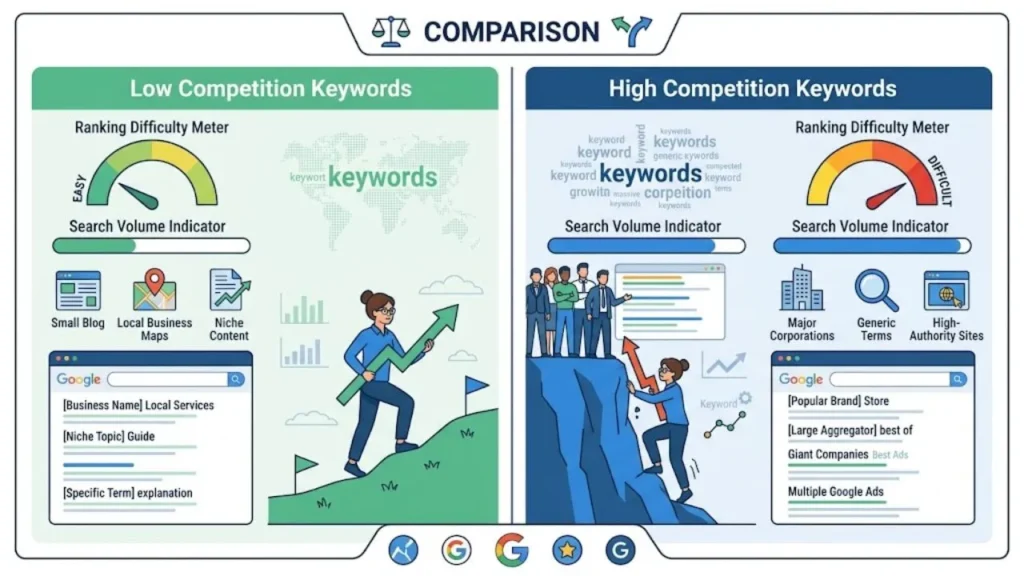
Low competition keywords are search terms that have relatively fewer websites competing for the top positions in search engine results. They typically have a lower keyword difficulty (KD) score than highly competitive keywords, making them easier to rank for—especially if your website is new or has limited authority.
Many beginners believe that targeting the highest search volume keywords will generate the most traffic. In reality, those keywords are often dominated by established websites with strong backlink profiles and years of SEO experience. Trying to outrank them can take months or even years. A smarter strategy is to focus on keywords with lower competition that still have meaningful search demand and match your audience’s intent.
For example, imagine you run a digital marketing blog. Targeting a broad keyword like “SEO” is extremely difficult because you’re competing with industry leaders. Instead, a long-tail keyword such as “how to find low competition keywords” is much more achievable. Although it may have lower search volume, it attracts users who are looking for a specific solution, making it more valuable for both rankings and conversions.
Characteristics of Low Competition Keywords
Not every keyword with a low search volume is a good opportunity. High-quality low competition keywords usually share these characteristics:
- They have a relatively low keyword difficulty score.
- They target a specific topic or question.
- They match clear search intent.
- They are often long-tail keywords with three or more words.
- The current search results include smaller blogs or niche websites rather than only large, authoritative brands.
When these factors come together, your chances of ranking on the first page of Google increase significantly.
Low Competition vs. High Competition Keywords
Understanding the difference between these two types of keywords helps you build a realistic SEO strategy.
High Competition Keyword
- Keyword: Digital Marketing
- Broad topic with millions of competing pages.
- Dominated by authoritative websites.
- Requires strong backlinks and domain authority.
Low Competition Keyword
- Keyword: how to find low competition keywords for a new blog
- Targets a specific audience and search intent.
- Faces fewer competitors.
- More achievable for newer websites.
For most beginners, the second option offers a much faster path to gaining organic traffic.
Why These Keywords Matter for SEO
Choosing the right keywords is one of the most important decisions in content marketing. Low competition keywords allow you to build momentum by ranking for smaller, targeted searches before competing for broader terms.
They can help you:
- Increase organic traffic without relying on paid advertising.
- Rank faster on Google.
- Reach users with specific questions or problems.
- Build topical authority within your niche.
- Improve click-through rates by matching user intent more closely.
As your website grows and earns backlinks, you can gradually target more competitive keywords while maintaining the traffic you’ve already built.
Understanding low competition keywords is a fundamental part of SEO for Beginners and helps new websites rank faster.
A Practical Example
Suppose you’re creating content for a new blog about blogging and SEO.
Instead of writing an article targeting the keyword “Keyword Research,” you could target “how to find low competition keywords for beginners.”
This keyword is more specific and addresses a clear problem. Someone searching for it is likely looking for practical guidance rather than a general overview. By providing a detailed, helpful article with real examples and actionable steps, you have a much better chance of ranking and satisfying the reader’s needs.
How to Identify a Good Low Competition Keyword
Before selecting a keyword, evaluate it using a simple checklist:
- Does it have clear informational or commercial search intent?
- Is the keyword difficulty suitable for your website’s authority?
- Are smaller websites already ranking on the first page?
- Can you create more comprehensive content than the current results?
- Does the keyword fit naturally into your site’s niche and content strategy?
If the answer is “yes” to most of these questions, you’ve likely found a keyword worth targeting.
Rather than chasing the biggest search volume, focus on keywords that your website can realistically rank for today. Consistently publishing high-quality content around low competition keywords is one of the most effective ways to grow organic traffic, establish topical authority, and build long-term SEO success.
Why Low Competition Keywords Are Important
Choosing the right keyword can determine whether your content gets discovered or remains buried in search results. While many website owners focus on high-volume keywords, experienced SEO professionals know that low competition keywords often deliver better results—especially for new websites, niche blogs, and small businesses.
If your goal is to increase organic traffic, improve search rankings, and build long-term authority, targeting low competition keywords is one of the smartest SEO strategies you can adopt.
Easier to Rank on Google
One of the biggest advantages of low competition keywords is that they are significantly easier to rank for than broad, highly competitive search terms.
For example, a new blog is unlikely to rank for a keyword like “SEO” because the first page is dominated by established websites with strong backlink profiles and years of authority. However, a more specific keyword such as “how to find low competition keywords for beginners” has fewer competitors and gives smaller websites a realistic opportunity to appear on the first page.
Instead of competing with industry giants, you compete with websites that have a similar level of authority, increasing your chances of success.
Faster Organic Traffic Growth
SEO is a long-term strategy, but choosing the right keywords can shorten the time it takes to see results.
Articles targeting low competition keywords often begin attracting impressions and clicks much sooner than those targeting highly competitive topics. Even if each keyword generates a modest amount of traffic, publishing multiple optimized articles creates a steady flow of visitors over time.
For example, imagine you publish 20 articles, each targeting a different low competition keyword. If each article attracts only 100 monthly visitors, your website could receive around 2,000 targeted organic visits every month. As your content library grows, this traffic compounds and strengthens your site’s overall authority.
Higher Conversion Potential
Not all website traffic has the same value. Visitors who search using specific, long-tail keywords usually know exactly what they want.
Consider these two searches:
- SEO
- How to find low competition keywords using free tools
The first search is broad and could have many different intentions. The second clearly indicates that the user is looking for practical guidance. Because the search intent is more specific, visitors arriving from long-tail, low competition keywords are often more engaged and more likely to subscribe, download resources, or purchase products and services.
This makes low competition keywords valuable not only for increasing traffic but also for improving conversion rates.
Helps Build Topical Authority
Google increasingly rewards websites that demonstrate expertise within a specific subject area.
Instead of publishing random articles across unrelated topics, create clusters of content around closely related keywords. For example, if your website focuses on SEO, you could publish articles covering:
- How to find low competition keywords
- Keyword research for beginners
- Long-tail keyword strategies
- Keyword difficulty explained
- Free keyword research tools
- Common keyword research mistakes
Together, these articles signal to search engines that your website has in-depth knowledge of keyword research. Over time, this strengthens your topical authority and improves your ability to rank for more competitive keywords.
Ideal for New Websites
New websites typically have limited backlinks, lower domain authority, and little search history. Trying to rank for highly competitive keywords at this stage can lead to slow progress and frustration.
A more effective approach is to target keywords that align with your site’s current authority level. Ranking for several low competition keywords helps you build credibility, earn backlinks naturally, and establish a consistent stream of organic traffic.
Once your website gains authority, you can gradually expand into more competitive topics with a stronger chance of success.
Makes Better Use of Your Content Effort
Creating high-quality content takes time. From research and writing to editing and optimization, every article represents a significant investment.
Targeting low competition keywords increases the likelihood that your content will reach its intended audience. Rather than publishing articles that struggle to rank, you focus on topics where you have a realistic opportunity to appear in search results and generate ongoing traffic.
This approach provides a better return on the time and effort you invest in content creation.
Actionable Tips for Choosing Low Competition Keywords
To maximize your results, follow these best practices:
- Focus on long-tail keywords with clear search intent.
- Look for keywords where smaller websites already rank on the first page.
- Balance keyword difficulty with reasonable search volume instead of chasing the highest numbers.
- Publish comprehensive, helpful content that answers the user’s question better than competing pages.
- Build internal links between related articles to strengthen topical authority and improve user navigation.
Low competition keywords are not shortcuts—they are strategic opportunities. By consistently targeting relevant, achievable keywords and creating valuable content around them, you can build sustainable organic traffic, establish credibility in your niche, and create a strong foundation for long-term SEO growth.
Understanding Keyword Difficulty (KD)

Keyword Difficulty (KD) is an SEO metric that estimates how challenging it is to rank on the first page of Google for a specific keyword. Most SEO tools, such as Ahrefs, Semrush, Mangools, and Ubersuggest, calculate this score by analyzing factors like the authority of ranking websites, the number and quality of backlinks, and overall competition.
While each tool uses a different algorithm, the purpose is the same: to help you determine whether a keyword is realistic for your website to target.
What Is a Good Keyword Difficulty Score?
KD scores are typically measured on a scale from 0 to 100. A lower score generally indicates less competition.
- KD 0–10: Very easy – Ideal for new websites.
- KD 11–20: Easy – Great for beginners and niche blogs.
- KD 21–30: Moderate – Suitable for growing websites with quality content.
- KD 31–50: Competitive – Requires strong on-page SEO and backlinks.
- KD 51+: Highly competitive – Usually dominated by authoritative websites.
If your blog is relatively new, focus primarily on keywords with a KD below 30. As your website gains authority and backlinks, you can gradually target more competitive keywords.
Keyword Difficulty vs. Search Volume
A common mistake beginners make is choosing keywords based only on search volume. However, a keyword with thousands of monthly searches isn’t always the best choice if the competition is too high.
For example:
- Keyword A: Search Volume: 20,000 | KD: 75
- Keyword B: Search Volume: 600 | KD: 15
Although Keyword A has higher search volume, ranking for it may take years. Keyword B is much easier to rank for and can bring targeted traffic much sooner. Over time, publishing multiple articles targeting similar low-difficulty keywords often generates more sustainable organic traffic than chasing one highly competitive keyword.
Why Search Intent Matters More Than KD
Keyword Difficulty is an important metric, but it should never be the only factor in your decision.
Always ask yourself:
- What is the user trying to accomplish?
- Can my content fully answer their question?
- Does my article match the intent behind the search?
For example, someone searching “how to find low competition keywords” expects a practical, step-by-step guide. If your content provides clear instructions, real examples, screenshots, and useful recommendations, you have a better chance of satisfying both readers and search engines.
Don’t Rely Only on the KD Score
Remember that KD is an estimate, not a guarantee. Before selecting a keyword, manually review the first page of Google.
Look for these signs of an opportunity:
- Smaller blogs ranking alongside larger websites.
- Content that is outdated or lacks depth.
- Articles that don’t fully answer the search query.
- Weak titles, poor formatting, or missing examples.
If you can create a more comprehensive and user-focused article, you may be able to outrank competitors even if the keyword has a moderate difficulty score.
Practical Tips for Using KD
To make better keyword decisions:
- Target keywords with KD below 30 if your website is new.
- Balance keyword difficulty with search volume and search intent.
- Analyze the current search results instead of relying only on SEO tools.
- Prioritize long-tail keywords that solve specific user problems.
- Reassess your keyword strategy regularly as your website grows in authority.
Keyword Difficulty is a valuable guide, but successful SEO depends on more than a single metric. Combining a realistic KD score with strong search intent, helpful content, and consistent optimization gives you the best chance of achieving higher rankings and sustainable organic traffic.
How to Find Low Competition Keywords (Step-by-Step Guide)

Finding low competition keywords isn’t about guessing which phrases might rank. It’s a structured process that combines audience research, search intent, competitor analysis, and SEO data. Follow these ten steps to build a keyword list that gives your content the best chance of ranking on Google.
Step 1 – Brainstorm Seed Keywords
Start by listing broad topics related to your niche. These are known as seed keywords and serve as the foundation for your research.
For example, if your blog is about digital marketing, your seed keywords might include:
- SEO
- Blogging
- Affiliate Marketing
- AI Tools
- Content Marketing
- Email Marketing
Think about the questions your audience asks and the problems they want to solve. These ideas will help you discover more specific keyword opportunities.
Action Tip: Create a spreadsheet and write down at least 20–30 seed keywords before using any SEO tool.
Step 2 – Use Google Autocomplete
Google Autocomplete is one of the easiest free keyword research tools available. Start typing your seed keyword into Google Search, and Google will display popular search suggestions based on real user queries.
For example, typing “low competition keywords” may reveal suggestions such as:
- low competition keywords for beginners
- low competition keywords for blogging
- low competition keywords free
- low competition keywords for SEO
These suggestions often represent long-tail keywords with clear search intent.
Action Tip: Try adding letters (A–Z) after your keyword to uncover even more ideas.
Step 3 – Explore People Also Ask
The People Also Ask (PAA) section on Google shows related questions that users frequently search for. These questions help you understand user intent and provide excellent ideas for article headings and FAQ sections.
For example, you might find questions like:
- What are low competition keywords?
- How do beginners find keywords?
- Which keyword research tool is best?
Answering these questions within your article improves topical coverage and increases your chances of appearing in featured snippets.
Action Tip: Include relevant PAA questions as H2 or H3 headings whenever appropriate.
Step 4 – Analyze Related Searches
Scroll to the bottom of Google’s search results to find the Related Searches section.
These suggestions reveal additional keyword variations and closely related topics that Google associates with your main keyword.
For example:
- keyword research for beginners
- easy keywords to rank
- free keyword research tools
- long-tail keyword examples
These related searches can inspire future blog posts or strengthen your existing content.
Action Tip: Add useful related searches to your keyword list and group similar topics together.
Step 5 – Check Google Search Console Data
If your website already receives some traffic, Google Search Console is one of your most valuable keyword research tools.
Navigate to:
Performance → Search Results
Look for keywords that:
- Already receive impressions.
- Rank between positions 8 and 20.
- Have high impressions but low click-through rates.
These keywords often represent quick SEO wins because Google already recognizes your content as relevant.
Action Tip: Update existing articles targeting these keywords before creating new content.
Step 6 – Research Competitor Keywords
Your competitors can reveal keyword opportunities you’ve overlooked.
Search your primary keyword and analyze the websites ranking on the first page. Pay attention to:
- Article titles
- Headings (H2 and H3)
- Frequently asked questions
- Keyword variations
- Content depth
SEO tools like Ahrefs, Semrush, and Ubersuggest can also show the keywords competitors rank for.
Action Tip: Don’t copy competitor content. Instead, identify gaps and create a more detailed, up-to-date resource.
Step 7 – Evaluate Keyword Difficulty
Not every keyword is worth targeting.
Review important metrics such as:
- Keyword Difficulty (KD)
- Monthly Search Volume
- Domain Authority of ranking websites
- Backlink profiles
- Search Intent
For newer websites, prioritize keywords with a lower KD score and realistic competition.
Action Tip: Always review Google’s first page manually rather than relying solely on SEO tool metrics.
Step 8 – Focus on Long-Tail Keywords
Long-tail keywords usually contain three or more words and target a specific search intent.
Instead of targeting:
Keyword Research
Target:
How to find low competition keywords for a new blog
Although long-tail keywords typically have lower search volume, they are easier to rank for and often convert better because users know exactly what they’re looking for.
Action Tip: Make long-tail keywords a core part of your SEO strategy, especially if your website is new.
Step 9 – Match Search Intent
Search intent is one of Google’s most important ranking factors.
Before choosing a keyword, determine what users expect to find.
The four main types of search intent are:
- Informational
- Navigational
- Commercial Investigation
- Transactional
For example, someone searching “how to find low competition keywords” expects a practical tutorial—not a sales page.
Action Tip: Study the top-ranking pages to understand the format, depth, and type of content Google favors for your target keyword.
Step 10 – Create a Keyword List
Once you’ve completed your research, organize your keywords into a structured list.
Include columns such as:
- Primary Keyword
- Secondary Keywords
- Search Volume
- Keyword Difficulty
- Search Intent
- Target URL
- Content Status
Grouping related keywords into content clusters also helps build topical authority and improves internal linking opportunities.
Action Tip: Review and update your keyword list every few months to identify new opportunities, refresh older content, and stay aligned with changing search trends.
By following these ten steps consistently, you’ll discover keyword opportunities that match your website’s authority, satisfy user intent, and support long-term SEO growth. Instead of competing for the most difficult keywords, you’ll build a sustainable content strategy that attracts qualified organic traffic and positions your website as a trusted resource in your niche.
Best Free Tools to Find Low Competition Keywords
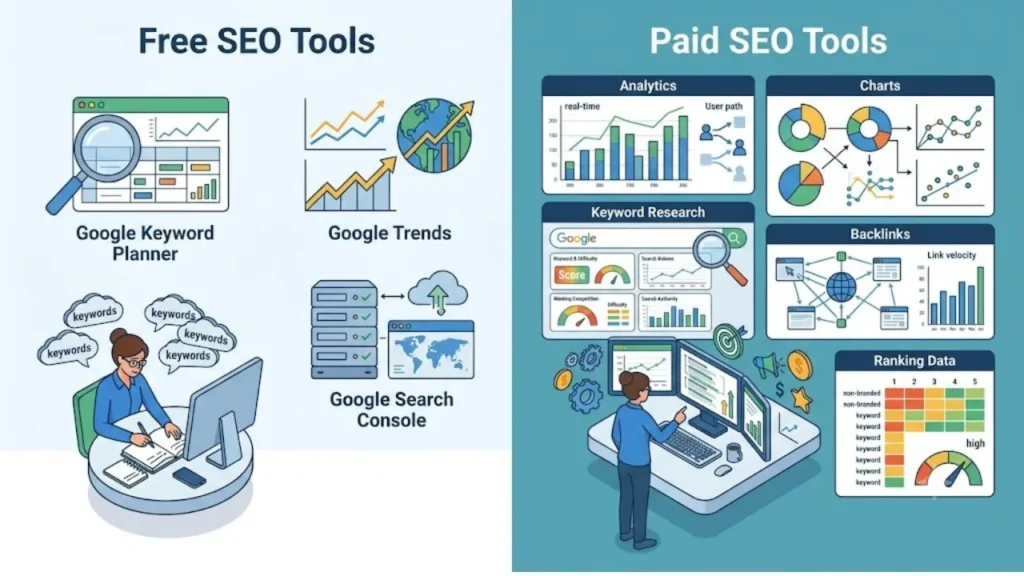
You don’t need an expensive SEO subscription to discover low competition keywords. Many free tools provide valuable insights into search behavior, keyword ideas, and ranking opportunities. While premium tools offer more advanced data, these free resources are more than enough for beginners, bloggers, affiliate marketers, and small business owners.
Below are some of the best free tools you can use to find low competition keywords and improve your SEO strategy.
1. Google Keyword Planner
Google Keyword Planner is one of the most reliable free keyword research tools because the data comes directly from Google. Although it was designed for advertisers, it’s also useful for SEO research.
You can use it to:
- Discover new keyword ideas.
- Check estimated monthly search volume.
- Compare similar keywords.
- Identify seasonal search trends.
Example:
Searching for “keyword research” may reveal related terms like:
- keyword research for beginners
- free keyword research tools
- long-tail keywords
- keyword research strategy
Use Google Keyword Planner to discover keyword ideas and estimate monthly search volume.
Best for: Finding keyword ideas and understanding search demand.
2. Google Autocomplete
Google Autocomplete suggests popular searches as you type into the search bar. These suggestions are based on real user searches, making them an excellent source of long-tail keywords.
For example, typing:
how to find low competition keywords
may display suggestions such as:
- how to find low competition keywords for SEO
- how to find low competition keywords free
- how to find low competition keywords for blogging
These keyword ideas often have lower competition and clearly defined search intent.
Pro Tip: Add different letters (A–Z) after your keyword to uncover even more search suggestions.
To discover keyword opportunities more efficiently, explore our guide to the Best Free Keyword Research Tools.
3. Google Search Console
If your website is already receiving traffic, Google Search Console can reveal keyword opportunities that many website owners overlook.
Navigate to:
Performance → Search Results
Look for keywords that:
- Receive many impressions.
- Rank between positions 8 and 20.
- Have a low click-through rate.
Updating existing content around these keywords is often faster than creating a new article from scratch.
Best for: Finding “easy-win” keywords your website is already close to ranking for.
4. Google Trends
Google Trends helps you understand whether a keyword is gaining or losing popularity over time.
Instead of relying only on search volume, you can compare multiple keywords and identify emerging topics before they become highly competitive.
For example, comparing:
- AI SEO Tools
- Keyword Research
- SEO Automation
can help you identify growing trends worth targeting.
Analyze seasonal trends and compare keyword popularity with Google Trends.
Best for: Seasonal content planning and identifying rising search trends.
5. Keyword Surfer
Keyword Surfer is a free browser extension that displays keyword data directly within Google search results.
It provides useful information such as:
- Estimated monthly search volume
- Similar keyword suggestions
- Content word count recommendations
- Related search terms
Because it works inside Google Search, it speeds up keyword research without switching between multiple tools.
Best for: Quick keyword research while browsing Google.
6. Ubersuggest (Free Version)
Ubersuggest offers a limited number of free daily searches but still provides valuable SEO insights.
You can analyze:
- Keyword difficulty (SEO Difficulty)
- Search volume
- Content ideas
- Top-ranking pages
- Related keywords
Although the free version has usage limits, it’s an excellent starting point for beginners.
Best for: Checking keyword difficulty and generating additional keyword ideas.
How to Get Better Results with Free Tools
No single free tool provides every metric you need. The most effective approach is to combine multiple tools.
For example:
- Start with Google Autocomplete to generate keyword ideas.
- Verify search demand using Google Keyword Planner.
- Check search trends with Google Trends.
- Analyze existing opportunities in Google Search Console.
- Confirm keyword difficulty using Ubersuggest or another SEO tool.
This workflow helps you discover keywords that have realistic ranking potential while avoiding topics dominated by highly authoritative websites.
Key Takeaway
Free keyword research tools may not offer every advanced feature available in premium SEO platforms, but they are more than capable of helping you build a successful content strategy. By combining Google Keyword Planner, Google Autocomplete, Google Search Console, Google Trends, Keyword Surfer, and Ubersuggest, you can consistently discover low competition keywords, understand user search intent, and create content that has a much better chance of ranking on Google.
💡 Expert Tips: How SEO Professionals Find Low Competition Keywords
After years of working with keyword research tools, one lesson stands out: never rely on a single metric or tool. A keyword with low difficulty isn’t automatically a good opportunity, and a keyword with modest search volume isn’t necessarily low value.
Follow these practical tips to improve your keyword research:
- Don’t chase search volume alone. A keyword with 300 targeted monthly searches can outperform one with 10,000 searches if the competition is lower and the search intent matches your content.
- Always check Google’s first page manually. If you see smaller blogs, niche websites, forum discussions, or outdated articles ranking, there’s often room for better content.
- Prioritize search intent over keyword difficulty. Create content that completely answers the user’s question instead of focusing only on SEO metrics.
- Combine multiple free tools. Start with Google Autocomplete for ideas, validate them with Google Keyword Planner, analyze trends using Google Trends, and uncover hidden opportunities in Google Search Console.
- Look for content gaps. If the top-ranking pages miss important details, examples, screenshots, or recent updates, you can create a more comprehensive resource that deserves to rank higher.
- Build keyword clusters instead of isolated articles. Publish several related articles around one topic and connect them with internal links. This helps establish topical authority and improves your chances of ranking for multiple keywords.
Pro Tip: The best low competition keyword isn’t always the one with the lowest Keyword Difficulty score. It’s the keyword where you can create the most helpful, complete, and trustworthy content for your audience. Consistently providing better answers than competing pages is one of the strongest long-term SEO strategies.
Best Paid Keyword Research Tools
Free keyword research tools are excellent for getting started, but as your website grows, paid SEO tools can help you make faster and more informed decisions. They provide accurate keyword metrics, competitor analysis, backlink data, content gap reports, and advanced filtering options that are difficult to find in free tools.
If you’re serious about growing organic traffic, investing in a reliable keyword research tool can save time and uncover opportunities your competitors may be missing.
Ahrefs
Ahrefs is widely regarded as one of the most comprehensive SEO platforms for keyword research. It offers one of the largest keyword databases and provides detailed insights into search volume, keyword difficulty (KD), traffic potential, and backlink profiles.
Key Features:
- Extensive keyword database
- Accurate Keyword Difficulty score
- Traffic Potential metric
- SERP overview and backlink analysis
- Content Gap and Keyword Gap tools
Example:
When researching “how to find low competition keywords,” Ahrefs shows not only the keyword difficulty but also the strength of the websites currently ranking. This helps you determine whether you have a realistic chance of competing.
Best For: SEO professionals, agencies, content marketers, and websites focused on long-term organic growth.
Semrush
Semrush is an all-in-one digital marketing platform that combines keyword research, competitor analysis, content optimization, PPC insights, and technical SEO in a single dashboard.
One of its biggest strengths is helping you discover keywords your competitors already rank for but your website does not.
Key Features:
- Keyword Magic Tool
- Keyword Difficulty analysis
- Competitor keyword research
- Topic Research
- Position Tracking
Example:
If a competing blog ranks for hundreds of keyword variations related to SEO, Semrush can quickly identify those opportunities so you can build better content around them.
Best For: Bloggers, businesses, and marketers who want a complete SEO and content marketing solution.
Mangools KWFinder
KWFinder by Mangools is known for its beginner-friendly interface and reliable keyword difficulty scores. Unlike some advanced SEO platforms, it focuses primarily on keyword research, making it easy to use without a steep learning curve.
Key Features:
- Easy-to-understand Keyword Difficulty score
- Long-tail keyword suggestions
- Local keyword research
- SERP analysis
- Search volume and trend data
One of its biggest advantages is that it highlights keywords that are realistically achievable for smaller websites.
Best For: Beginners, bloggers, affiliate marketers, and niche website owners.
LowFruits
LowFruits is designed specifically to help website owners discover keywords that larger competitors often ignore. Instead of relying only on keyword metrics, it analyzes Google’s search results to identify weak competition.
It highlights opportunities where forums, small blogs, or websites with low authority are already ranking—making it easier to find keywords that newer websites can realistically target.
Key Features:
- Finds hidden low competition keywords
- Identifies weak SERPs
- Bulk keyword analysis
- Domain and ranking analysis
- Long-tail keyword discovery
For bloggers and niche site owners, LowFruits can reveal keyword opportunities that traditional SEO tools sometimes overlook.
Best For: New websites, niche blogs, affiliate marketers, and publishers looking for quick ranking opportunities.
SE Ranking
SE Ranking is an affordable SEO platform that combines keyword research, rank tracking, competitor analysis, website auditing, and backlink monitoring.
It offers many features found in premium enterprise tools while remaining budget-friendly for freelancers and small businesses.
Key Features:
- Keyword research and suggestions
- Keyword Difficulty analysis
- Rank tracking
- Competitor research
- Website audit and backlink monitoring
Its clean interface makes it easy to organize keyword research and monitor ranking progress over time.
Best For: Small businesses, freelancers, agencies, and growing websites looking for an affordable all-in-one SEO platform.
Which Paid Tool Should You Choose?
The best keyword research tool depends on your experience level, budget, and SEO goals.
| Tool | Best For | Key Strength |
|---|---|---|
| Ahrefs | Advanced SEO professionals | Industry-leading backlink and keyword database |
| Semrush | Digital marketers and businesses | Complete SEO and competitor analysis platform |
| Mangools KWFinder | Beginners and bloggers | Simple interface with reliable keyword research |
| LowFruits | New websites and niche blogs | Identifies easy-to-rank, low competition keywords |
| SE Ranking | Freelancers and small businesses | Affordable all-in-one SEO toolkit |
Expert Tip
Don’t choose an SEO tool based solely on the number of features it offers. Instead, select the one that matches your current needs and budget. If you’re just starting, prioritize tools that help you find realistic keyword opportunities. As your website grows, advanced features like backlink analysis, competitor research, and content gap reports become increasingly valuable.
Remember, even the best SEO tool cannot guarantee rankings. Consistent keyword research, high-quality content, strong internal linking, and a focus on user intent remain the foundation of long-term SEO success.
The Semrush Keyword Research Guide explains how professionals discover profitable keywords and analyze competitors.
How to Analyze Keyword Competition Like an SEO Expert

Finding a keyword with a low Keyword Difficulty (KD) score is only the first step. Professional SEOs know that ranking potential depends on much more than a single metric. Before investing time in writing an article, you should analyze the current search results to determine whether you can realistically outperform the competition.
The following process will help you evaluate keyword competition like an SEO expert and identify keywords that offer the best ranking opportunities.
Examine the First Page of Google
The first page of Google is one of the most valuable sources of keyword research. It reveals exactly what Google considers the best content for a search query.
Search your target keyword and carefully review the top 10 results.
Pay attention to:
- The types of websites ranking (blogs, news sites, eCommerce stores, forums, or official websites)
- Article length
- Content format (guides, tutorials, listicles, videos)
- Publication dates
- Featured Snippets and People Also Ask boxes
For example, if several independent blogs rank alongside larger websites, it’s often a sign that the keyword is achievable.
However, if the entire first page consists of well-known brands with highly authoritative domains, the competition may be much stronger.
Expert Tip: Search the keyword in an incognito browser to minimize the influence of your personal search history.
Check Domain Authority
Domain Authority (DA) or Domain Rating (DR) isn’t a Google ranking factor, but it provides a useful estimate of a website’s overall authority.
Tools like Ahrefs, Moz, and Semrush can help you compare the authority of competing websites.
As a general guideline:
- DA below 30 – Easier competition
- DA 30–60 – Moderate competition
- DA above 60 – Strong competition
Don’t be discouraged by one or two high-authority websites. Instead, examine the entire first page.
If several websites have authority levels similar to yours, there’s still a realistic opportunity to compete.
Example:
If your website has a DA of 20 and four websites on the first page have DAs between 15 and 30, that keyword may be worth targeting.
Evaluate Content Quality
Authority alone doesn’t guarantee the best content.
Carefully read the top-ranking articles and ask yourself:
- Does the content completely answer the user’s question?
- Is the information current?
- Are there practical examples?
- Does the article include screenshots, visuals, or case studies?
- Is the content easy to read?
Sometimes you’ll discover articles that rank well despite being outdated or lacking depth.
For example, if the existing content briefly explains keyword research without providing real examples or actionable steps, you can create a more valuable resource by including:
- Step-by-step tutorials
- Original screenshots
- Real keyword research examples
- Updated SEO recommendations
- Frequently asked questions
Google increasingly rewards content that demonstrates expertise and genuinely helps users solve their problems.
Identify Ranking Weaknesses
Professional SEOs don’t only look at what competitors do well—they look for what competitors are missing.
Common weaknesses include:
- Outdated information
- Thin or incomplete content
- Poor page structure
- Missing FAQs
- Weak internal linking
- Slow page speed
- Poor user experience
- No images or visual explanations
Every weakness is an opportunity.
For instance, if competing articles haven’t been updated in two or three years, publishing a comprehensive guide with the latest SEO strategies can give you a competitive advantage.
Expert Tip: Compare at least the top five ranking pages before making a decision.
Spot Easy Ranking Opportunities
The final step is identifying keywords where your content has the highest chance of success.
Good opportunities often share these characteristics:
- Smaller blogs already rank on page one.
- Forums such as Reddit or Quora appear in the search results.
- Keyword Difficulty is relatively low.
- Search intent is clear.
- Existing articles are outdated or incomplete.
- Few pages fully answer the user’s question.
For example, instead of targeting a broad keyword like “SEO,” you might choose “how to find low competition keywords for beginners.” Although the search volume is lower, the competition is usually much weaker, and the audience is more specific.
Expert SEO Checklist Before Targeting Any Keyword
Before writing your article, ask yourself these questions:
- Is the search intent clear?
- Can I create better content than the current top results?
- Are smaller websites already ranking?
- Is the keyword difficulty appropriate for my website?
- Can I add unique insights, examples, screenshots, or personal experience?
- Does this keyword fit my site’s topical authority?
If you answer “Yes” to most of these questions, you’ve likely found a keyword worth targeting.
Key Takeaway
Successful keyword research isn’t about finding the lowest Keyword Difficulty score—it’s about finding the best opportunity. By analyzing the first page of Google, evaluating competitor authority, assessing content quality, identifying weaknesses, and matching search intent, you can choose keywords that your website has a realistic chance of ranking for. This strategic approach leads to better rankings, more targeted traffic, and stronger long-term SEO growth.
Common Mistakes to Avoid

Finding low competition keywords is only half the battle. Many websites fail to rank because they make avoidable keyword research mistakes. Even with the right tools, poor keyword selection or content planning can limit your organic traffic.
By understanding these common mistakes, you can create a smarter SEO strategy and improve your chances of ranking on Google.
Targeting Only High Search Volume Keywords
One of the biggest mistakes beginners make is choosing keywords based solely on search volume.
For example, a keyword with 50,000 monthly searches may look attractive, but if the first page is dominated by authoritative websites like Google, HubSpot, or industry-leading blogs, ranking for it can be extremely difficult.
Instead, look for keywords that balance search volume, keyword difficulty, and search intent. A keyword with 300–1,000 monthly searches and low competition can often generate more consistent traffic than a highly competitive term.
What to do instead:
- Prioritize realistic ranking opportunities.
- Focus on long-tail keywords with lower competition.
- Build authority before targeting broad keywords.
Ignoring Search Intent
A keyword is only valuable if your content matches what users are looking for.
Google ranks pages that best satisfy the user’s intent, not just those that include the keyword most often.
For example:
- Someone searching “how to find low competition keywords” expects a step-by-step guide.
- Someone searching “best keyword research tools” expects comparisons and recommendations.
If your content doesn’t align with the search intent, it’s unlikely to rank well—even if the keyword has low competition.
What to do instead:
- Analyze the top-ranking pages before writing.
- Match the content format, depth, and purpose to user expectations.
- Answer the primary question clearly and early in the article.
Choosing Broad Keywords
Broad keywords are usually more competitive and less specific.
Compare these examples:
❌ Keyword Research
✅ How to Find Low Competition Keywords for a New Blog
The second keyword has a clearer audience, stronger search intent, and a higher chance of ranking.
Specific keywords also attract visitors who are more likely to engage with your content because they are searching for a precise solution.
What to do instead:
- Target niche-specific topics.
- Use descriptive, long-tail keyword phrases.
- Create content that solves one problem thoroughly.
Overlooking Long-Tail Keywords
Many website owners underestimate the value of long-tail keywords because they have lower search volume.
In reality, long-tail keywords often:
- Have lower competition.
- Match specific search intent.
- Generate higher conversion rates.
- Are easier to rank for.
For example:
Instead of targeting:
SEO Tools
Target:
Best Free SEO Tools for Beginners
Although fewer people search for the second keyword, those visitors are much more likely to find exactly what they need.
What to do instead:
- Use Google Autocomplete and People Also Ask to discover long-tail opportunities.
- Build content clusters around related long-tail keywords.
- Optimize each article for one primary keyword and several closely related secondary keywords.
If you’re publishing content but still not getting visitors, read our guide on Why Your Website Is Not Getting Traffic to identify common SEO issues.
Skipping Competitor Analysis
Publishing content without reviewing the competition is a missed opportunity.
Before choosing any keyword, analyze the first page of Google.
Ask yourself:
- Are smaller blogs ranking?
- Is the existing content outdated?
- Can you provide better examples?
- Are important questions unanswered?
Competitor analysis helps you identify content gaps and understand what Google already rewards for that search query.
What to do instead:
- Review at least the top five ranking pages.
- Look for weaknesses you can improve upon.
- Create more comprehensive, accurate, and user-friendly content.
Expert Tips to Avoid These Mistakes
SEO professionals rarely rely on a single metric when selecting keywords. Instead, they combine keyword difficulty, search volume, search intent, and manual SERP analysis to identify the best opportunities.
Keep these best practices in mind:
- Don’t chase the highest search volume.
- Prioritize user intent over keyword metrics.
- Choose keywords your website can realistically rank for.
- Update older articles instead of always publishing new ones.
- Build topical authority by creating multiple related articles.
- Review keyword performance regularly using Google Search Console.
Key Takeaway
Successful keyword research isn’t about finding the “perfect” keyword—it’s about avoiding poor decisions that waste time and effort. By steering clear of these common mistakes and focusing on realistic, user-focused keyword opportunities, you’ll create content that ranks more consistently, attracts qualified visitors, and supports long-term SEO growth.
Real Example: Finding a Low Competition Keyword
Understanding the theory behind keyword research is important, but seeing the process in action makes it much easier to apply. Let’s walk through a practical example to show how an SEO professional identifies a low competition keyword from start to finish.
For this example, imagine you own a new website in the Digital Marketing niche with moderate domain authority and want to publish an article that has a realistic chance of ranking on Google.
Step 1: Start with a Seed Keyword
Every keyword research process begins with a broad topic, also known as a seed keyword.
Suppose your seed keyword is:
Keyword Research
This keyword is highly competitive because thousands of websites have already published comprehensive guides on the topic.
Instead of targeting it directly, you’ll use it to discover more specific opportunities.
Step 2: Generate Keyword Ideas
Next, use free tools like:
- Google Autocomplete
- Google Keyword Planner
- Google Trends
- People Also Ask
- Related Searches
These tools may suggest keywords such as:
- keyword research for beginners
- free keyword research tools
- how to find low competition keywords
- long-tail keyword research
- keyword difficulty explained
- how to find easy keywords
At this stage, don’t worry about choosing the best keyword. Your goal is to create a list of potential opportunities.
Step 3: Check Keyword Metrics
Now evaluate each keyword using an SEO tool such as Ahrefs, Semrush, KWFinder, or Ubersuggest.
Review important metrics like:
- Keyword Difficulty (KD)
- Monthly Search Volume
- Search Intent
- CPC (optional)
- SERP Competition
For example:
| Keyword | Search Volume | Keyword Difficulty | Decision |
|---|---|---|---|
| Keyword Research | High | High | ❌ Too Competitive |
| SEO | Very High | Very High | ❌ Skip |
| How to Find Low Competition Keywords | Moderate | Low | ✅ Excellent Choice |
| Keyword Research for Beginners | Moderate | Medium | ✅ Good Option |
The goal isn’t to find the highest search volume—it’s to find the best balance between demand and competition.
Step 4: Analyze Google’s First Page
Search your chosen keyword on Google and review the first page carefully.
Ask these questions:
- Are smaller blogs ranking?
- Do forum discussions appear?
- Are the articles outdated?
- Can you create a more complete guide?
- Are there missing examples or screenshots?
Suppose you discover that several ranking articles:
- Were published two or three years ago.
- Lack step-by-step instructions.
- Don’t include real examples.
- Ignore newer SEO tools.
This indicates an opportunity to create a more valuable resource.
Step 5: Match Search Intent
Every keyword reflects a user’s goal.
For “how to find low competition keywords,” searchers are looking for practical guidance—not a sales page or a brief definition.
To satisfy this intent, your article should include:
- A clear explanation of low competition keywords.
- Step-by-step instructions.
- Free and paid keyword research tools.
- Real-world examples.
- Common mistakes.
- FAQs.
- Actionable tips readers can implement immediately.
When your content aligns with search intent, Google is more likely to view it as a relevant result.
Step 6: Build a Content Plan
Instead of optimizing for a single keyword, build your article around a keyword cluster.
For this topic, your content could naturally include:
Primary Keyword
- how to find low competition keywords
Secondary Keywords
- low competition keywords
- keyword research for beginners
- keyword difficulty
- long-tail keywords
- free keyword research tools
- SEO keyword research
- high volume low competition keywords
- Google Keyword Planner
- keyword research strategy
Using related keywords naturally helps search engines understand your content without keyword stuffing.
Final Decision
After completing your research, you decide to target:
Primary Keyword: How to Find Low Competition Keywords
Why this keyword is a good choice:
- The competition is relatively low.
- Search intent is clear and informational.
- The topic supports detailed, high-quality content.
- Smaller websites already rank on the first page.
- It fits your website’s niche and topical authority.
- It offers opportunities for internal linking to related SEO articles.
Expert Tip
Professional SEOs don’t choose keywords based on one metric alone. They combine keyword difficulty, search intent, search volume, competitor analysis, and content quality before making a decision.
A keyword with lower search volume but weaker competition often delivers better long-term results than a highly competitive keyword with thousands of monthly searches. Consistently targeting these realistic opportunities allows your website to build authority, gain organic traffic, and compete for broader keywords over time.
Pro Tips to Rank Faster with Low Competition Keywords
Choosing the right keyword is only the beginning. To consistently rank on the first page of Google, you need to combine smart keyword research with high-quality content and strong on-page SEO. The following strategies are used by experienced SEO professionals to improve rankings and accelerate organic traffic growth.
Create Helpful, In-Depth Content
Google rewards content that thoroughly answers a user’s question. Instead of writing a short article filled with keywords, focus on creating content that is informative, well-structured, and genuinely useful.
For example, if your target keyword is “how to find low competition keywords,” don’t stop at defining the term. Explain the complete process, include real examples, compare free and paid tools, highlight common mistakes, and answer frequently asked questions.
A comprehensive guide is more likely to satisfy search intent and keep visitors engaged, which can improve rankings over time.
Pro Tip: Before publishing, ask yourself, “Does this article answer every important question a beginner might have?” If not, expand it.
Optimize Your On-Page SEO
Even excellent content needs proper optimization so search engines can understand its topic.
Include your primary keyword naturally in key locations such as:
- SEO title
- Meta description
- URL slug
- H1 heading
- First 100 words
- At least one H2 or H3 heading
- Image alt text (where relevant)
Use secondary keywords naturally throughout the article instead of repeating the primary keyword excessively. This helps search engines understand the context while keeping the content readable.
Avoid: Keyword stuffing. Write for people first, then optimize for search engines.
Finding the right keywords is only the first step. Following a comprehensive Technical SEO Checklist ensures your content is properly optimized for search engines.
Build Strong Internal Links
Internal linking is one of the most overlooked SEO strategies.
Whenever you publish a new article, link it to other relevant content on your website. This helps search engines discover your pages, distributes page authority, and encourages visitors to explore more of your content.
For example, if you’re publishing an article about low competition keywords, you could internally link to related articles such as:
- Digital Marketing for Beginners
- SEO for Beginners
- Complete Technical SEO Checklist
- Best Free AI Tools for Content Creators
- Why Your Website Is Not Getting Traffic
A strong internal linking structure also supports topical authority, making it easier for Google to recognize your expertise in a specific niche.
Update Existing Content Regularly
SEO isn’t a one-time task. Search trends, algorithms, and user expectations change over time.
Review your top-performing articles every few months and update them by:
- Adding new information.
- Replacing outdated statistics.
- Including recent screenshots.
- Expanding sections with more examples.
- Improving readability and formatting.
Fresh, accurate content signals that your website remains relevant and trustworthy.
Pro Tip: Articles ranking on page two of Google often improve significantly after a well-planned content update.
Improve User Experience
Google increasingly considers user experience when evaluating content quality.
Even if your keyword research is excellent, visitors are unlikely to stay on your page if it’s difficult to read or navigate.
Improve the user experience by:
- Writing short paragraphs.
- Using descriptive headings and subheadings.
- Adding bullet points and numbered lists.
- Including relevant images, charts, or screenshots.
- Ensuring your website loads quickly on mobile and desktop devices.
The easier your content is to consume, the longer users are likely to stay, which can positively influence engagement signals.
Bonus Pro Tips from SEO Experts
If you want to maximize your ranking potential, follow these additional best practices:
- Target one primary keyword and several closely related secondary keywords in each article.
- Build topic clusters instead of publishing unrelated content.
- Analyze the first page of Google before writing every article.
- Answer People Also Ask questions within your content to improve your chances of earning featured snippets.
- Add FAQ Schema, optimized title tags, and compelling meta descriptions.
- Track keyword performance using Google Search Console and update your content based on real search data.
- Focus on topical authority by publishing multiple high-quality articles around the same subject rather than covering unrelated topics.
Key Takeaway
Ranking faster with low competition keywords isn’t about finding shortcuts—it’s about executing a well-rounded SEO strategy. Choose keywords your website can realistically rank for, create the most helpful content available, optimize every page carefully, strengthen your internal linking, and keep your articles updated. When you consistently combine these practices, your website is far more likely to earn sustainable rankings, attract qualified organic traffic, and build long-term authority in your niche.
Key Takeaways In Short:

Before you start your next keyword research session, keep these essential lessons in mind. Applying these best practices consistently will help you identify better keyword opportunities, create content that aligns with user intent, and improve your chances of achieving sustainable rankings on Google.
- Understand keyword difficulty before choosing a keyword. Don’t target keywords based solely on search volume. Evaluate the Keyword Difficulty (KD) score and analyze the first page of Google to determine whether your website can realistically compete.
- Prioritize search intent over search volume. The best keyword is one that matches what users are actually looking for. Create content that fully answers their questions rather than chasing the highest monthly search numbers.
- Focus on long-tail keywords for faster rankings. Long-tail keywords usually have lower competition, clearer search intent, and higher conversion potential, making them ideal for new websites and growing blogs.
- Use both free and paid keyword research tools. Start with free tools like Google Autocomplete, Google Keyword Planner, Google Trends, and Google Search Console. As your website grows, combine them with advanced tools like Ahrefs, Semrush, or LowFruits for deeper insights.
- Always analyze your competitors before creating content. Review the first page of Google to identify content gaps, outdated information, and opportunities to publish a more comprehensive and valuable resource.
- Build topical authority with related content. Instead of publishing isolated articles, create topic clusters around your niche. Connect related posts using internal links to help search engines understand your expertise and improve overall rankings.
- Monitor and update your keyword strategy regularly. SEO is an ongoing process. Track your keyword performance using Google Search Console, refresh outdated content, and adapt your strategy as search trends and user behavior evolve.
Final Thought
Successful keyword research isn’t about finding shortcuts—it’s about making informed decisions. By choosing realistic keywords, understanding search intent, analyzing the competition, and consistently publishing high-quality content, you can build long-term organic traffic and establish your website as a trusted authority in your niche.
Conclusion
Finding low competition keywords is one of the most effective ways to build sustainable organic traffic, especially if you’re running a new website or growing a niche blog. Instead of competing for highly competitive search terms, focus on keywords that match your website’s authority, align with user search intent, and provide realistic ranking opportunities.
As you’ve learned in this guide, successful keyword research goes beyond checking search volume. It involves understanding keyword difficulty, analyzing the first page of Google, evaluating competitor content, identifying long-tail opportunities, and creating content that genuinely helps your audience.
Remember, SEO is a long-term strategy. You won’t rank overnight, but consistently targeting the right keywords and publishing high-quality, user-focused content will help you build topical authority and improve your search visibility over time.
Once you’ve chosen the right keywords, these Best Free AI Tools for Content Creators can help you research, write, and optimize high-quality articles more efficiently.
Start by researching one keyword, create the best possible article around it, and track its performance using tools like Google Search Console. As you repeat this process, you’ll develop a stronger content strategy and uncover more opportunities to grow your website.
The most successful websites don’t rank because they target the biggest keywords—they rank because they consistently answer the right questions better than their competitors. Make low competition keyword research a core part of your SEO strategy, and you’ll be well on your way to attracting more organic traffic and achieving long-term online success.
Struggling to get traffic to your website? Explore our SEO and digital marketing guides to learn proven strategies for improving rankings, increasing visibility, and growing your organic traffic faster.
About the Author
Toppez Digital is a digital marketing and technology company specializing in SEO, AI tools, blogging, affiliate marketing, and digital marketing. We publish practical, research-backed content to help bloggers, creators, entrepreneurs, and businesses grow their online presence with confidence. Learn more about our company, editorial standards, and expertise on our About Page.
Frequently Asked Questions (FAQs) :
Low competition keywords are search terms with relatively low ranking competition, making them easier to rank for in search engines. They often have lower Keyword Difficulty (KD) scores and are ideal for new websites, bloggers, and small businesses looking to grow organic traffic.
You can find low competition keywords by using tools like Google Keyword Planner, Google Autocomplete, Google Search Console, Google Trends, Ahrefs, Semrush, or LowFruits. Analyze keyword difficulty, search intent, competitor rankings, and long-tail variations before selecting a keyword.
For new websites, a Keyword Difficulty score below 30 is generally considered a good target. As your website gains authority and backlinks, you can gradually target keywords with higher KD scores.
There isn’t a single “best” tool, but Google Keyword Planner, Google Search Console, Google Trends, and Google Autocomplete are excellent free resources. Using them together provides better keyword insights than relying on just one tool.
Yes. Long-tail keywords usually have lower competition, clearer search intent, and attract more targeted visitors. They are often easier to rank for than broad, high-volume keywords, making them an excellent choice for new websites.
Absolutely. Many bloggers successfully discover keyword opportunities using free tools such as Google Search, Google Autocomplete, People Also Ask, Related Searches, Google Trends, Google Keyword Planner, and Google Search Console. Paid tools simply provide additional data and save time.
There’s no fixed timeline. Depending on your website’s authority, content quality, competition, and SEO efforts, ranking may take anywhere from a few weeks to several months. Publishing helpful, well-optimized content consistently improves your chances of ranking faster..
The best approach is to balance both. Instead of targeting the highest search volume keywords, choose keywords with reasonable search demand, low competition, and strong search intent. This strategy gives your content a better chance of ranking and attracting relevant visitors.
Focus on one primary keyword and 5–10 closely related secondary keywords. Use them naturally throughout your content, headings, and meta tags without overusing or forcing keywords into the text.
The most common mistake is targeting highly competitive keywords without considering their website’s authority. Other mistakes include ignoring search intent, skipping competitor analysis, overlooking long-tail keywords, and relying on a single keyword research tool instead of combining multiple sources.
Related Article:
If you’re serious about improving your SEO skills and growing your website’s organic traffic, these guides are worth reading next: