Digital Marketing for Beginners: Complete Step-by-Step Guide
Digital Marketing for Beginners in India: Meaning, Benefits & Career
Digital marketing for beginners is the perfect starting point for anyone who wants to promote products, services, or personal brands online using the internet. In simple words, digital marketing means reaching the right audience through platforms like Google, social media, websites, email, and online ads.
Table of Contents
ToggleToday, businesses of all sizes use digital marketing to grow faster, attract customers, and increase sales at a lower cost than traditional marketing. Whether you are a student, freelancer, blogger, or business owner, learning digital marketing basics can open new career and income opportunities. This beginner-friendly guide will help you understand digital marketing step by step.
What Is Digital Marketing?
Digital marketing means promoting products, services, or brands using the internet and digital platforms. In simple words, it is a way of reaching people online where they spend most of their time—on Google, social media, websites, email, and mobile apps.
Instead of using newspapers, TV, or posters, digital marketing uses online tools to show the right message to the right audience at the right time. Businesses use digital marketing to attract customers, build trust, and increase sales. For beginners, digital marketing is an easy and affordable way to start online marketing and grow a career or business.
How Digital Marketing Works?
Digital marketing works by connecting businesses with their target audience through online channels. First, a business creates content, ads, or offers based on what people are searching for online. Then, platforms like search engines, social media, websites, or email deliver that content to the right users. When people click, watch, or sign up, their actions are tracked using digital tools. Marketers analyze this data to see what is working and what is not. Based on the results, strategies are improved to get more traffic, leads, and sales. This process makes digital marketing measurable, flexible, and highly effective.
Digital Marketing vs Traditional Marketing
Digital marketing and traditional marketing differ mainly in how they reach people. Traditional marketing uses offline methods like newspapers, TV, radio, banners, and flyers, where results are hard to measure. Digital marketing uses online platforms such as Google, social media, websites, and email, allowing businesses to track clicks, views, and sales in real time. Digital marketing is more affordable, targeted, and flexible, making it ideal for beginners and small businesses. Traditional marketing reaches a broad audience but lacks precision. Today, most businesses prefer digital marketing because it offers better control, measurable results, and higher return on investment.
⇒ Learn more in our Digital Marketing Basic Guide.
Why Digital Marketing Is Important Today
Growth of Internet & Smartphone Users
The rapid growth of internet and smartphone users has changed how people search, shop, and communicate. Today, millions of users access the internet daily through smartphones, making online platforms more powerful than ever. People use their phones to search on Google, watch videos, scroll social media, and buy products online. This shift has increased the demand for digital marketing, as businesses now follow their customers online. For beginners, this growth creates huge opportunities to learn digital marketing skills and reach a large audience at a low cost. As internet usage continues to rise, digital marketing will keep growing.
Digital Marketing for Small Businesses
Digital marketing is especially useful for small businesses because it is affordable and highly effective. Unlike traditional advertising, small businesses can promote their products or services online with a limited budget. Using tools like Google search, social media, websites, and email marketing, they can reach the right customers at the right time. Digital marketing also allows small businesses to track performance, understand customer behavior, and improve strategies easily. For beginners and local business owners, digital marketing helps build brand awareness, attract more customers, and compete with bigger brands without spending a lot of money.
Small businesses can also combine SEO, social media, content marketing, and other digital marketing strategies to build visibility without depending entirely on paid advertising.
Digital Marketing for Personal Branding
Digital marketing plays a key role in building a strong personal brand online. It helps individuals showcase their skills, knowledge, and expertise through platforms like websites, blogs, social media, and video channels. By creating valuable content and staying consistent, people can build trust and connect with their target audience. Digital marketing also makes it easier to grow visibility, attract opportunities, and stand out in a competitive market. For beginners, personal branding through digital marketing can lead to freelancing work, job offers, collaborations, or online income. A strong personal brand helps you build credibility and long-term success online.
Why Digital Marketing Is Important for Beginners
Digital marketing is important for beginners because it offers a practical way to learn the process of attracting online customers, engaging with them, and converting them into buyers. Unlike traditional marketing, digital marketing allows beginners to experiment with channels like search engines, social media, websites, email, and online advertising without needing a large budget.
For instance, a beginner who has created a small blog can learn SEO by researching keywords, publishing relevant and informative articles, and monitoring performance via ‘Google Search Console.’ Similarly, someone interested in social media can practice by creating content for a Facebook or Instagram page. Such hands-on projects make it much easier to grasp marketing concepts compared to relying solely on theoretical study.
Digital marketing is also valuable because it fosters skills that are applicable across various professional fields. A beginner might start with a specific area—such as SEO, content marketing, social media, PPC, or email marketing—and gradually acquire additional skills as they gain experience.
Another advantage is the ability to measure results. By analyzing metrics such as impressions, clicks, engagement, website traffic, leads, and conversions, beginners can observe how people respond to their content. This enables them to test ideas, review outcomes, and make necessary improvements rather than relying on guesswork.
Digital marketing can also help beginners build their own online presence. Through a website, blog, portfolio, or professional social media profile, they can showcase their practical skills to potential employers or clients. This is particularly beneficial for those interested in freelancing, content creation, blogging, or online business.
However, beginners should not expect immediate results. Generating significant traffic through SEO and content marketing can take time, whereas paid advertising requires careful budget planning and experimentation. The best approach is to select a specific skill, practice it on a real-world project, evaluate the results, and then gradually expand into other areas.
In short, digital marketing is significant for beginners because it combines accessible tools, hands-on learning opportunities, the ability to measure results, and diverse career prospects. Instead of trying to master every marketing channel at once, beginners should start with a single skill and enhance their knowledge and proficiency through regular practice.
How Does Digital Marketing Work?
Digital marketing essentially finds potential customers online—where they naturally spend their time—and guides them toward specific actions, such as making a purchase, signing up, or conducting a search. It is not about relying on a single, massive effort; rather, it is an ongoing process that involves understanding your audience, establishing a presence on the right platforms, offering something of value, and refining your strategy based on what actually works.
Identify Your Target Audience
To begin, you must know whom you want to reach. This means going beyond basic demographics (such as age, location, and income) to gain insight into customer behavior, their pain points or needs, and their purchasing habits. Tools like customer surveys, website analytics, and social media insights help build a clear picture of your ideal customer—revealing the problems they face, where they spend their time online, and the types of messaging or styles that capture their attention.
Choose the Right Marketing Channels
A B2B software company might achieve great results through LinkedIn and email marketing, whereas a fashion brand might find more success on Instagram and TikTok. The right channel depends on where your customers actually spend their time and how they prefer to discover new products or services; common channels include search engines (SEO/PPC), social media, email, and various content platforms.
Create Valuable Content or Offers
Once you know whom you are targeting and where to reach them, the next step is to present something that captures their attention. This could be an informative blog post, a practical “how-to” video, a discount code, or a free resource like an e-book or checklist. The primary goal is to deliver genuine value—something that solves a problem or answers a question—rather than simply pushing hard to sell a product.
Reach Your Customers
Once you have identified the right message and medium, it is time to put it in front of your audience. This can involve organic efforts like SEO and social media posts, as well as paid strategies such as Pay-Per-Click (PPC) advertising or sponsored content. Often, a combination of both works best: organic methods build long-term trust, while paid strategies ensure rapid, immediate visibility.
Monitor and Improve Results
Digital marketing is not a “set-it-and-forget-it” process. By using analytics tools, you can track metrics like click-through rates, conversions, engagement, and ROI to understand what is working and what isn’t. This data allows you to continuously refine your targeting, messaging, and channel mix—making each campaign more effective than the last.
Types of Digital Marketing
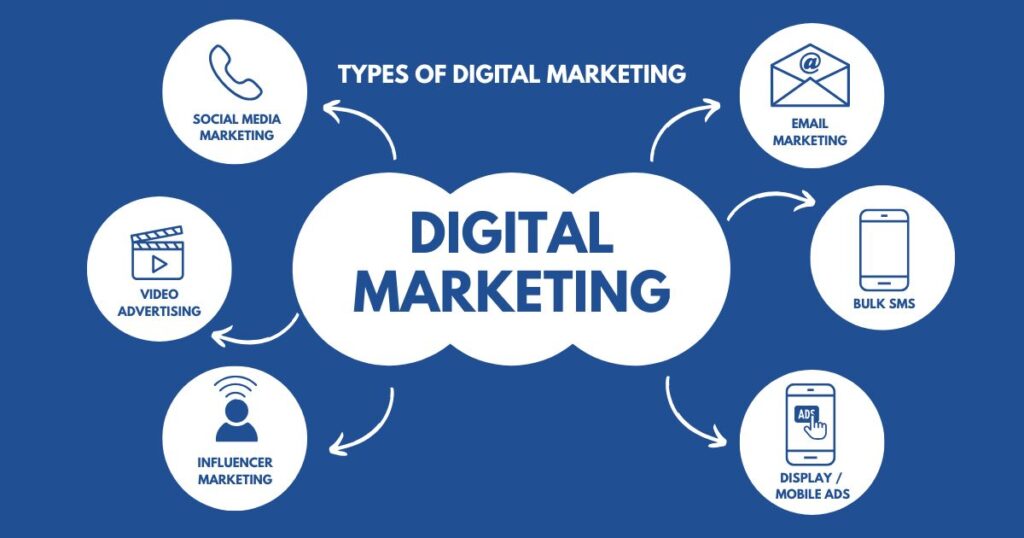
Digital marketing encompasses various methods that businesses use to attract people online, engage with them, and convert them into customers. Each method serves a different purpose; some focus on increasing organic traffic (visitors arriving naturally), while others help build relationships, generate potential customers or ‘leads,’ or drive immediate sales.
Beginners do not need to learn every method simultaneously. Instead, it is better to understand how each channel works and then select one or two areas that align with their specific goals and interests.
Search Engine Optimization (SEO)
Search Engine Optimization (SEO) is the process of improving a website and its content so that it ranks higher or becomes more visible in search engine results. SEO primarily focuses on attracting organic (free) traffic from people who are actively searching for specific information, products, or services.
For example, a local web design firm could create a helpful page based on relevant search queries like “website design services for small businesses.” If that page provides valuable information and adheres to proper SEO practices, it can attract potential customers through search engines.
If you are new to search optimization, start with our SEO Basics for Beginners guide to understand the fundamentals of optimizing content and websites for search engines.
Key aspects of SEO include:
- Researching keywords and search intent
- Creating useful content
- On-page optimization
- Technical SEO
- Internal linking
- Website performance and usability
- Building relevant authority and references
Best for those who: Enjoy research, writing, and understanding how websites and search engines work.
SEO is one of the most important digital marketing skills for beginners who want to understand organic search, keyword research, and website optimization.
Content Marketing
Content marketing involves creating and distributing valuable, relevant content to attract and educate a specific audience or customer base. Rather than focusing solely on direct promotion, content marketing helps build awareness and trust by answering questions and solving problems.
Common types of content include:
- Blog articles
- Tutorials and guides
- Videos
- Infographics
- Case studies
- Social media posts
- Newsletters
For example, a company selling gardening tools might publish guides for beginners on selecting plants, preparing soil, and maintaining a home garden. Such resources can attract people who might become future customers.
Best for those who enjoy: writing, teaching, researching, designing, or creating videos.
Social Media Marketing
Social Media Marketing (SMM) involves using various social media platforms to raise awareness, engage with the audience, promote content, and market products or services.
Businesses can use platforms like Facebook, Instagram, LinkedIn, YouTube, and X (formerly Twitter), depending on where their target audience is most active. For instance, a small clothing business might share product photos, styling tips, short videos, customer testimonials, and seasonal offers on social media. The goal is not merely to gain followers, but to build an audience that engages with the brand and eventually takes valuable actions.
Social media marketing can encompass both organic content and paid advertising.
Best for those who enjoy: social platforms, communication, visual content, and community building.
Pay-Per-Click (PPC) Advertising
Pay-Per-Click (PPC) advertising is a form of paid digital marketing where advertisers pay a fee whenever a user clicks on their ad, based on the specific pricing model of the advertising platform.
Google Ads and social advertising platforms allow businesses to target audiences based on factors such as search queries, interests, demographics, location, and other available signals.
For example, a local plumbing business might run search ads targeting people looking for plumbing services within its service area. Unlike SEO, paid advertising can generate visibility relatively quickly, but businesses must carefully manage their budgets and campaign performance.
PPC typically involves:
- Keyword or audience research
- Ad creation
- Budget management
- Landing page
- optimization
- Conversion tracking
- Campaign testing and optimization
It is an excellent choice for beginners who enjoy working with numbers, testing, advertising, and data analysis.
Email Marketing
Email marketing is a process of communicating with customers or subscribers via email. Businesses use it to share educational content, product information, updates, offers, and other relevant messages.
For instance, an online store might offer visitors the option to subscribe to a newsletter. The company can then send useful product guides, new product announcements, or relevant offers to those who have agreed to receive such emails.
The primary goal of effective email marketing is to deliver relevant messages to the right audience at the right time, rather than simply sending out a large volume of promotional emails.
Common activities involved include:
- Building an email list
- Creating newsletters
- Segmenting subscribers
- Sending automated messages
- Testing subject lines and content
- Measuring open rates, click-through rates, and conversions
This field is well-suited for individuals who enjoy communication, writing, managing customer relationships, and working with automation processes.
Affiliate Marketing
Affiliate marketing is a performance-based marketing model in which an affiliate promotes another company’s products or services. The affiliate can earn a commission when a specific action—such as a product sale or lead generation—is completed through their referral.
For example, a technology blogger might publish a detailed comparative review of several laptops and include affiliate links—clearly disclosed—where appropriate. If a reader purchases the product through that referral link, the affiliate earns a commission based on the program’s terms.
Successful affiliate marketing generally relies on audience trust and valuable content; success is not achieved merely by inserting a large number of affiliate links.
Beginners who are interested in affiliate marketing can also learn how to start affiliate marketing without a website before investing in a full website.
Channels that newcomers can utilize:
- Blogs
- YouTube
- Social media
- Email newsletters
- Product comparison reviews
This approach is suitable for those who enjoy creating content, researching products, writing reviews and comparisons, and building an audience.
Influencer Marketing
Influencer marketing involves collaborating with individuals who have an established audience and influence within a specific niche. A brand can partner with a content creator to introduce a new product, demonstrate how it works, or share personal experiences with the audience.
For instance, a skincare brand might collaborate with a beauty content creator whose audience is interested in skincare. The creator can showcase the product and explain how it fits into their daily routine.
Influencer marketing is not limited to famous celebrities. Micro-influencers and niche content creators can also be highly valuable if their audience closely aligns with the brand’s target customers.
This method is ideal for those interested in creator marketing, partnerships, social media, and audience engagement. Which type of digital marketing should a beginner start with?
There is no single “best” option for everyone. Your choice should depend on your interests and goals:
| If you enjoy… | Consider starting with… |
|---|---|
| Search and research | SEO |
| Writing and teaching | Content Marketing |
| Social platforms and communication | Social Media Marketing |
| Numbers and testing | PPC |
| Writing and customer communication | Email Marketing |
| Product research and reviews | Affiliate Marketing |
| Creators and partnerships | Influencer Marketing |
The important thing is not to learn everything simultaneously. Choose one core skill, practice it on a real project, measure your results, and then expand into related areas.
Real-World Digital Marketing Examples
Understanding digital marketing becomes much easier when you see how different people and businesses use it in real situations. The strategy depends on the business goal, target audience, budget, and available resources. A local business may focus on attracting nearby customers, while a blogger may focus on organic traffic and audience trust.
The following examples show how beginners can combine different digital marketing channels to achieve specific goals.
Digital Marketing Example for a Local Business
Imagine a local dental clinic in Kolkata that wants to attract more patients.
The clinic could create a Google Business Profile, build a website with pages for its major services, and publish helpful articles such as “How Often Should You Get a Dental Checkup?” It could also optimize its website for relevant local searches and maintain an active social media presence.
For example, the clinic might use:
- Local SEO to become more visible in relevant local searches
- Content marketing to answer common patient questions
- Social media to share educational tips and updates
- Google Ads to reach high amount of people actively searching for these services
- Reviews to build trust with potential customers
The business ultimately wants those visitors to call, book an appointment, or visit the clinic.
Beginner lesson: Start with a clearly defined local audience and focus on the channels that can directly connect your business with potential customers.
Digital Marketing Example for a Blogger
Consider a beginner who creates a blog about personal finance for young adults.
Instead of publishing random articles, the blogger could research questions that their target audience is actually searching for. They might create articles about budgeting, saving money, credit cards, or beginner investing.
The blogger could use:
- Keyword research to identify relevant topics
- SEO to attract organic search traffic
- Content marketing to provide useful guides
- Email marketing to build a returning audience
- Social media to distribute new articles
- Analytics to understand which content performs best
For example, if an article about “How to Create a Monthly Budget” consistently attracts visitors, the blogger could create related content such as budgeting templates, saving tips, and expense-tracking guides.
Over time, the blog could potentially generate revenue through advertising, affiliate marketing, sponsorships, or digital products, depending on the audience and business model.
Beginner lesson: Build around a specific audience and solve their problems consistently instead of publishing content simply to increase the number of articles.
Digital Marketing Example for an Online Store
Suppose an online store sells home décor products.
The store can use product pages, search optimization, social media, email marketing, and paid advertising to attract potential customers and encourage purchases.
For example:
- SEO can help product and category pages appear for relevant searches.
- Social media can showcase products through photos and short videos.
- Content marketing can provide decorating ideas and buying guides.
- Email marketing can inform subscribers about new products and offers.
- Paid advertising can promote selected products to relevant audiences.
- Analytics can help identify which products and campaigns generate sales.
Suppose a particular product receives many clicks but very few purchases. Instead of simply increasing advertising spend, the store could review the product page, images, price, description, shipping information, and checkout experience.
Beginner lesson: Digital marketing does not stop when someone clicks an advertisement. The entire journey—from discovery to purchase—affects the final result.
Digital Marketing Example for a Freelancer
Imagine a beginner who wants to offer SEO services to small businesses.
Instead of simply creating a social media profile saying “I provide SEO services,” the freelancer could build a simple portfolio website and demonstrate their knowledge through useful content.
Their strategy could include:
- Publishing SEO tutorials
- Creating sample website audits
- Showing before-and-after improvements from legitimate projects
- Building a professional LinkedIn profile
- Networking with potential clients
- Offering a clearly defined beginner-friendly service
For example, the freelancer could offer a basic SEO audit for small websites. After completing several projects and developing measurable results, they could expand into ongoing SEO services.
The freelancer should focus on demonstrating what they can actually do, rather than making unrealistic promises about rankings or traffic.
Beginner lesson: Your portfolio can be more persuasive than simply claiming that you have digital marketing skills.
Digital Marketing Example for a YouTube Creator
Consider a YouTube creator who publishes videos about technology and AI tools.
The creator could research topics that their audience wants to learn about and produce videos that answer specific questions. Every video can then be supported by additional digital marketing activities.
For example:
- Keyword and topic research can help identify useful video ideas.
- YouTube SEO can improve discoverability.
- Thumbnails and titles can encourage relevant viewers to click.
- Social media can distribute clips and announcements.
- Email or a website can create an additional audience channel.
- Analytics can show which videos attract and retain viewers.
If videos about free AI tools consistently perform well, the creator could develop related tutorials, comparisons, and beginner guides rather than randomly changing topics.
Beginner lesson: Use audience data to understand what works, then create more useful content around proven interests instead of chasing every trend.
What These Examples Teach Beginners
Although these five examples involve different types of businesses and creators, the underlying process is similar:
Understand the audience → Choose the right channel → Create useful content or offers → Reach the audience → Measure results → Improve.
Digital marketing is therefore not just about posting content or running advertisements. It is a process of matching the right message with the right audience and continuously improving based on real results.
10 Key Benefits of Digital Marketing
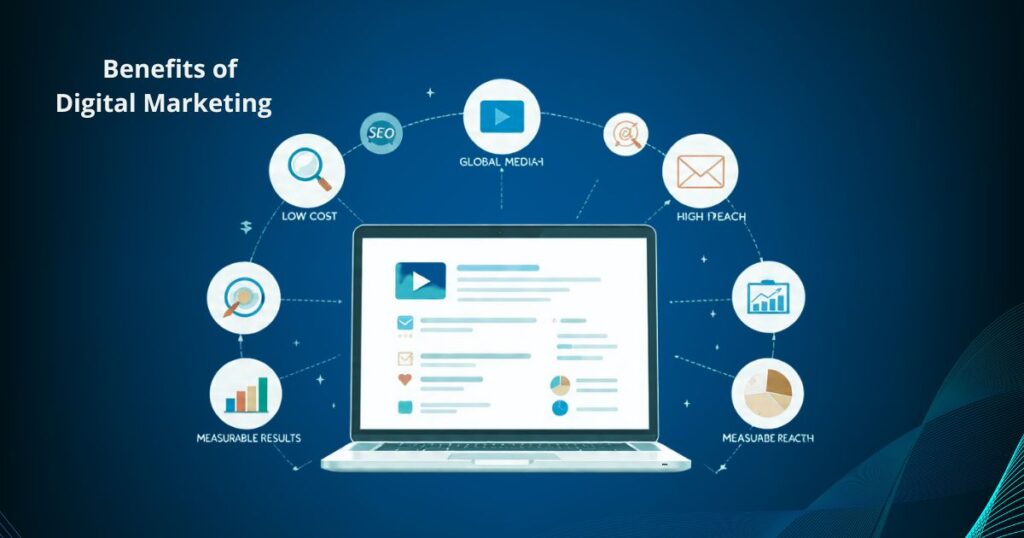
Digital marketing offers businesses, creators, freelancers, and professionals several ways to reach and understand their audiences online. Unlike traditional marketing, digital channels make it possible to target specific audiences, measure campaign performance, and adjust strategies based on real results.
However, digital marketing is not automatically cheap or successful. Results depend on factors such as the chosen channel, quality of content, audience targeting, budget, competition, and execution. Understanding these benefits helps beginners use digital marketing more strategically.
Cost-Effective Marketing
Digital marketing can be more accessible than many traditional advertising methods, especially for small businesses and beginners. You can start with organic channels such as SEO, content marketing, and social media without paying for every visitor.
Paid advertising also allows businesses to set budgets and test campaigns at different spending levels. For example, a local business could start with a small advertising budget, measure the results, and increase spending only when the campaign produces acceptable results.
Beginner tip: Start with free or low-cost channels while learning. Do not assume that spending more money automatically produces better results.
Global and Local Reach
Digital marketing can help a business reach customers beyond its immediate location or focus specifically on people in a particular area.
An online store may target customers across India, while a local restaurant may focus only on people searching for services in its city.
This flexibility allows businesses to choose their geographic reach based on their products and goals.
Example: A freelance designer can work with clients from different countries, while a local plumber can focus marketing efforts on customers within a specific service area.
Targeted Audience
Digital marketing allows businesses to create campaigns and content for specific audiences rather than communicating with everyone at once.
Depending on the platform and available data, marketers can use factors such as location, search behaviour, interests, demographics, or previous interactions to make their marketing more relevant.
For example, a fitness coach offering online programs for beginners could create content specifically for people interested in beginner-friendly workouts rather than targeting all internet users.
Beginner tip: Define your target audience before creating content or launching an advertising campaign.
Measurable Results
The best opportunity of digital marketing is the ability to measure performance of your success.
Depending on the channel, marketers can monitor metrics such as:
- Impressions
- Clicks
- Website traffic
- Engagement
- Leads
- Conversions
- Sales
For example, if a blog article receives search impressions but very few clicks, you may need to improve its title or search-result presentation. If an advertisement receives clicks but produces no sales, the problem may be related to the landing page, offer, targeting, or conversion process.
Beginner tip: Do not judge a campaign only by traffic. Connect your metrics to the actual business goal.
Faster Feedback and Optimization
Digital campaigns can provide feedback much faster than many traditional marketing methods. Marketers can review performance, identify weaknesses, and make changes without waiting for an entire campaign to finish.
For example, an online store testing two advertising creatives may discover that one receives significantly more relevant engagement. The business can then investigate why it performs better and adjust the campaign accordingly.
This creates a useful cycle:
1.Test → 2.Measure → 3.Learn → 4.Improve → 5.Test Again
The speed of this feedback loop allows marketers to learn from both successful and unsuccessful campaigns.
24/7 Online Presence
A website, blog, online store, or published video can remain available to potential customers outside normal business hours.
For example, someone searching for information about a product late at night may discover a company’s website, read its content, compare products, or submit an inquiry.
This does not mean that digital marketing works completely without human involvement. Websites need maintenance, customer questions may require responses, and content often needs updating.
Beginner tip: Think of your online presence as a digital storefront that needs regular maintenance rather than a system you can simply set up once and forget.
Better Customer Engagement
Digital marketing provides multiple ways for businesses to communicate with their audiences.
Customers can interact through:
- Social media comments
- Direct messages
- Website forms
- Reviews
- Online communities
This two-way communication can help businesses understand customer questions, concerns, and preferences.
For example, if several customers repeatedly ask the same question about a product, the business could create an FAQ or explanatory video that addresses it.
Beginner tip: Treat customer questions as potential content ideas. They often reveal exactly what your audience wants to know.
Data-Driven Decision Making
Digital marketing produces data that can help marketers make more informed decisions.
Instead of simply asking, “Did this campaign work?”, marketers can examine questions such as:
- Which channel brought the most qualified visitors?
- Which content generated the most engagement?
- Which pages produced leads?
- Where are users leaving the website?
- Which campaigns generated conversions?
For example, a blogger may discover through analytics that detailed tutorials attract more engaged visitors than short articles. That information can influence future content planning.
Data should support decision-making, but it should also be interpreted in context. A single metric rarely tells the complete story.
Automation Opportunities
Many repetitive digital marketing tasks can be partially automated with appropriate tools and workflows.
Examples include:
- Scheduling social media posts
- Sending email sequences
- Collecting leads
- Organizing customer data
- Generating reports
- Triggering follow-up messages
Automation can save time and make processes more consistent. However, automation should not replace human review, especially for customer communication, important content, and strategic decisions.
Beginner tip: Automate repetitive tasks only after you understand the process manually. Otherwise, you may simply automate an inefficient workflow.
Supports Business and Career Growth
Digital marketing can support both business development and individual career growth.
A business can use digital marketing to attract potential customers, build brand awareness, generate leads, and increase sales. Individuals can use the same skills to build portfolios, pursue jobs, offer freelance services, create content, or develop online businesses.
For beginners, the ability to demonstrate practical work can be particularly valuable. A person learning SEO, for example, can practice on a website and use the project todemonstrate their skills to potential employers or clients.
Beginner tip: Do not focus only on collecting certificates. Build real projects that show what you can actually do.
Key Takeaway
The biggest advantage of digital marketing is not simply that it happens online. Its real strength is the combination of reach, targeting, measurement, interaction, and continuous improvement.
For beginners, the best way to benefit from these advantages is to choose one marketing channel, practice it on a real project, track meaningful results, and improve based on what the data and audience feedback reveal.
If you want to explore the advantages in greater detail, read our guide to the Benefits of Digital Marketing.
Which digital marketing skill should beginners learn first?
Digital marketing includes many different skills, but beginners do not need to learn everything at once. Trying to master SEO, social media, paid advertising, email marketing, content creation, and analytics simultaneously can quickly become overwhelming.
A better approach is to choose one core skill based on your interests, strengths, and career goal, practice it on a real project, and gradually add related skills. The right starting point is different for every beginner.
Choose SEO If You Enjoy Search and Research
SEO can be a good starting point if you enjoy researching topics, understanding search behaviour, working with websites, and improving content.
You can learn how people search for information, identify relevant topics and keywords, optimize web pages, improve internal linking, and understand how search engines discover and evaluate content.
For example, you could create a small website or blog and practice SEO by researching a specific topic, publishing helpful content, and monitoring search performance.
Start with: keyword research, search intent, on-page SEO, internal linking, technical SEO basics, and Google Search Console.
Good fit for: people who enjoy research, writing, websites, and long-term organic growth.
Choose Content Marketing If You Enjoy Writing
Content marketing may suit you if you enjoy explaining ideas, researching subjects, writing articles, or teaching people.
You can create blog posts, guides, tutorials, case studies, newsletters, videos, or other useful resources designed around the needs of a specific audience.
For example, instead of writing random articles about technology, you could focus on helping beginners understand AI tools and create tutorials that solve specific problems.
Start with: audience research, search intent, content planning, writing, content distribution, and performance analysis.
Good fit for: writers, researchers, teachers, and people who enjoy explaining complex topics simply.
Choose Social Media Marketing If You Enjoy Social Platforms
Social media marketing can be a natural starting point if you enjoy creating posts, interacting with people, following trends, and building online communities.
You can practice by managing your own page or helping a small business create and organize content.
For example, a local clothing business could use Instagram and Facebook to publish product photos, styling ideas, short videos, customer stories, and seasonal promotions.
Start with: content planning, platform-specific content, audience engagement, basic analytics, and social media scheduling.
Good fit for: communicators, community builders, and people who enjoy visual and interactive content.
Choose PPC If You Like Data and Advertising
Pay-per-click advertising may be a good choice if you enjoy numbers, experimentation, budgets, and performance analysis.
PPC involves creating paid campaigns, selecting appropriate audiences or search terms, managing budgets, testing advertisements, and analyzing results.
For example, a local service provider could run a small search advertising campaign and compare which keywords or advertisements generate relevant enquiries.
Because PPC involves real advertising budgets, beginners should first learn the fundamentals using training resources, demonstrations, or carefully controlled small experiments rather than spending heavily before understanding campaign measurement.
Start with: campaign structure, keyword or audience targeting, ad copy, conversion tracking, budgeting, and performance analysis.
Good fit for: analytical thinkers who enjoy testing and measurable results.
Choose Email Marketing If You Like Communication
Email marketing can be a good starting point if you enjoy writing directly to an audience and building long-term customer relationships.
Businesses can use email to send newsletters, educational content, product updates, offers, and automated messages to subscribers who have opted to receive communications.
For example, a blogger could offer a useful free resource in exchange for an email subscription and then send subscribers additional educational content.
Start with: email list building, newsletters, audience segmentation, subject lines, automation, and performance measurement.
Good fit for: strong communicators, writers, and people interested in customer relationships.
Choose Content Creation If You Enjoy Design and Video
Content creation is a strong option if you enjoy graphic design, photography, video editing, presentations, or storytelling.
Digital marketers increasingly need visual and video content for websites, social media, advertisements, and other online channels.
For example, a beginner interested in technology could create short educational videos explaining useful apps or AI tools and distribute them through YouTube and social media.
Start with: basic design principles, video editing, thumbnails, short-form video, storytelling, and platform-specific content.
Good fit for: designers, video creators, storytellers, and visually oriented learners.
How to Choose Your First Skill
You can use this simple approach:
| If you enjoy… | Start with… |
|---|---|
| Search, research, and websites | SEO |
| Writing and explaining | Content Marketing |
| Social platforms and interaction | Social Media Marketing |
| Numbers, testing, and advertising | PPC |
| Communication and relationships | Email Marketing |
| Design, video, and storytelling | Content Creation |
Remember that these skills overlap. An SEO specialist benefits from content skills, a content marketer benefits from SEO knowledge, and a social media marketer can benefit from analytics and content creation.
The goal is not to choose one skill forever. Choose one skill to start, build practical experience, and then add complementary skills as you progress.
Digital Marketing for Beginners – Step-by-Step Roadmap
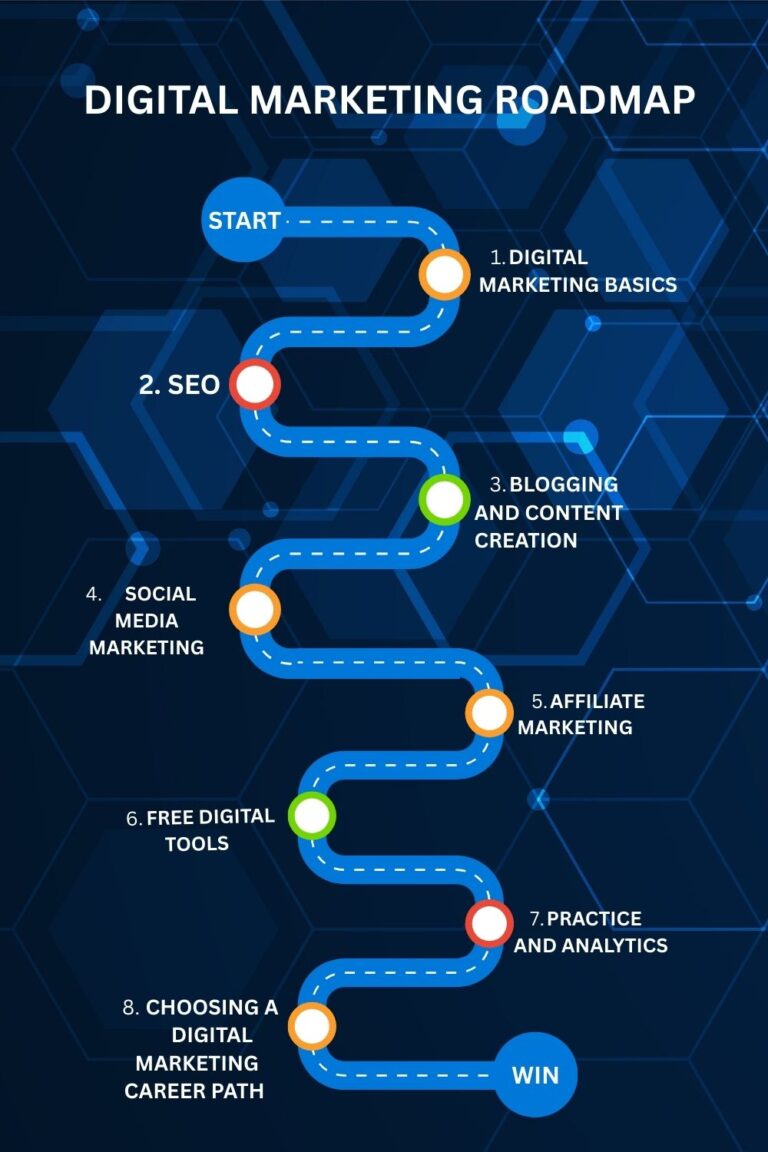
Learning digital marketing becomes easier when you follow a structured process instead of trying to master every channel at the same time. A good roadmap combines learning, practice, publishing, measurement, and continuous improvement.
Start with the fundamentals, choose one core skill, apply what you learn to a real project, and gradually develop additional skills as your experience grows.
Step 1: Learn Digital Marketing Fundamentals
Start by understanding how digital marketing works before choosing a specialization. Learn the basic purpose of SEO, content marketing, social media marketing, PPC, email marketing, affiliate marketing, and other major channels.
You should also understand basic concepts such as:
- Target audience
- Search intent
- Customer journey
- Content strategy
- Traffic
- Leads
- Conversions
- Engagement
- Return on investment (ROI)
At this stage, focus on understanding why a marketing activity is being performed, not just which tool to click.
Beginner action: Spend your first few weeks learning the fundamentals and studying real websites, social media pages, advertisements, and marketing campaigns.
Step 2: Choose One Core Skill
Once you understand the basics, choose one area to develop more deeply.
For example:
- Enjoy research and websites → SEO
- Enjoy writing and teaching → Content Marketing
- Enjoy social platforms → Social Media Marketing
- Enjoy numbers and advertising → PPC
- Enjoy communication → Email Marketing
- Enjoy design and video → Content Creation
Choosing one core skill prevents information overload and gives you a clear direction.
You can learn complementary skills later. For example, an SEO learner will eventually benefit from understanding content marketing, analytics, and basic technical SEO.
Beginner action: Choose one skill and commit to practicing it consistently rather than changing your focus every few days.
Step 3: Learn the Essential Tools
After choosing your core skill, learn the tools that help you perform and measure the work.
For beginners, free tools can provide enough experience to get started. Depending on your chosen skill, these might include:
- Google Search Console for search performance
- Google Analytics for website and user data
- Google Trends for topic and trend research
- Google Keyword Planner for keyword research
- Canva for basic visual content
- Meta Business Suite for managing social content
Do not try to learn dozens of tools at once. First understand the marketing process, then learn the tools that support it.
Beginners can also use free AI tools for content creators to support research, content planning, design, and other digital marketing tasks.
Beginner action: Pick two or three relevant tools and learn how to use them through a real project.
Step 4: Build a Real Project
This is where learning becomes practical.
Instead of only watching tutorials or completing courses, create something where you can apply your knowledge.
You could build:
- A simple blog
- A personal website
- A social media page
- A YouTube channel
- A small online store
- A portfolio website
For example, if you are learning SEO, create a small website and practice keyword research, content optimization, internal linking, and Search Console analysis.
A real project also gives you something to show potential employers or clients later.
Beginner action: Choose one project that you can manage consistently for at least several weeks.
Step 5: Create and Publish Content
Once your project is ready, start creating useful content for your target audience.
Depending on your chosen channel, this could include:
- Blog posts
- Social media posts
- Short videos
- YouTube tutorials
- Email newsletters
- Guides
- Infographics
- Product comparisons
Do not create content simply to increase the number of posts. Each piece should have a clear purpose and answer a genuine audience need.
For example, instead of publishing a generic article titled “Digital Marketing Tips,” create a focused guide such as “How a Small Business Can Get Its First 100 Website Visitors.”
Beginner action: Create a realistic publishing schedule that you can maintain consistently.
Step 6: Measure Your Results
Publishing content is not the end of the process. You need to understand how people respond to it.
Depending on the platform, track relevant metrics such as:
- Search impressions
- Clicks
- Website traffic
- Engagement
- Leads
- Conversion rate
- Sales
- Email clicks
- Video watch time
Do not focus on every available metric. Choose measurements that relate directly to your goal.
For example, if your goal is to attract organic search traffic, search impressions, clicks, queries, and relevant website traffic may be more useful than simply counting social media followers.
Beginner action: Review your performance regularly and identify one thing that is working and one thing that needs improvement.
Step 7: Improve Your Strategy
Digital marketing is an ongoing process. Your first strategy will rarely be perfect, and poor results do not necessarily mean that digital marketing does not work.
Use your data and audience feedback to identify what needs to change.
You might need to:
- Improve your content
- Target a more specific audience
- Choose better topics
- Improve your landing page
- Change your content format
- Test different headlines or creatives
- Improve website usability
- Adjust your advertising strategy
For example, if an article receives search impressions but few clicks, you could review its title and search-result presentation. If visitors arrive but leave quickly, you may need to improve the content, page experience, or relevance to the search query.
The complete learning cycle is:
Learn → Choose → Practice → Publish → Measure → Improve → Repeat
For beginners, this cycle is more valuable than trying to memorize every digital marketing technique. Build one real project, develop one core skill, measure your progress, and use what you learn to improve your next decision.
30-Day Digital Marketing Learning Plan
A 30-day learning plan can help beginners turn digital marketing theory into practical experience. Instead of trying to master every marketing channel in one month, focus on understanding the fundamentals, practicing SEO and keyword research, creating content, and learning how to measure and improve your work.
You do not need expensive software or a paid course to complete this plan. A simple website, blog, or social media project can provide enough practical experience to get started.
Week 1: Learn the Fundamentals
The first week should focus on understanding how digital marketing works and how its major channels fit together.
Learn the basics of:
- SEO
- Content marketing
- Social media marketing
- PPC advertising
- Email marketing
- Affiliate marketing
- Target audience
- Customer journey
- Traffic, leads, and conversions
Do not try to memorize every marketing term. Focus on understanding what each channel does, who it is designed to reach, and what business goal it can support.
For example, SEO is mainly used to attract relevant organic search traffic, while PPC can provide paid visibility more quickly. Social media can help businesses build awareness and engage with their audience.
Practical task: Choose a real website or business and identify which digital marketing channels it appears to be using.
By the end of Week 1: You should understand the basic digital marketing ecosystem and have a clearer idea of which skill interests you most.
Week 2: Practice SEO and Keyword Research
During the second week, learn the basics of SEO and search behaviour.
Start by understanding:
- Search intent
- Keywords and search queries
- Long-tail keywords
- On-page SEO
- Title tags and headings
- Internal linking
- Helpful content
- Basic technical SEO
Use beginner-friendly tools such as Google Trends, Google Keyword Planner, and Google Search Console to explore topics and understand search performance.
As search continues to evolve, beginners should also understand how SEO, GEO, and AEO differ and how these approaches relate to modern search.
For example, instead of choosing a broad topic such as “digital marketing,” you could investigate more specific searches such as “digital marketing for beginners” or “how to learn digital marketing.”
The objective is not simply to find keywords with high search volume. You should also consider what the searcher wants to accomplish and whether your content can provide a genuinely useful answer.
Practical task: Choose one topic, research several related queries, identify the likely search intent, and create an outline for an article.
By the end of Week 2: You should be able to perform basic keyword research and create a search-focused content outline.
Week 3: Create Content and Build an Online Presence
In Week 3, move from research to execution.
Choose one platform for your practical project:
- Blog or website
- YouTube channel
- Facebook or Instagram page
- LinkedIn profile
- Personal portfolio
Then create useful content for a clearly defined audience.
For a blog, you might publish one or two detailed articles. For social media, you could create educational posts or short videos. For YouTube, you could produce a beginner-friendly tutorial.
Focus on quality and consistency rather than publishing as much as possible.
For each piece of content, ask:
- Who is this for?
- What problem does it solve?
- What should the audience learn or do?
- Where will people discover it?
- What action should they take next?
Practical task: Publish your first pieces of content and connect them through relevant internal or platform links where appropriate.
By the end of Week 3: You should have a real online project containing content that you created yourself.
Week 4: Analyze Results and Improve
The final week focuses on measurement and improvement.
Review how your content or project has performed. Depending on the platform, examine metrics such as:
- Search impressions
- Clicks
- Website visits
- Engagement
- Audience retention
- Leads
- Conversions
Do not worry if you have very little traffic during the first month. A new website or social account may need considerably more time and content before meaningful performance trends become visible.
Instead, use the available data to learn.
For example, if your content receives impressions but few clicks, review the title and how clearly it matches the searcher’s intent. If people visit but leave quickly, examine whether the content actually answers their question and whether the page is easy to use.
Practical task: Choose three pieces of content, identify what worked and what did not, and write down specific changes you would make to improve them.
By the end of Week 4: You should understand the basic cycle of create → publish → measure → improve.
Your 30-Day Goal
At the end of 30 days, you do not need to consider yourself a digital marketing expert. A more realistic goal is to have:
- A clear understanding of digital marketing fundamentals
- One core skill you want to develop further
- Basic keyword research experience
- Familiarity with essential free tools
- A real online project
- Published content
- Basic performance-analysis experience
- A plan for continuing your learning
The most important lesson is that digital marketing is learned through practice, not by completing a fixed number of courses or watching endless tutorials. Use the first 30 days to build the foundation, then continue developing one skill through real projects and measurable results.
Tools Used in Digital Marketing
Digital marketing tools help marketers plan, execute, track, and improve their online campaigns effectively. These tools save time and provide accurate data for better decision-making. Search engine optimization (SEO) tools like Google Search Console and keyword research tools help improve website visibility on search engines. Analytics tools such as Google Analytics track website traffic, user behavior, and conversions.
Social media tools help manage posts, comments, and engagement across platforms like Facebook, Instagram, and LinkedIn. Content creation tools are used to design graphics, write content, and edit videos for blogs and social media. Email marketing tools help send newsletters, promotional emails, and automated messages to customers.
There are also paid advertising tools used to run and manage ads on search engines and social platforms. Affiliate marketing and tracking tools help monitor links, clicks, and earnings. For beginners, many digital marketing tools are free or offer free plans, making it easy to start learning and practicing. Using the right tools helps improve performance, save effort, and grow faster in digital marketing.
Free Digital Marketing Tools
| Tool Name | Category | How It Helps Beginners |
|---|---|---|
| Google Search Console | SEO | Helps monitor website performance, fix indexing issues, and improve Google rankings. |
| Google Analytics | Analytics | Tracks website traffic, user behavior, and conversions for better decisions. |
| Google Keyword Planner | Keyword Research | Finds keyword ideas and search volume for content and ads. |
| Google Trends | Market Research | Shows trending topics and keyword popularity over time. |
| Canva (Free) | Design & Content | Creates social media posts, banners, and blog images easily. |
| Meta Business Suite | Social Media | Manages Facebook and Instagram posts, messages, and insights. |
| Mailchimp (Free Plan) | Email Marketing | Sends newsletters and automated emails to small audiences. |
| Ubersuggest (Limited Free) | SEO | Provides keyword ideas, SEO audits, and competitor insights. |
| Yoast SEO (Free) | On-Page SEO | Optimizes blog posts for SEO inside WordPress. |
| Bitly (Free) | Link Management | Shortens and tracks links for campaigns and social sharing. |
⇒ Use these free digital marketing tools Check Our Recommended Digital Marketing Tools & Courses.
Paid Digital Marketing Tools
| Tool Name | Category | How It Helps |
|---|---|---|
| Ahrefs | SEO & Backlink Analysis | Helps find keywords, analyze competitors, and track backlinks to improve rankings. |
| SEMrush | SEO & PPC | All-in-one tool for keyword research, site audits, ads, and competitor analysis. |
| Moz Pro | SEO | Improves on-page SEO, keyword tracking, and website health monitoring. |
| Google Ads | Paid Advertising | Runs paid search and display ads to get instant traffic and leads. |
| Meta Ads Manager | Social Media Advertising | Manages paid ads on Facebook and Instagram with advanced targeting options. |
| Mailchimp (Paid) | Email Marketing | Automates emails, audience segmentation, and advanced analytics. |
| Canva Pro | Design & Branding | Creates professional designs, brand kits, and marketing visuals faster. |
| Hootsuite | Social Media Management | Schedules posts, monitors engagement, and manages multiple accounts. |
| HubSpot | CRM & Marketing Automation | Manages leads, email campaigns, and customer relationships. |
| ClickFunnels | Sales Funnel Tool | Builds landing pages and sales funnels for higher conversions. |
👉 Start with free tools first, then upgrade to paid tools only when your traffic or income grows.
Digital Marketing Career Scope
Digital Marketing Jobs
| Job Role | Main Responsibilities | Best For |
|---|---|---|
| Digital Marketing Executive | Handles SEO, social media, content, and basic ads campaigns. | Beginners starting a career |
| SEO Executive / Specialist | Optimizes websites, keywords, and backlinks to improve Google rankings. | People interested in search engines |
| Content Marketer | Creates blogs, articles, videos, and website content. | Writers and creative learners |
| Social Media Manager | Manages posts, ads, comments, and engagement on social platforms. | Social media enthusiasts |
| PPC / Google Ads Specialist | Runs and optimizes paid ad campaigns to generate leads and sales. | Data-driven learners |
| Email Marketing Specialist | Designs email campaigns, newsletters, and automation. | Communication-focused users |
| Affiliate Marketer | Promotes products and earns commission per sale or lead. | Passive income seekers |
| Digital Marketing Analyst | Analyzes data, reports performance, and improves strategies. | Analytical thinkers |
| Influencer Marketing Manager | Works with influencers to promote brands and products. | Branding & outreach lovers |
| Digital Marketing Manager | Plans, manages, and scales overall digital marketing strategies. | Experienced professionals |
Freelancing with Digital Marketing
Freelancing with digital marketing allows individuals to work independently and offer services to clients online. Instead of working in a company, digital marketers can provide services like SEO, social media management, content writing, paid ads, and email marketing. Freelancers can find clients through platforms like Fiverr, Upwork, Freelancer, or LinkedIn. Digital marketing freelancing is popular because it offers flexible working hours, location freedom, and unlimited income potential.
Beginners can start by learning one skill, building a small portfolio, and working with a few clients at low rates. With experience and results, freelancers can increase prices and build a long-term online career.
If you are considering digital marketing as a profession, our detailed guide on a career in digital marketing covers career opportunities and related considerations.
How to Make Money with Digital Marketing?
Digital marketing offers multiple ways to earn money online. One common method is freelancing, where you provide services like SEO, social media management, content writing, or paid ads to clients. Another option is affiliate marketing, where you promote products or services and earn a commission on every sale made through your referral link. Blogging and content creation can generate income through ads, sponsored posts, and affiliate links.
Many people also earn by managing social media pages for brands. With experience, you can start your own digital marketing agency or sell online courses and services. For beginners, learning one skill and practicing consistently can lead to a stable and scalable income.
If you are considering digital marketing as a career, read our guide to building a career in digital marketing.
Digital Marketing Salary in India
Beginner Salary
| Role | Experience Level | Average Monthly Salary (India) |
|---|---|---|
| Digital Marketing Executive | Fresher (0–1 year) | ₹15,000 – ₹25,000 |
| SEO Executive | Fresher | ₹12,000 – ₹22,000 |
| Social Media Executive | Fresher | ₹15,000 – ₹30,000 |
| Content Marketer | Fresher | ₹12,000 – ₹25,000 |
| PPC / Google Ads Executive | Fresher | ₹18,000 – ₹35,000 |
| Email Marketing Executive | Fresher | ₹15,000 – ₹28,000 |
| Digital Marketing Intern | Entry Level | ₹8,000 – ₹15,000 |
💡 Salary depends on skills, location, company size, and practical experience. Freelancers can earn more based on projects and clients.
Experienced Digital Marketer Salary
| Role | Experience | Average Monthly Salary |
|---|---|---|
| Digital Marketing Manager | 4–7 years | ₹60,000 – ₹1,20,000 |
| SEO Manager | 3–6 years | ₹50,000 – ₹1,00,000 |
| Performance Marketing Manager (PPC) | 3–6 years | ₹70,000 – ₹1,50,000 |
| Social Media Manager | 3–5 years | ₹45,000 – ₹90,000 |
| Content Marketing Manager | 3–6 years | ₹50,000 – ₹1,00,000 |
| Email & CRM Specialist | 3–5 years | ₹55,000 – ₹1,10,000 |
| Digital Marketing Consultant | 5+ years | ₹1,00,000 – ₹2,50,000+ |
💡 Experienced professionals earn more with specialization, certifications, and proven results. Freelancers and consultants can earn even higher based on clients and projects.
How Long Does It Take to Learn Digital Marketing?
Learning Time for Beginners
The time required to learn digital marketing depends on your learning pace and goals. For beginners, understanding the basic concepts usually takes 1 to 2 months with regular study and practice. Learning one specific skill such as SEO, social media marketing, or content marketing may take 2 to 3 months. To gain practical experience and confidence, beginners should spend 3 to 6 months practicing with real projects, websites, or social media pages. Digital marketing is not learned overnight; it improves with continuous practice and updates. Consistency, hands-on work, and learning from real results help beginners grow faster and succeed.
Skill-Based Learning Approach
A skill-based learning approach is the best way for beginners to learn digital marketing effectively. Instead of trying to master everything at once, beginners should focus on learning one skill at a time, such as SEO, social media marketing, content creation, or paid advertising. This approach helps build strong practical knowledge and confidence.
After learning the basics, beginners should practice the skill using real projects like a blog, website, or social media page. Once comfortable, they can move on to the next skill. Skill-based learning saves time, improves results, and makes it easier to find jobs or freelancing opportunities in digital marketing.
Is Digital Marketing Easy or Hard?
Common Challenges for Beginners
Beginners often face several challenges when learning digital marketing. One common problem is information overload, as there are many tools, strategies, and resources available online. Many beginners also struggle with lack of practical experience, knowing theory but not how to apply it. Understanding SEO and analytics may feel confusing at first. Another challenge is patience, as digital marketing results do not appear instantly, especially with SEO and content marketing.
Beginners may also fear making mistakes or feel unsure about choosing the right skill. With consistent practice, real projects, and step-by-step learning, these challenges can be overcome successfully.
Tips to Learn Digital Marketing Faster
To learn digital marketing faster, beginners should follow a focused and practical approach. Start by learning the basics clearly before moving to advanced topics. Choose one skill at a time, such as SEO or social media marketing, and practice it daily. Create a blog, website, or social media page to apply what you learn in real life.
Use free tools to gain hands-on experience. Follow trusted learning resources and stay updated with industry trends. Avoid jumping between too many courses at once. Consistency, experimentation, and learning from mistakes will help you master digital marketing faster and build confidence.
Digital Marketing Courses – Free vs Paid
Best Free Digital Marketing Learning Resources
| Platform / Resource | Type | What You Can Learn |
|---|---|---|
| Google Digital Garage | Free Course | Digital marketing basics, SEO, ads, analytics, and certifications |
| Google Skillshop | Free Training | Google Ads, Google Analytics, and performance marketing |
| HubSpot Academy | Free Courses | Content marketing, email marketing, SEO, and inbound marketing |
| YouTube | Video Learning | SEO, social media, ads, blogging, and real-life case studies |
| Moz Blog | Blog | SEO fundamentals, keyword research, and ranking strategies |
| Ahrefs Blog & YouTube | Blog + Videos | SEO, backlinks, content marketing, and tutorials |
| Meta Blueprint | Free Courses | Facebook and Instagram marketing, ads, and analytics |
| LinkedIn Learning (Free Trials) | Courses | Digital marketing, branding, and professional skills |
| Blogs & Case Studies | Reading | Latest trends, strategies, and real-world examples |
| Online Communities & Forums | Community | Practical tips, discussions, and beginner support |
When to Choose a Paid Course
Choosing a paid digital marketing course makes sense when you already understand the basics and want structured, in-depth learning. If you feel confused by free resources or need step-by-step guidance, a paid course can save time. Paid courses are useful when they offer practical projects, expert mentorship, certifications, or placement support. Beginners who want faster skill development or career-focused training may benefit from paid programs.
However, a paid course is not mandatory at the start. Learn fundamentals through free resources first, then invest in a paid course only when you are clear about your goals and ready to apply the skills professionally.
Frequently Asked Questions (FAQs)
Digital marketing means promoting products, services, or brands using the internet. It includes marketing through search engines, social media, websites, email, and online ads. Digital marketing helps businesses reach the right audience online, track results, and grow faster at a lower cost than traditional marketing.
Yes, digital marketing is very beginner-friendly. Anyone with basic internet knowledge can start learning it. You do not need technical or coding skills initially. With step-by-step learning, practice, and consistency, beginners can build skills and start a career or online income in digital marketing.
For beginners, learning basic digital marketing concepts usually takes 1 to 2 months. Gaining practical skills in one area like SEO or social media marketing may take 2 to 3 months. With regular practice, most beginners become confident within 3 to 6 months.
Yes, you can learn digital marketing without technical skills. Most digital marketing tools are user-friendly and do not require coding. Skills like content creation, social media management, SEO basics, and email marketing are easy to learn for non-technical beginners.
Digital marketing is a strong career option in India due to the growth of internet users and online businesses. Companies, startups, and agencies actively hire digital marketers. Freelancing and online earning opportunities also make digital marketing a flexible and high-demand career.
Beginners can start digital marketing from home by learning basics through free courses, choosing one skill, and practicing on a blog or social media page. Using free tools and creating real projects helps gain experience without investing much money.
Yes, beginners can make money with digital marketing by offering freelance services, doing affiliate marketing, blogging, or managing social media accounts. Starting with small projects and improving skills over time helps build income and long-term career growth.
Author Experience
I have been working with blogging, SEO, affiliate marketing, and content marketing for several years. This guide is based on practical experience, industry research, and real-world digital marketing strategies used by businesses and creators.
Final Thoughts
Digital marketing is one of the most valuable skills in today’s digital world, especially for beginners who want to build a career, start a business, or earn online. With the rapid growth of the internet and smartphone users, digital marketing has become essential for companies of all sizes. The best part is that anyone can start learning digital marketing without prior experience or technical knowledge.
For beginners, success in digital marketing depends on learning the basics clearly, choosing one skill at a time, and practicing consistently. Free learning resources and tools make it easier than ever to gain practical experience. As skills improve, opportunities in jobs, freelancing, blogging, and online business also grow. Digital marketing is not about shortcuts or overnight success—it is about patience, learning from mistakes, and adapting to changes.
Whether your goal is to get a job, work as a freelancer, build a personal brand, or grow your own business, digital marketing provides long-term growth and flexibility. Start small, stay consistent, and keep learning. With the right approach and dedication, digital marketing can open the door to endless opportunities in the digital age.
Ready to start your digital marketing journey?
Explore our beginner-friendly guides on SEO, blogging, affiliate marketing, AI tools, and content creation at Tech Terapias and start building your online career today.
About the Author:

Sona Bera Kar
Founder of Toppez Digital
I’m Sona Bera Kar, the founder of Toppez Digital and a digital marketing professional with over five years of experience in SEO, blogging, WordPress, AI tools, and affiliate marketing. Through Tech Terapias, I share practical, research-backed, and experience-based insights, guides, and advice on digital marketing and technology. My goal is to help bloggers, content creators, entrepreneurs, and business owners build better websites, improve their search visibility, and grow their online presence and businesses with confidence.